
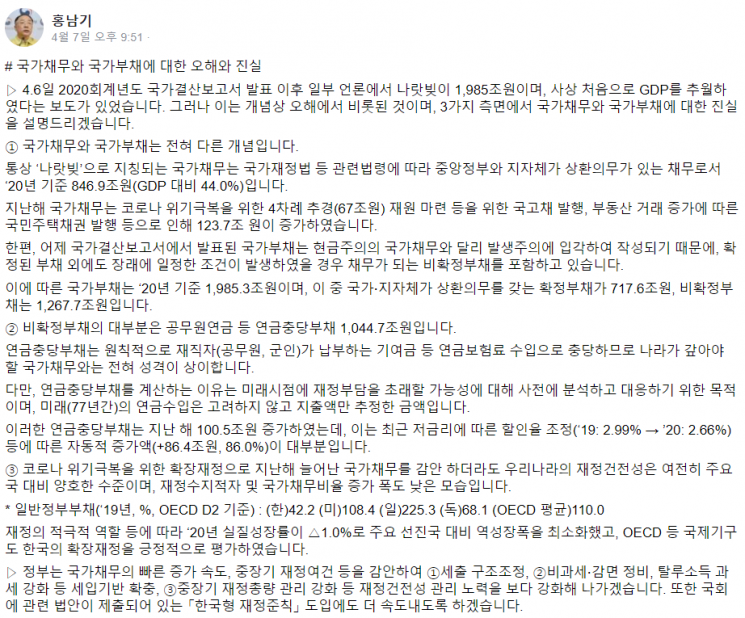
[Asia Economy Reporter Seoyoung Kwon] Hong Nam-ki, Deputy Prime Minister and Minister of Economy and Finance, has stepped forward to clarify misunderstandings regarding the 2020 fiscal year national settlement report.
On the 7th, Deputy Prime Minister Hong pointed out on his Facebook that many media outlets on the 6th inaccurately referred to the confirmed national debt of 1,985 trillion won in the national settlement report as "government debt."
On the 7th, Hong posted a message on his Facebook titled "Misunderstandings and Truths about National Debt and National Liabilities." He stated, "National debt and national liabilities are completely different concepts," and explained, "Unlike national debt, which is based on cash accounting, national liabilities are prepared on an accrual basis, so they include not only confirmed debts but also contingent liabilities that may become debts if certain conditions arise in the future."
Here, contingent liabilities refer to the amount converted to present value that must be paid to retired public officials currently receiving pensions and current employees who will become future pension recipients. According to Deputy Prime Minister Hong's post, out of the total national liabilities of 1,985 trillion won, 1,044.7 trillion won is pension liabilities such as public servant pensions. Since this amount only includes expenditures without considering pension income, using the term "government debt" for the entire national liabilities is inappropriate.
However, there is a reason why pension liabilities are labeled as "debt." If the income from public servant and military pensions falls short of pension expenditures, the government must cover the deficit. This expression was chosen in preparation for pension shortages due to population decline and a decrease in the number of public officials.
Meanwhile, through his Facebook, Deputy Prime Minister Hong asserted, "Even considering the increase in national debt last year due to expansionary fiscal policy to overcome the COVID-19 crisis, our country's fiscal soundness remains favorable compared to major countries, and the increase in fiscal deficit and national debt ratio is also low."
© The Asia Business Daily(www.asiae.co.kr). All rights reserved.


















