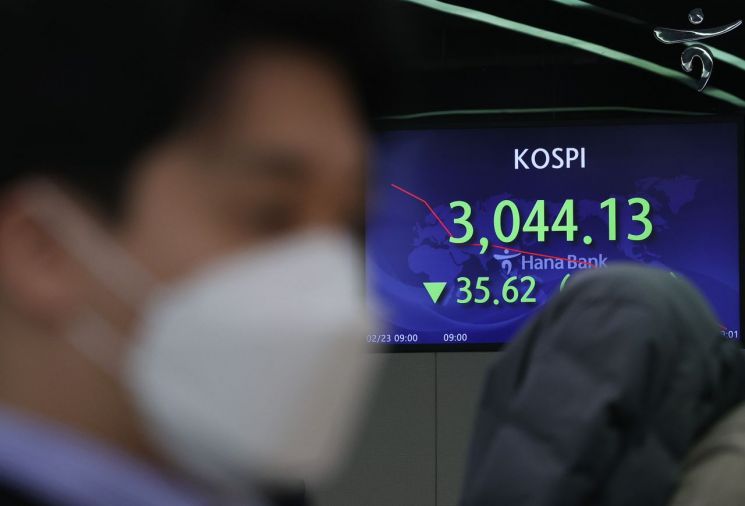
[Asia Economy Reporter Lee Seon-ae] On the 23rd, the KOSPI, which started the day lower, turned to an upward trend during the session. The news that the People's Bank of China did not absorb liquidity helped reduce the decline, ultimately leading to a successful shift to gains. In particular, expectations that Federal Reserve Chair Jerome Powell would soothe the market are believed to have attracted aggressive buying.
As of 1:50 PM, the KOSPI was at 3,083.72, up 3.24 points (0.013%) from the previous day. The KOSPI started at 3,069.26, down 10.49 points (0.34%), and at one point fell as much as 1.44% to 3,035.46.
However, net buying by individuals and institutions absorbed the selling pressure from foreigners, lifting the index. Individuals and institutions are net buyers of approximately 117 billion KRW and 171 billion KRW, respectively, offsetting foreign selling of 284.4 billion KRW.
At the same time, the KOSDAQ was at 941.24, down 13.12 points (-1.37%) from the previous day. While individuals are net buyers of about 143.6 billion KRW, foreigners and institutions are net sellers of approximately 65.2 billion KRW and 38.1 billion KRW, respectively.
Seosangyoung, a researcher at Kiwoom Securities, explained, "The Korean stock market started lower as the Nasdaq fell 2.5% due to rising interest rates and sharp declines in major thematic stocks the previous day. However, the decline narrowed after news that the People's Bank of China did not absorb liquidity was reported, and global major investment banks released analyses suggesting that the semiconductor shortage could persist long-term, leading related stocks to strengthen and reduce the decline."
Most of the large-cap stocks that recorded declines in the morning session showed mixed trends as some stocks turned upward. Samsung Electronics, SK Hynix, NAVER, and Hyundai Motor are showing gains.
Although the market is showing mixed trends and moving sideways, the dominant view is that it will draw an upward curve after the adjustment ends.
Park Sang-hyun, a researcher at Hi Investment & Securities, said, "Concerns about rising interest rates are emerging, but looking at the trends of stock prices and economic indicators during the U.S. 10-year Treasury yield rise phases since 1990, there has been only one instance where stock prices fell during a rising interest rate phase. Supported by strong economic stimulus measures and expanded vaccine distribution, there is a high possibility of a strong rebound in the global economy, including the U.S. Although interest rates may rise faster than expected, solid economic fundamentals are expected to absorb much of the shock from rising rates."
Lee Sang-min, a researcher at KakaoPay Securities, also emphasized, "The market's main topics are interest rates and inflation, but we believe inflation will not damage the market, and the current rise in interest rates is a natural flow due to economic recovery. This is not an issue that would cause the Fed to shift to a tightening policy."
Currently, investors are closely watching Federal Reserve Chair Jerome Powell's remarks scheduled for this evening. Han Dae-hoon, a researcher at SK Securities, said, "Powell's speech is scheduled, and the market's attention is inevitably focused on it. Since the Fed has stated it will continue accommodative monetary policy, the dominant view is that Powell will attempt to soothe the market."
© The Asia Business Daily(www.asiae.co.kr). All rights reserved.

















