Total of 1,203 Confirmed Cases in Detention Centers
High Infection Rates Among New Entrants and Pretrial Detainees in Early Stage of Second Wave
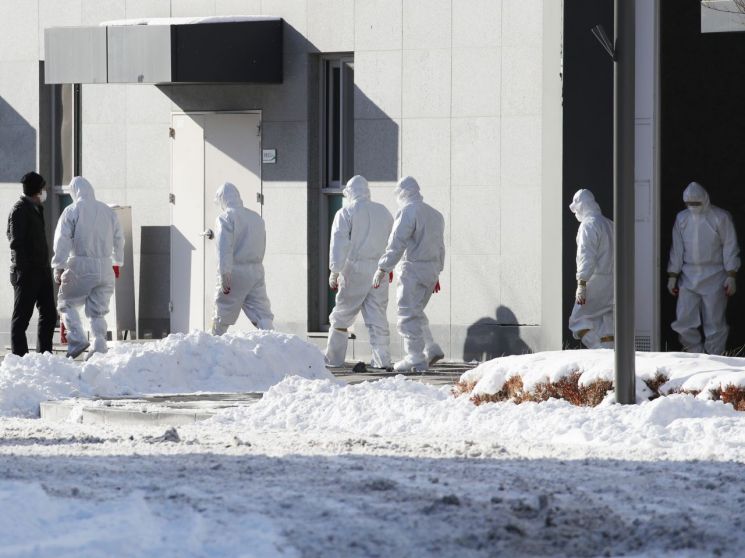 On the 7th, officials wearing protective suits were seen exiting the Seoul Eastern Detention Center. [Image source=Yonhap News]
[Asia Economy Reporter Lee Chun-hee] The quarantine authorities have analyzed that following the first wave of infections centered on staff at the Seoul Dongbu Detention Center, there was a second wave centered on inmates, presumed to have been introduced through asymptomatic new admissions.
The Central Disease Control Headquarters announced the interim results of the epidemiological investigation into the COVID-19 cluster outbreak at Dongbu Detention Center, conducted jointly with the Ministry of Justice investigation team, on the 20th.
Since the first confirmed case among detention center staff on November 28 last year, a total of 1,203 confirmed cases have been identified within the detention center as of this date. There have been two deaths. The cumulative incidence rate is 4.9% among staff (27 out of 552) and 42.9% among inmates (1,176 out of 2,738).
The quarantine authorities determined that two waves of infection occurred within the detention center. In addition to the first wave centered on staff, there was a second wave centered on inmates, presumed to have been introduced through asymptomatic new admissions.
The authorities judged that the two waves had different routes of introduction based on the facts that ▲ no epidemiological links were observed between the two waves, ▲ the genetic similarity of the virus was low, and ▲ the positivity rate among inmates was very low during the first wave.
In particular, during the early stage of the second wave, the 8th floor, which had many new admissions, and pretrial detainees had incidence rates of 40.4% and 10.6%, respectively. Their relative risks compared to other floors and sentenced inmates were 11.6 times and 6.6 times higher, respectively. Additionally, the quarantine authorities noted that the high genetic similarity of the virus between new admissions and additional confirmed cases, as well as numerous epidemiological links between new admissions and existing inmates, indicate a high likelihood that the second wave was introduced through new admissions.
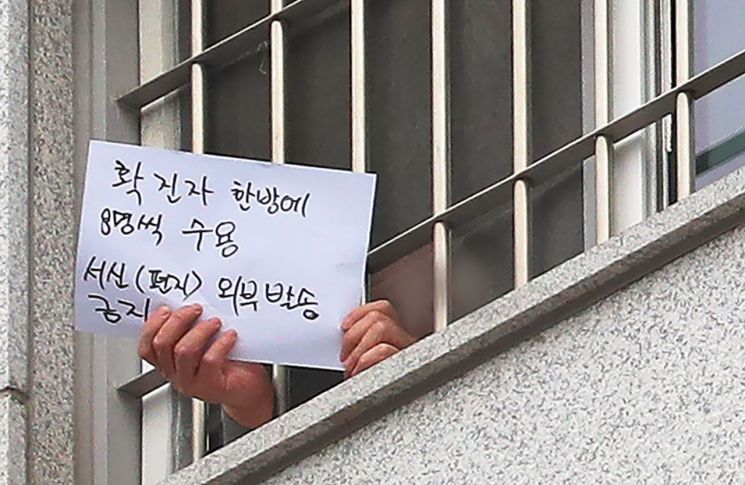 On the 29th of last month, an inmate at Dongbu Detention Center in Songpa-gu, Seoul, wrote down complaints about overcrowding of confirmed cases and the prohibition of sending letters, and showed them to the press.
 [Image source=Yonhap News]
Due to limited accommodation conditions at Dongbu Detention Center, new inmates were initially isolated individually for one week, followed by a second week of group isolation in multi-person rooms with other new admissions. If testing was not conducted before lifting isolation, it is believed that infections likely spread through new admissions in the incubation period during the process of placement into the main housing units after isolation.
Furthermore, the quarantine authorities pointed out that the characteristics of the detention center?such as overcrowding beyond capacity, communal living within the facility, and frequent contact among pretrial detainees due to court appearances and lawyer visits?contributed to the spread of the outbreak. In addition, the transmission range expanded between housing units and buildings through support workers who had frequent contact with inmates.
To prepare for such cluster infections, the Central Disease Control Headquarters, in cooperation with the Ministry of Justice, conducted mass testing of 65,888 people across 52 correctional institutions from the 31st of last month to the 13th of this month. On the 8th, they also established group response guidelines for correctional facilities, including measures such as 14-day preventive isolation for new inmates, universal testing before moving to shared rooms, designation of quarantine management officers, and preparation of self-response plans.
A quarantine authority official stated, "We will continue to promote and monitor recurrence prevention measures specialized for correctional facilities, including the establishment of quarantine plans for each correctional institution nationwide."
© The Asia Business Daily(www.asiae.co.kr). All rights reserved.


















