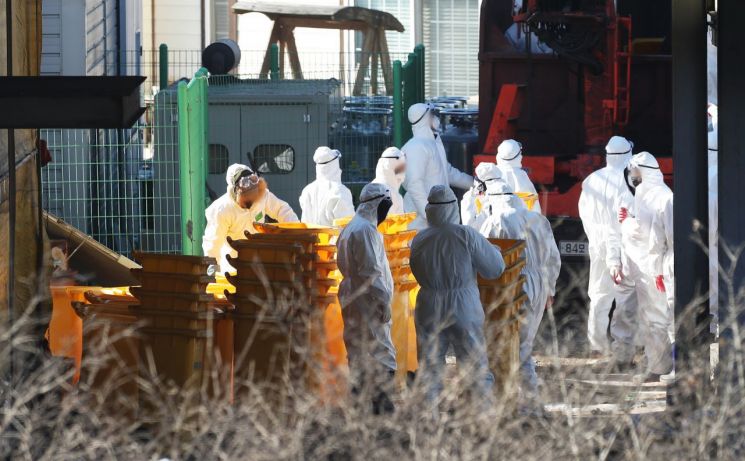
 On the morning of the 17th, officials are preparing for culling at a layer farm in Hwaseong-si, Gyeonggi-do, where the H5 type avian influenza (AI) antigen was detected. (Photo by Yonhap News)
[Asia Economy Reporter Seungjin Lee] As avian influenza (AI) continues to spread across farms nationwide, wholesale prices of chicken and eggs are rising. Although retail prices of chicken and eggs had remained relatively stable despite the AI outbreak, recent increases in wholesale prices are expected to push retail prices up as well.
According to the Livestock Products Quality Evaluation Service on the 2nd, the wholesale price of broilers (unit of 10) was recorded at 3,246 KRW as of the 31st of last month. This marks a 15% increase from 2,774 KRW on December 1st, within just 30 days. The price of broilers exceeding 3,200 KRW is the first occurrence in the past year, due to a significant rise in the number of broilers culled because of AI.
Egg wholesale prices are also on the rise. As of the 31st of last month, the wholesale price of special eggs (10 pieces) was recorded at 1,416 KRW. Since the AI outbreak in November, egg wholesale prices had remained relatively stable. However, prices began to increase in mid-December. From 1,181 KRW on December 1st, prices rose to 1,267 KRW on the 15th, and surpassed 1,400 KRW for the first time last year on the 31st.
So far, a total of 201 farms have conducted culling, with 11,524,000 birds culled. Among these, 9,793,000 chickens and ducks were culled. Laying hens accounted for the largest number at 4,318,000 (65 farms), followed by broilers at 3,503,000 (48 farms), and 1,168,000 (53 farms) respectively.
The Ministry of Agriculture, Food and Rural Affairs believes that considering the short rearing period and the higher-than-average number of birds raised, the volume of culled birds is not at a level that would directly disrupt supply and demand.
During 2016-2017, 36% of laying hens were culled, triggering an 'egg crisis' in some regions where the price of a carton of eggs (30 pieces) exceeded 10,000 KRW, leading to egg imports from the United States. However, experts analyze that a similar situation is unlikely to occur this time.
Nevertheless, as AI spreads rapidly in various locations and simultaneous movement restrictions are imposed nationwide, some regions are experiencing supply disruptions. Additionally, the number of culled birds is increasing significantly, making a temporary price hike difficult to avoid.
In fact, as wholesale prices continue to rise, retail prices have begun to respond. Considering that wholesale prices affect retail prices after stockpiled supplies are exhausted, experts predict that the price surge reflected at the retail level will likely occur around the Lunar New Year in February.
A distribution industry official explained, "Currently, there is no immediate supply disruption as contracts are being made with farms unaffected by AI or newly established. However, given the severe spread and rising prices at production sites, price adjustments are expected."
© The Asia Business Daily(www.asiae.co.kr). All rights reserved.

















