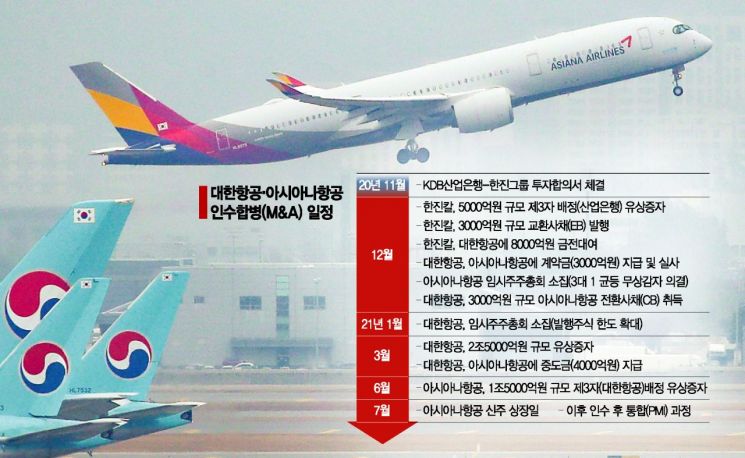
[Asia Economy Reporter Kim Hyewon] With Korean Air's push to acquire Asiana Airlines, existing Asiana Airlines customers are expressing curiosity about the use of mileage and the possibility of airfare increases. We have organized a Q&A format to explain what will change for consumers after the integration of Korean Air and Asiana Airlines.
-What will happen to Asiana Club mileage?
▲Mileage will not disappear. Historically, after mergers and acquisitions (M&A) between airlines, frequent flyer programs (FFP) are often integrated. Kim Sang-do, Director of the Aviation Policy Office at the Ministry of Land, Infrastructure and Transport, previously stated, "Asiana Airlines mileage had limited usage options causing inconvenience to consumers, but now consumers will benefit from being able to use Korean Air-related partner services."
The nominal value of mileage is likely to change. Industry insiders estimate that the value of Asiana Club mileage corresponds to about 70-80% of the value of Skypass mileage. Korean Air President Woo Ki-hong explained regarding the mileage integration ratio between the two companies, "The integration ratio will be reasonably determined through due diligence."
Membership tiers will also inevitably be adjusted. Currently, Korean Air operates three tiers (planned to adjust to four tiers in 2022), while Asiana Airlines operates four tiers. Since the value of mileage accumulated to achieve these tiers differs, it is unlikely that the tiers will be transferred as-is.
-Will we no longer be able to enjoy 'Star Alliance' benefits?
▲There is a high possibility of that outcome. Korean Air is a founding leader of SkyTeam, one of the world's three major airline alliances, and globally, there have been many cases where airlines have withdrawn from or switched alliances during M&A processes.
For example, Shanghai Airlines moved from Star Alliance to SkyTeam in 2010 after becoming a subsidiary of China Eastern Airlines. In 2015, US Airways (now American Airlines), which merged with the old American Airlines, followed the old American Airlines in switching from Star Alliance to oneworld.
This is somewhat disappointing for consumers who have been accumulating Asiana Club mileage with Star Alliance connectivity and lounge benefits in mind. Star Alliance has 26 member airlines, surpassing the 19 members of the later entrant SkyTeam in terms of route network. This means the options will be reduced accordingly.
-Will routes be significantly reduced?
▲There are concerns that supply might drastically decrease during post-acquisition restructuring. The two airlines operate 14 and 11 routes respectively in North America and Europe, many of which overlap. In fact, many North American routes overlap in terms of days and times, leading to criticism of inefficiency.
However, industry experts expect Korean Air to strengthen competitiveness by diversifying schedules through discussions with authorities, as not utilizing allocated traffic rights would be a loss, and flight frequency is directly linked to revenue.
President Woo also said, "Since we will become one company, we will coordinate rather than maintain the same schedules," adding, "Diversification of times and destinations, as well as aircraft adjustments, will be possible." He emphasized, "Korean Air and Asiana Airlines currently operate overlapping flights to Seattle, but if acquired, Asiana Airlines will not withdraw from Seattle," and "We are not currently considering eliminating overlapping routes."
-Will fares skyrocket due to an oligopoly created by the merger of the two major airlines?
▲When Korean Air was the sole operator on the Incheon-Ulaanbaatar (Mongolia) route, fares were comparable to those of long-haul routes due to monopoly effects. This was because only Korean Air and MIAT Mongolian Airlines were allowed to operate under the air service agreement between Korea and Mongolia. Given that the merger would create a monopoly market under the Hanjin Group, such concerns are natural.
Some argue that foreign airlines occupy about 33% of the Korean aviation market, and fare increases due to Chinese and Middle Eastern airlines are unlikely. The emergence of low-cost carriers (LCCs) has lowered fares on medium- and short-haul routes, and before COVID-19, Chinese and Middle Eastern airlines focused on transfer business based on low fares.
However, since the East Asian aviation market is not a perfectly competitive market like Europe, the presence of foreign airlines has limited ability to control fare increases. Concerns are even greater for long-haul routes operated only by major airlines.
Regarding this, both Hanjin Group and authorities have stated that "there will be no sudden fare hikes." Hanjin Group Chairman Cho Won-tae said, "While such concerns may exist, there will never be a deterioration in customer convenience or price increases." The Ministry of Land, Infrastructure and Transport also said, "We will increase the scoring weight for single-route fare evaluations when allocating traffic rights and consider imposing penalties for excessive fare setting when allocating slots (number of takeoffs and landings per hour)." Active monitoring by consumers, authorities, and politicians is necessary.
Separately, some predict medium- to long-term fare increases for other reasons. Since the domestic aviation industry suffered from overinvestment and oversupply before COVID-19, fares perceived by consumers may rise somewhat after restructuring.
Social distancing also plays a role. The aviation and aircraft manufacturing industries have raised the issue of "seat distancing" due to COVID-19. There are calls to increase the seat pitch in newly manufactured aircraft compared to current standards. If realized, the number of seats per aircraft will inevitably decrease, leading to fare increases.
© The Asia Business Daily(www.asiae.co.kr). All rights reserved.

















