[Asia Economy Reporter Hwang Yoon-joo] Amid the rapid expansion of the global digital trade market due to the novel coronavirus disease (COVID-19) and the digitalization of industries, there is a call not to miss the golden time for building digital infrastructure and responding to discussions on international norms.
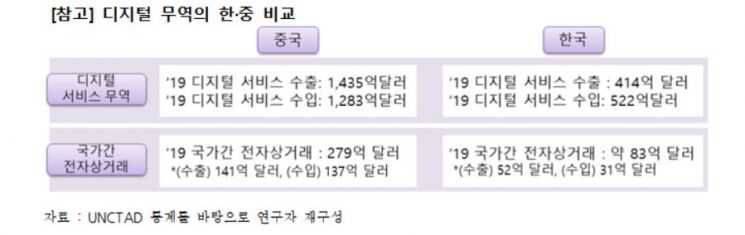
According to the "Comparison of Digital Trade between Korea and China and Global Issues of Trade Norms" released on the 26th by the Korea International Trade Association's Institute for International Trade and Commerce, last year, digital service exports from Korea and China amounted to $41.4 billion and $143.5 billion respectively, while e-commerce exports recorded $5.2 billion for Korea and $14.1 billion for China, showing that Korea's digital trade export sector is about one-third the size of China's.
There were also differences in growth rates for digital service exports and e-commerce exports between the two countries. From 2015 to 2019, China's digital service exports grew at an average annual rate of 11.4%, whereas Korea's grew by only 6.6% annually. Additionally, from 2016 to 2019, China's e-commerce exports grew at an average annual rate of 58.8%, compared to Korea's 38.2%.
The report stated, "Although Korea's e-commerce sector has consistently recorded a surplus since 2016, the digital service sector has not escaped deficits annually, which is causing the sluggishness in digital trade."
The report continued, "Recently, China has embarked on a full-scale expansion of digital trade support by investing 10 trillion yuan over the next five years in building new social overhead capital (SOC) such as digital infrastructure, while also promoting the establishment of digital trade pilot zones and international big data exchanges. To secure a leading position in the rapidly expanding digital trade market, not only China but also the United States and the European Union (EU) are making massive investments and fostering experts. Therefore, Korea must hasten more concrete follow-up investments such as establishing digital trade special zones and cultivating digital trade professionals, going beyond digital New Deal policies and the introduction of the three data laws."
Furthermore, strategic responses by the Korean government and companies are expected to become increasingly important regarding global issues surrounding the establishment of digital trade norms. China is expanding its domestic-centered digital trade market strategy by establishing laws such as the Data Security Law, while Korea is actively participating in international norm discussions such as the World Trade Organization (WTO) e-commerce agreement, striving to reflect its position as much as possible. However, difficulties in reaching agreements persist due to conflicting interests among various related countries.
The report stated, "To create an ecosystem necessary for the development of Korea's digital trade, it is essential to ▲establish global digital trade norms, ▲develop countermeasures against controversies over the introduction of digital taxes, ▲ease regulations and expand digital trade infrastructure, and ▲expand digital service exports through convergence with manufacturing."
© The Asia Business Daily(www.asiae.co.kr). All rights reserved.

















