NSSC: "Cannot Prejudge Safety Technology Institute On-Site Investigation Results... Will Request Korea Hydro & Nuclear Power to Correct if Necessary"
Korea Hydro & Nuclear Power: "No Plans Yet to Revise Emergency Procedures for Transmission Line Management"
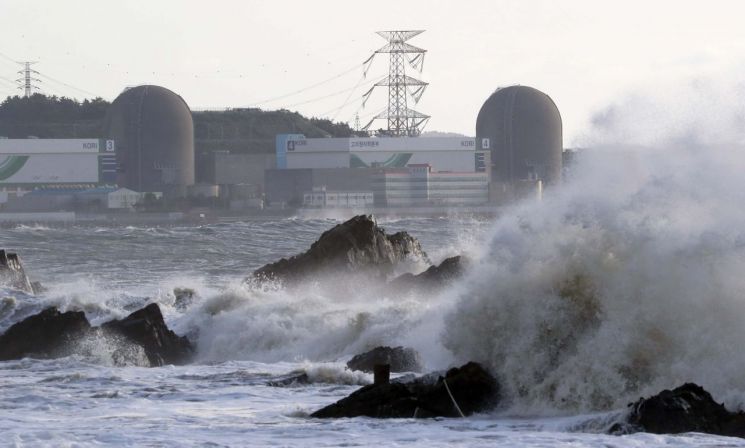
[Asia Economy Reporter Moon Chaeseok] Amid the impact of typhoons 'Maysak' and 'Haishen' that struck the Korean Peninsula, 13 out of 24 nuclear reactors in South Korea have stopped, and it has been confirmed that specific measures such as reactor restart approvals and related regulatory revisions cannot be pinpointed in terms of timing. For now, the only option is to wait for the prompt announcement of on-site investigation results.
According to Korea Hydro & Nuclear Power (KHNP) on the 12th, Kori Units 3 and 4 in Busan's Gijang, Shin-Kori Units 1 and 2, and Wolsong Units 2 and 3 in Gyeongju, Gyeongbuk, have ceased operation. According to the energy industry, seven reactors including Hanul Units 1 and 6 in Uljin, Gyeongbuk, Hanbit Units 3, 4, and 5 in Yeonggwang, Jeonnam, Wolsong Unit 4 in Gyeongju, and Kori Unit 2 in Gijang have stopped for planned preventive maintenance.
The most serious cases are the shutdowns of reactors at Kori Units 3 and 4 and Shin-Kori Units 1 and 2 in Busan's Gijang. Wolsong Units 2 and 3 can resume operation immediately once turbine issues are resolved, but reactor shutdowns require restart approval from the Nuclear Safety and Security Commission (NSSC).
KHNP has speculated that the six reactors at Kori, Shin-Kori, and Wolsong stopped due to saltwater intrusion caused by the typhoons, but this remains only KHNP's assumption. The possibility that on-site investigation results may differ cannot be excluded. In other words, the cause is still speculative, and it is unknown when countermeasures will be announced.
In the case of reactor shutdowns, the Korea Institute of Nuclear Safety (KINS), dispatched by the NSSC, conducts on-site investigations and may request corrective actions from KHNP. An NSSC official stated, "It is difficult to predict whether the restart approval for the four reactors at Kori and Shin-Kori will take 'several months as usual.' If necessary, KINS will request corrections from the operator (KHNP) based on the on-site investigation results."
According to the Nuclear Power Safety Information Operation System (OPIS) of KINS, the last on-site investigation for the four reactors at Kori and Shin-Kori was conducted on July 19 and is still ongoing. This was related to the reactor shutdown at Hanul Unit 6, where the root cause was the stoppage of the reactor coolant pump. This implies that investigations for the four reactors at Kori and Shin-Kori could also take up to two months.
KHNP is preparing an internal guideline called the "Emergency Procedure for Loss of Offsite Power" related to external transmission line issues caused by natural disasters. KHNP's position is that there are currently no plans to revise the emergency procedures. A KHNP official explained, "We need to identify the cause of the reactor shutdowns due to this typhoon, but we believe there are no procedural issues. There are no plans to revise the procedures at this time."
The stoppage of 13 reactors among operating reactors is the highest ever recorded. Even when the nuclear power operation rate hit a historic low of 54.8% in March 2018, 12 reactors were stopped, and during the 2013 nuclear power supply corruption scandal, 10 reactors were stopped. According to KHNP, the latest data as of July shows a nuclear power operation rate of 74.8%, the lowest in five months since February. It is highly likely to decrease further in August and September. The last time the operation rate was in the 50% range was November last year at 59.4%.
According to the status of nuclear power accidents and failures by cause posted on OPIS, 'external influences,' including typhoons, accounted for 37 cases, or 12.1% of the total 305 cases as of July.
© The Asia Business Daily(www.asiae.co.kr). All rights reserved.

















