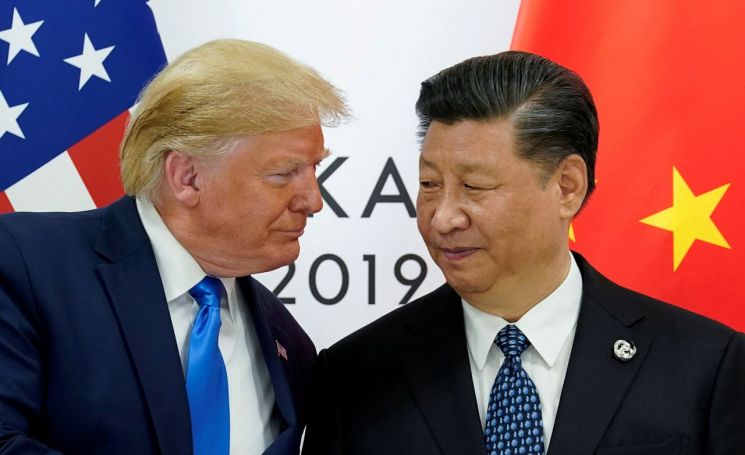
[Asia Economy Reporter Kim Eunbyeol] As the spread of the novel coronavirus infection (COVID-19) continues, future economic recovery is evaluated to depend on the economic recovery directions of major countries such as the United States and China. Therefore, economic experts are focusing their attention on the economic recovery trends of major overseas countries. While China is expected to maintain solid growth in the second half of the year, the United States is analyzed to be hindered by rising unemployment due to the ongoing COVID-19 situation.
According to KB Financial Group Management Research Institute on the 17th, China's recent production indicators show a clear recovery trend, and consumption and investment indicators are gradually reducing their decline.
Earlier, China's second-quarter growth rate recorded 3.2%, showing a clear recovery compared to the first quarter (-6.3%). Among expenditure components, investment (5.0 percentage points) and net exports (0.5 percentage points), excluding consumption (-2.4 percentage points), led the positive rebound in growth rate.
KB Financial Management Research Institute stated, "With government measures to promote consumption and expand investment to stimulate domestic demand becoming visible, it is expected to achieve a growth rate around 5% in the second half of the year," adding, "The overall growth for this year is expected to be 2-3%."
China is regarded as the first major economy to overcome the novel coronavirus infection (COVID-19) and successfully rebound economically.
Since mid-March, when COVID-19 began to subside, China lifted lockdown measures. While promoting economic normalization, it also introduced various stimulus measures such as tax cuts and increased fiscal spending. The stock market surged with expectations of economic recovery. If China's economy recovers, South Korea, which has a large export share to China, can also gain positive effects.
However, downside risks to the Chinese economy include the intensifying US-China trade conflict and recent price increases due to heavy rains. There is also analysis that consumer sentiment has not fully recovered, making rapid recovery difficult to expect.
Meanwhile, in the United States, worsening employment conditions are holding back recovery. According to the Bank of Korea's New York office, the recent US real economy shows improvement in both consumption and production but remains at a lower level compared to the beginning of the year. Additionally, government support is decreasing, and with the resurgence of COVID-19, the momentum for improvement has weakened.
The Bank of Korea's New York office explained, "Employment conditions continue to improve, but sectors with frequent interpersonal contact are still experiencing worse conditions compared to the beginning of the year," adding, "Whether employment conditions improve depends on the virus's progression, making the outlook uncertain, and employment instability and structural unemployment issues among workers are stagnating or worsening."
Professor Son Seongwon of Loyola Marymount University in the United States also pointed out, "Out of the 22 million jobs lost due to COVID-19, 9.3 million have been recovered, but the job engine has already lost vitality," warning, "The resurgence of COVID-19 risks causing more people to lose jobs, potentially turning many temporary layoffs into permanent ones."
© The Asia Business Daily(www.asiae.co.kr). All rights reserved.

















