[Asia Economy Reporter Bu Aeri] "We applied for a regulatory sandbox with the government, but there has been no response." As the carpool company Poolus, which was used by one million people, recently shut down its business, Wemobility's carpool service 'Wepool' is also at a crossroads. Since another carpool company, Witz Mobility, closed its business last year, Wepool is virtually the last remaining carpool service.
◆ Applied for regulatory sandbox but facing a bleak situation= On the 24th, Park Hyun, CEO of Wemobility, said in an interview with Asia Economy, "After the social grand compromise, Korea's mobility startups are on the edge of a cliff," adding, "We are trying to resume business through the regulatory sandbox, but the situation is not favorable."
The regulatory sandbox is a system where the government exempts existing regulations for a certain period to facilitate companies' smooth business entry. The ICT regulatory sandbox that CEO Park applied for at the Ministry of Science and ICT earlier last month aims to extend the allowable carpool hours up to 10 hours (5 AM to 10 AM, 6 PM to 11 PM). However, to avoid conflicts with the taxi industry, CEO Park devised a system that matches carpools only for long-distance trips over 10 km and when the driver’s and passenger’s routes overlap by more than 70%.

The reason CEO Park applied for the regulatory sandbox is that the 4-hour limit set by the government makes business sustainability impossible. Last year, the 'Taxi-Carpool Social Grand Compromise Committee,' which included the government, ruling party, taxi industry, and Kakao Mobility, fixed commuting hours to 4 hours (7-9 AM, 6-8 PM) during which carpool services are allowed. However, 4 hours is insufficient to attract many users, making it difficult to create a revenue model and limiting business expansion. This is also why Poolus shut down. CEO Park lamented, "Given Korea’s characteristic of concentrated commuting populations in the metropolitan area, many long-distance commuters start as early as 5-6 AM, and many return home later to avoid traffic congestion, so the actual demand and supply do not align with the set hours."
◆ Carpool blocked in Korea but thriving overseas= The reason the regulatory sandbox for carpooling is blocked is interpreted as political. The current regulatory sandbox system involves the business operator applying to the Ministry of Science and ICT or the Ministry of Trade, Industry and Energy, with decisions made after consultation with the relevant ministries. In the case of carpooling, the matter is transferred to the Ministry of Land, Infrastructure and Transport. The industry expects that since the Ministry of Land played a certain role in the social grand compromise, it will not easily approve Wepool’s regulatory sandbox application.
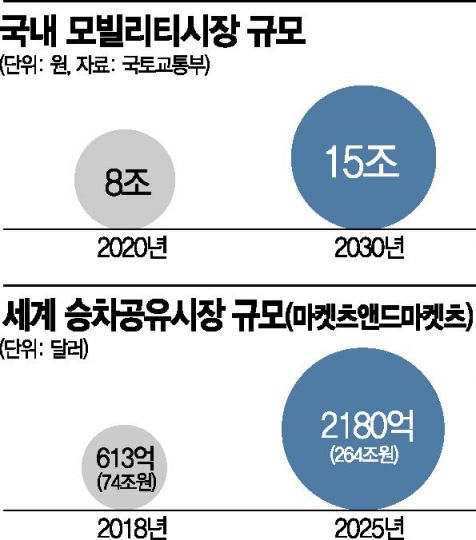
While ride-sharing companies are disappearing one by one in Korea due to regulations, mobility companies based on carpooling are growing into unicorns (private companies valued over $1 billion) overseas. Founded in 2012, China’s largest ride-sharing company Didi Chuxing is valued at $56 billion (63 trillion KRW). Didi Chuxing offers comprehensive mobility services including carpooling and designated driving, is called the 'Uber of China,' and operates overseas in Australia, Latin America, and more. Although Didi Chuxing initially faced strong opposition from the taxi industry, the Chinese government allowed the business first and later applied negative regulations that impose restrictions and require corrective measures if problems arise. France’s carpool service BlaBlaCar faced lawsuits from local Spanish bus unions and other opposition from existing industries, but European governments did not impose special regulations. BlaBlaCar currently has 90 million members in 22 countries worldwide and is valued at $1.6 billion (2 trillion KRW).
Experts point out that strict legal restrictions on passenger transport businesses like those in Korea cut off the growth of global mobility companies. Professor Choi Kyung-jin of Gachon University said, "Current laws basically require mobility companies to operate based on taxis, making it difficult for ride-sharing services to operate," adding, "Even if carpool services enter the regulatory framework, entry regulations need to be further relaxed to allow them to conduct business."
© The Asia Business Daily(www.asiae.co.kr). All rights reserved.



















