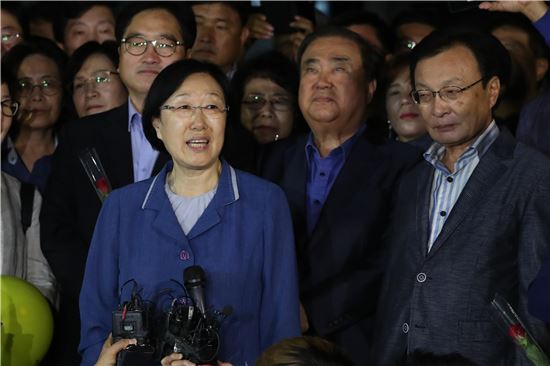
 On August 23, 2017, former Prime Minister Han Myeong-sook, who was released after serving her sentence, is holding a press conference in front of Uijeongbu Prison. [Image source=Yonhap News]
[Asia Economy Reporter Choi Seok-jin] Amid rising calls within the ruling party for a retrial request regarding the bribery case of former Prime Minister Han Myeong-sook, triggered by the ‘memorandum’ of the late Han Man-ho, former CEO of Hanshin Construction and the bribe giver in the case, various prospects are emerging within the legal community.
On the 22nd, the legal community showed mixed reactions regarding former Prime Minister Han’s bribery case, with opinions ranging from “legally not impossible” to “not highly feasible.”
◆ ‘Memorandum’ as new evidence? Predominantly negative views = The retrial controversy surrounding former Prime Minister Han’s case was ignited by the recently published ‘memorandum’ of former CEO Han. It contains content that casts doubt on the credibility of former CEO Han’s testimony, which had been key evidence of guilt, including claims that “there was coercion and inducement by the prosecution during the investigation.”
Within the legal community, the prevailing view is that since the memorandum itself had already been submitted as evidence in court, it would be difficult to meet the retrial requirements under the Criminal Procedure Act. The investigation team that probed former Prime Minister Han also stated that, based on the same logic, the ‘memorandum’ cannot be considered ‘new evidence’ necessary for a retrial request.
Attorney Baek Seong-moon of the Ariyul Law Firm said, “Since the memorandum was already submitted as evidence during the trial, it seems difficult under our country’s retrial system.” Attorney Noh Young-hee, former spokesperson of the Korean Bar Association, also predicted, “The memorandum itself has already surfaced once, so it cannot be regarded as new evidence for a retrial request, and a retrial request based solely on the memorandum would be ineffective.”
On the other hand, there are differing opinions. Attorney Yang Ji-yeol of Able Law Firm said, “The prosecution claims that the memorandum itself was presented as evidence, but there is debate over whether the entire memorandum was disclosed or only parts favorable to the prosecution were released,” adding, “If there are problematic parts among the undisclosed sections, they could potentially be used as new evidence.”
◆ Retrial grounds under the Criminal Procedure Act require a ‘final judgment’ = Among the retrial grounds stipulated in Article 420 of the Criminal Procedure Act, those relevant to this case include “when it is proven by a final judgment that evidence (No. 1) or testimony (No. 2) was false” and “when it is proven by a final judgment that a prosecutor or judicial police officer involved in the investigation committed a crime related to their duties.”
However, many legal experts predict it will be difficult to overturn the case since there are already two Supreme Court final judgments related to former CEO Han’s statements to investigative agencies and court testimonies, including perjury cases involving former Prime Minister Han and former CEO Han himself.
Ultimately, for a retrial to proceed, it would require that the prosecutors who investigated former Prime Minister Han or former CEO Han be found guilty of duty-related crimes, leading to an investigation, prosecution, and a final guilty verdict, which is also considered unlikely.
Attorney Baek said, “Assuming prosecutors made mistakes and are investigated, they must be indictable, but since the statute of limitations has expired, while a truth-finding commission like the Past Photo Investigation Committee might clarify the facts, punishing those responsible is difficult.”
The statute of limitations for abuse of authority under criminal law is seven years.
◆ New witness variable from those who did not testify = Attorney Yang said, “Among those who gave unfavorable testimony against former CEO Han at the time, some claim during the reinvestigation process that they were coerced by the prosecution to testify,” adding, “If these people come forward as new witnesses, it would be new clear evidence, so a retrial might be opened.”
Attorney Noh said, “In the case of Representative Park Ji-won’s violation of the Political Funds Act, there was also wavering testimony from an employee of Bohae Savings Bank,” adding, “That person later explained why they changed their statement, and the pattern is similar to the former CEO Han case.”
She continued, “Regarding former CEO Han’s changed testimony in court, three fellow inmates at the time talked about it, and I understand that one of those who did not testify as a witness back then recently spoke again to a certain media outlet,” but added, “A retrial based solely on new witnesses seems difficult and would need to be clarified through reinvestigation.”
◆ Mentioning the Corruption Investigation Office for High-ranking Officials (CIO) and special investigation committees is inappropriate regardless of retrial outcome = In a situation where a retrial request seems practically difficult, some within the ruling party have argued that suspicions related to the investigation of former Prime Minister Han could become subjects of investigation by the Corruption Investigation Office for High-ranking Officials (CIO), which is set to launch in July.
Regarding this, former Seoul Bar Association President Kim Han-gyu said, “Democratic Party Representative Park Joo-min mentioned the CIO, but if there is no clue to any crime, and the CIO investigates this, it would actually go against the purpose of introducing the CIO,” criticizing, “It would again make the investigative agency a servant of power.”
He predicted, “From a systemic perspective, since the memorandum is not new evidence, a retrial is difficult, and even if the Ministry of Justice tries to inspect whether the prosecutors at the time were at fault, the disciplinary statute of limitations has already passed, so they are not subject to inspection, and ultimately, like past investigation teams, they might create laws or guidelines to conduct an investigation.”
He added, “However, if a team is forcibly created for an individual who has already been convicted by the Supreme Court with an overwhelming majority in the National Assembly, it would set a very unfortunate precedent in our constitutional history,” expressing concern, “When the regime changes someday, they could create ‘Lee Myung-bak investigation teams’ or ‘Park Geun-hye investigation teams,’ right?”
Attorney Baek also predicted, “The CIO is not an agency for fact-finding but for investigation and prosecution, and based on what is currently available, it is not an easy situation.”
A former chief prosecutor turned attorney A strongly criticized, saying, “Mentioning CIO investigations regarding matters already finalized with a guilty verdict by the Supreme Court denies the rule of law.”
◆ Opinions that investigation errors and court rulings should be distinguished = Meanwhile, opinions have emerged that the current political and media discussions about retrials are based on a flawed premise.
Active Chief Judge A said, “It is problematic to talk as if the Ministry of Justice or prosecution’s investigation errors and reflections during past investigations and court rulings are one and the same,” adding, “Within the executive branch, it is of course possible to reflect on and reinvestigate past administrative actions, but equating that with changing court rulings disrupts the rule of law.”
A said, “Currently, those in favor and those against retrials are each using their own logic to lump together retrial trials and errors in prosecution or evidence collection,” adding, “Opponents say ‘It’s a violation of the trial, so it shouldn’t even be discussed,’ while supporters talk as if the trial can be easily touched, but I think it’s somewhere in the middle.”
He added, “It cannot be concluded that past investigations cannot be reviewed at all, and if there were coercive acts or sting operations during the investigation, reflection is possible, but whether that constitutes grounds for retrial is a matter to be examined, and even if a retrial is requested, the conclusion does not necessarily change.”
© The Asia Business Daily(www.asiae.co.kr). All rights reserved.
















