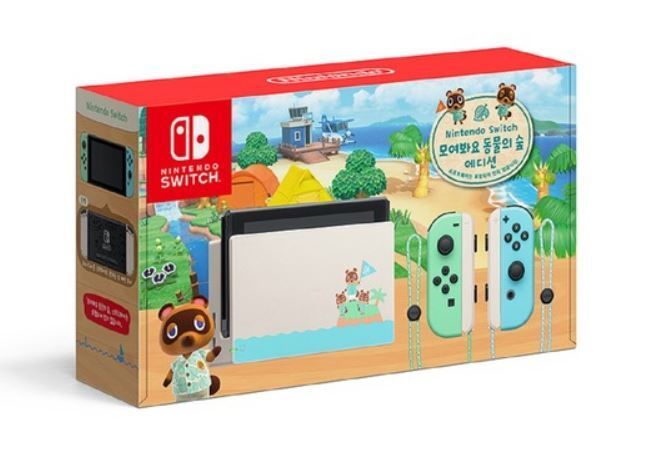
Nintendo Switch 'Animal Crossing' Edition
Long Lines to Buy Sold-Out Chanel Clutches
Department Stores See Sales Drop Despite Regular Sales
[Asia Economy Reporter Lee Seung-jin] Due to the impact of the novel coronavirus infection (COVID-19), consumption has been focused on daily necessities, leading to an increasing number of companies facing 'cries of distress.' In an atmosphere where outdoor activities are being refrained from, consumers' wallets remain tightly closed. However, despite this atmosphere, there are items for which people are willing to stand in long lines and hesitate little in spending: game consoles and luxury goods.
According to the related industry on the 10th, a craze for the Japanese game company Nintendo's game console 'Nintendo Switch' is sweeping the market. The game 'Animal Crossing,' released last month, has gained popularity, attracting not only avid gamers but also those who previously had little interest in gaming, all eager to purchase the console.
In particular, due to the COVID-19 impact causing the suspension of operations at the Chinese factories producing game consoles, a shortage of supply has occurred, leading to a phenomenon where buyers pay premiums to obtain the product. Currently, on secondhand trading sites, the product is being traded at around 800,000 KRW, approximately 300,000 KRW higher than the original price.
Recently, news that a small quantity of stock was arriving at Emart's electronics specialty store 'Electromart' caused crowds to form from early morning. In response, Emart distributed numbered tickets and turned customers away to prevent COVID-19 infection risks. Currently, dozens of calls inquiring about stock are received daily.
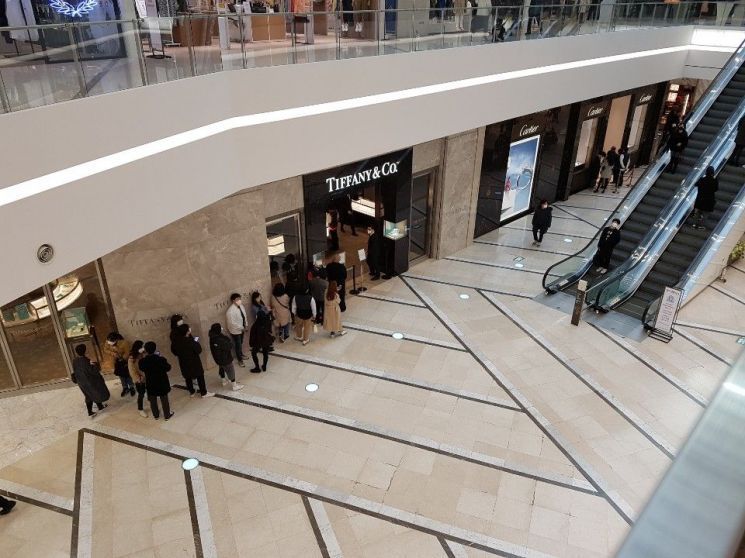 On the afternoon of the 7th last month, customers lined up to enter the Tiffany & Co. store on the first floor of Times Square. (Photo by Lee Seon-ae)
Luxury goods remain steadily popular amid the COVID-19 impact. The waiting lines in front of luxury brand stores have continued from February, when COVID-19 began in earnest, up to the present. On the 11th of last month, when the number of confirmed COVID-19 cases peaked, a long line formed even before the opening of the Chanel store at Shinsegae Department Store, following news of the restocking of a previously sold-out clutch product. The luxury department store's policy to manage the number of customers inside to minimize contact with unspecified individuals has ironically resulted in even longer queues outside the store.
Although department stores began their spring regular sales on the 3rd, sales excluding luxury goods have yet to recover. From the 3rd to the 7th, Lotte Department Store's overall sales decreased significantly by 15.4% compared to last year's sale period. However, luxury goods sales increased by 4.7% year-on-year. This contrasts sharply with the major department store category 'women's fashion,' which fell by 34.6% compared to the previous year. During the same period, both Shinsegae Department Store and Hyundai Department Store saw overall sales decline by around 15% year-on-year, but luxury goods sales increased by 0.8% and 5.3%, respectively.
Regarding this, a department store industry official explained, "Although weddings have been postponed due to COVID-19, the demand for preparing wedding necessities has continued without delay," adding, "It seems that those who usually consume luxury goods have spent more on wedding preparations."
This spring regular sale was delayed by one week compared to previous years due to concerns over the spread of COVID-19. The department store industry made this decision considering that prolonged consumption stagnation could lead to bankruptcy risks for small and medium-sized partner companies, but only luxury goods sales have steadily increased.
A department store industry official stated, "Clothing consumption should align with the seasons, but if items do not sell now, small and medium-sized partner companies will suffer significant damage as they cannot sell at the proper price," adding, "Products need to be sold so that companies can use the profits to operate factories for producing next season's items, but currently, this virtuous cycle has collapsed."
© The Asia Business Daily(www.asiae.co.kr). All rights reserved.


















