Up 1.2% Compared to Pre-COVID 2019
Last year, the number of airline passengers using domestic airports reached an all-time high. The surge was primarily driven by a significant increase in short-haul international passengers, especially to Japan and China.
Among airlines, passenger numbers rose for Eastar Jet, Aero K, and Air Premia, while Jeju Air and Air Busan saw declines.
According to aviation statistics released on January 9 by the Ministry of Land, Infrastructure and Transport and the Korea Civil Aviation Association, the total number of domestic and international airline passengers last year was 124,793,082, up 3.9% from the previous year’s 120,058,371. This figure is 1.2% higher than the pre-pandemic level of 123,360,000 in 2019 (32,980,000 on domestic routes and 90,380,000 on international routes), indicating that air travel demand has normalized since the COVID-19 pandemic.
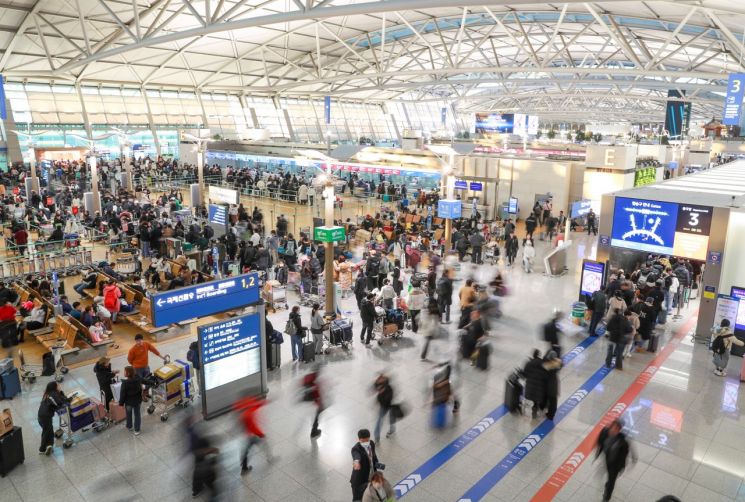
The number of domestic passengers was 30,245,051, down 2.8% year-on-year, but international passengers reached a record high of 94,548,031, a 6.3% increase.
By region, routes to Japan carried 27,310,000 passengers, an 8.6% increase in just one year. Compared to 2019, this represents a sharp 44.8% jump. Analysts attribute this to the continued weak yen and the expansion of routes, including those to smaller cities.
China-bound passengers totaled 16,800,000, up 22%, recovering to 91.2% of 2019 levels. In addition to China’s visa waiver policy for Koreans, since the end of September last year, Chinese group tourists have also been able to enter Korea without a visa.
In contrast, other Asian regions such as Southeast Asia saw passenger numbers fall by 0.5% year-on-year to 34,820,000, reaching only 95.6% of 2019 levels. Long-haul routes to the Americas carried 6,820,000 passengers (up 4.7%), while European routes saw 4,850,000 passengers (up 5.5%).
Looking at international passenger numbers by airline, while the overall number of travelers increased, the results varied by carrier.
Jeju Air recorded the largest year-on-year decrease among domestic airlines, with 7,780,000 passengers (down 9%). Air Busan carried 4,160,000 passengers, a 7.4% decrease. Both airlines reduced flights early last year following passenger aircraft accidents and fires, and concerns about safety further dampened demand.
Air Seoul, though free from major incidents, also saw an 8.4% decrease, with 1,680,000 passengers. This is attributed to its small fleet of six aircraft and a reduction in international flights to strengthen safety measures.
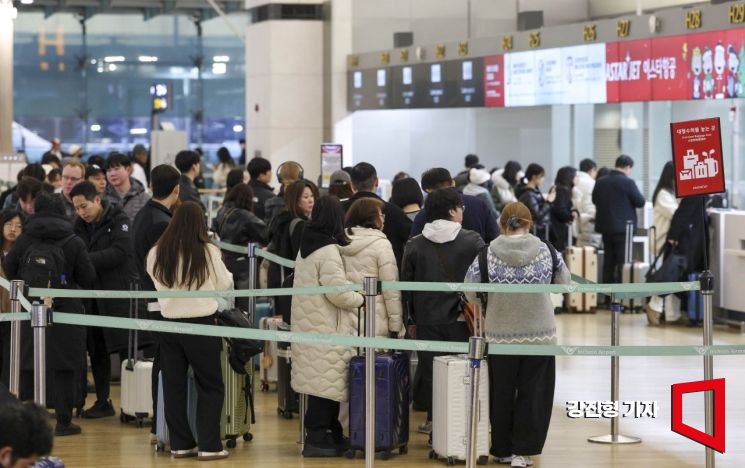 On the 31st, ahead of the New Year's bridge holiday, Incheon International Airport Terminal 1 was crowded with travelers. 2025.12.31 Photo by Kang Jinhyung
In contrast, T’way Air transported 7,060,000 passengers (up 7.3%), and Jin Air carried 6,670,000 passengers (up 2.2%).
Aero K saw its passenger numbers soar by 75.4% year-on-year to 1,500,000, while Eastar Jet recorded 3,070,000 passengers (up 59.7%), and Air Premia reached 1,080,000 (up 42.3%). These airlines consistently introduced new aircraft and expanded their route networks last year. The newly launched Parata Air, which began international flights in November, recorded 70,000 passengers.
Among the two major full-service carriers, Korean Air transported 19,140,000 passengers (up 8.2%), and Asiana Airlines carried 12,150,000 passengers (up 1.3%). Last year, the number of passengers using foreign airlines at domestic airports increased by 4.9% to 33,090,000.
© The Asia Business Daily(www.asiae.co.kr). All rights reserved.













![$29 Monthly Subscription AI Plant Appliance... US Startup Challenges LG [CES 2026]](https://cwcontent.asiae.co.kr/asiaresize/319/2026010819285284553_1767868133.png)