President Lee: "The Integration of Metropolitan Governments, Once Seemingly Difficult, Is Gradually Gaining Momentum"
On January 9, President Lee Jaemyung will host a luncheon meeting at the Blue House, inviting National Assembly members of the Democratic Party of Korea from the Gwangju and Jeonnam regions. President Lee has consistently raised the issue of administrative integration of metropolitan governments, and this move is seen as an effort to bolster discussions on integration in Gwangju and Jeonnam, following Daejeon and Chungnam. Both inside and outside the Blue House, there is speculation that President Lee aims to complete as much of the administrative integration process as possible ahead of the June 3 local elections.
According to the Blue House on January 9, President Lee will invite Democratic Party lawmakers from Gwangju and Jeonnam to the Blue House for a luncheon meeting. Since this meeting was scheduled immediately after President Lee mentioned the possibility of administrative integration between Gwangju and Jeonnam on social media, it is expected that the direction of the integration initiative and the political community's role will be discussed at the event.
Previously, at a luncheon meeting with Democratic Party lawmakers from Daejeon and Chungnam on December 18, President Lee stated, "Although integration of local governments is not easy, a policy decision that goes beyond complex political interests is necessary," emphasizing that integration should be considered as an alternative to the problem of overconcentration in the capital region.
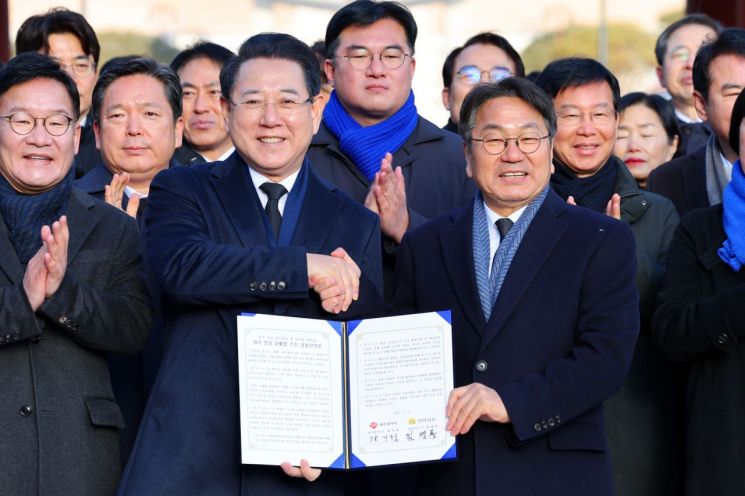
Discussions on the integration of Gwangju and Jeonnam have gained momentum since Gwangju Mayor Kang Gijeong and Jeonnam Governor Kim Youngrok announced a "Joint Declaration on Grand Integration" on January 2. On the same day, President Lee posted on X (formerly Twitter) under the title "After Daejeon and Chungnam, will it be Gwangju and Jeonnam?" stating, "The integration of metropolitan governments, which once seemed difficult, is gradually gaining speed," and "It seems that public consensus is forming around the need to overcome the capital-centric system and open a new path for 'region-led growth.'"
On January 5, Gwangju City and Jeonnam Province launched the Gwangju-Jeonnam Administrative Integration Planning Group and began practical preparations. Since the deadline for the National Assembly to process the "Gwangju-Jeonnam Integration Special Act" is February 28, the plan is to make a decision after a deliberative process involving local residents.
At the luncheon, Gwangju and Jeonnam lawmakers (eight from Gwangju and ten from Jeonnam) will attend, along with Mayor Kang and Governor Kim. As the agenda reportedly includes "discussion of the Gwangju-Jeonnam integration issue," it is expected that there will be an exchange of opinions on more concrete methods, procedures, and timing for integration. On January 4, Kang Hoonshik, Chief Presidential Secretary, appeared on a radio program and predicted, "I think we will see the broad outline of the integration." On January 6, Shin Jeonghun, Chair of the National Assembly's Public Administration and Security Committee, held a press conference in the Gwangju City Council briefing room, saying, "Let us open the way for a major transformation toward a decentralized nation and a new leap forward for Korea," and added, "I will make a direct proposal during the meeting with President Lee Jaemyung on January 9."
There is an interpretation, both inside and outside the Blue House, that President Lee is seeking to accelerate discussions in order to achieve tangible results before the local elections. At the luncheon with Daejeon and Chungnam lawmakers, President Lee cited administrative integration as an "alternative to the problem of overconcentration in the capital region," and called on the central government to provide substantial administrative support so that new integrated local governments can be elected during the local elections. However, some point out that administrative integration requires procedures such as enacting special laws and gathering public opinion, making it difficult to push ahead solely for the purpose of the local elections.
© The Asia Business Daily(www.asiae.co.kr). All rights reserved.







![$29 Monthly Subscription AI Plant Appliance... US Startup Challenges LG [CES 2026]](https://cwcontent.asiae.co.kr/asiaresize/319/2026010819285284553_1767868133.png)