High-Dividend ETFs Posting Strong Returns This Month
Sluggish Performance After July Policy Expectations Faded
Recent Policy Momentum Revives Stock Price Strength
High-Dividend Stocks Seen as Advantageous Amid Rising Volatility
Amid increased stock market volatility this month, interest in high-dividend stocks is growing. High-dividend exchange-traded funds (ETFs) are posting strong returns, reflecting this heightened attention. With additional policy momentum, the favorable share price trend of high-dividend ETFs is expected to continue.
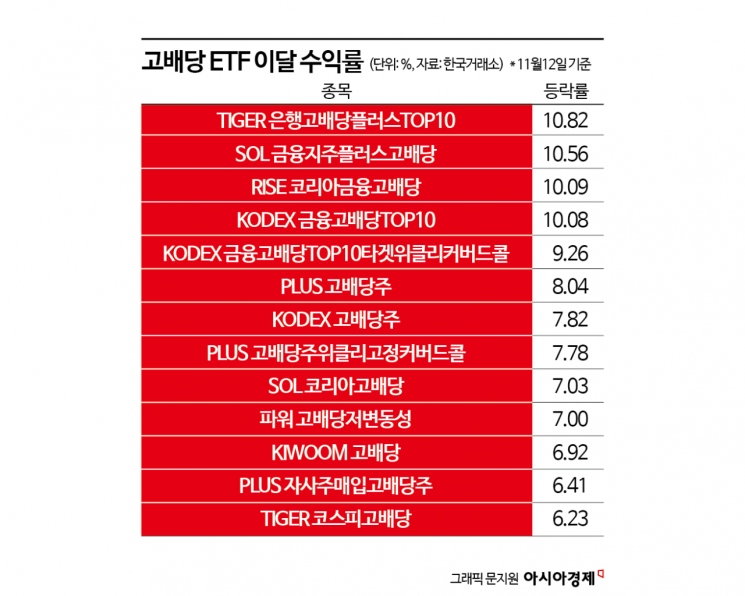
According to the Korea Exchange on November 14, the TIGER Bank High Dividend Plus TOP10 ETF rose by 10.82% from the beginning of the month through the 12th. The SOL Financial Holding Plus High Dividend ETF gained 10.56%, the RISE Korea Financial High Dividend ETF climbed 10.09%, and the KODEX Financial High Dividend TOP10 ETF increased by 10.08%, all recording double-digit growth rates. During the same period, the KOSPI index rose by 1.04%.
Just last month, high-dividend ETFs showed lackluster performance, with negative returns or gains limited to around 1%. However, this month has seen a clear turnaround, supported by policy momentum that has fueled share price increases. Recently, the government and the ruling party decided to ease the proposed separate taxation on dividend income to promote dividends in the stock market. As a result, the top tax rate on dividend income is expected to be reduced from 35% to around 25%. Additionally, discussions are underway to apply separate taxation to high-dividend corporate funds that allocate more than 60% of their assets to high-dividend companies, which is seen as a driving force behind the strong performance of high-dividend ETFs.
Ha Jaeseok, a researcher at NH Investment & Securities, said, "Since the sharp rise in the KOSPI in September, the performance of domestic high-dividend ETFs has somewhat stagnated. They showed strength after the first revision of the Commercial Act passed on July 3, but weakened at the end of July due to disappointment over the government’s tax reform plan and the absence of additional policy momentum." He added, "Expectations remain high for the third revision of the Commercial Act, which includes mandatory treasury share cancellation, as well as for the tax law revision that includes separate taxation of dividend income. In particular, following the separate taxation of dividend income for certain high-dividend companies, discussions are ongoing to extend separate taxation to high-dividend corporate funds that allocate more than 60% of their assets to high-dividend companies." He further noted, "It is time to pay attention to policy beneficiary ETFs, such as high-dividend ETFs, which have been relatively neglected in a market led by large-cap stocks."
Shin Chaerim, a researcher at Korea Investment & Securities, said, "There are discussions to lower the top tax rate from 35% to 25%, which is a favorable factor for dividend stocks." She continued, "Looking at the inflow of funds into dividend stock funds in July this year, driven by expectations for the separate taxation of dividend income, a lower tax rate would likely increase investor demand for high-dividend and dividend growth stocks, leading to renewed inflows into dividend stocks."
In particular, with market volatility rising this month, high-dividend ETFs are attracting attention. Shin explained, "The stock market fell sharply last week, and although it has rebounded somewhat this week, it is difficult to let down our guard given the rapid increase in volatility. Now is a good time to shift focus to dividend stocks that provide cash flow as market volatility expands."
There is also an opinion that high-dividend stocks are more advantageous than dividend growth stocks. Shin added, "Investors should pay attention to high-dividend ETFs that focus on companies with strong shareholder return expectations. Given that expectations for an interest rate cut in Korea have diminished, high-dividend stocks are likely to be more favorable than dividend growth stocks at this time."
© The Asia Business Daily(www.asiae.co.kr). All rights reserved.