Korean Society of Pediatric Endocrinology Surveyed 2,012 Parents
28% of Parents Gave Their Children Height Growth Supplements
Despite This, Digital Device Use Increased and Sleep and Exercise Remained Insufficient
A recent survey found that parents in South Korea hope their sons will grow to 180 cm and their daughters to 167 cm in height. In pursuit of taller children, 3 out of 10 parents reported giving their children growth supplements, calcium, or vitamin D. However, these same parents tended to be lenient about issues that hinder growth, such as excessive use of electronic devices, lack of sleep, and insufficient physical activity.

On October 23, the Korean Society of Pediatric Endocrinology released the results of a social awareness survey on proper growth and healthy lifestyle habits, conducted by Gallup Korea among 2,012 parents. The survey was carried out from June 23 to July 28, targeting parents with children aged 5 to 18.
The results showed that 28% of parents had given their children height growth supplements. The rates for calcium and vitamin D supplementation were also high, at 33.9% and 32.4%, respectively. Notably, among preschoolers aged 5 to 6, about 40% were taking calcium or vitamin D, indicating a high rate of supplement intake from a young age. Additionally, 4.6% of parents reported that their children had received growth hormone injections.
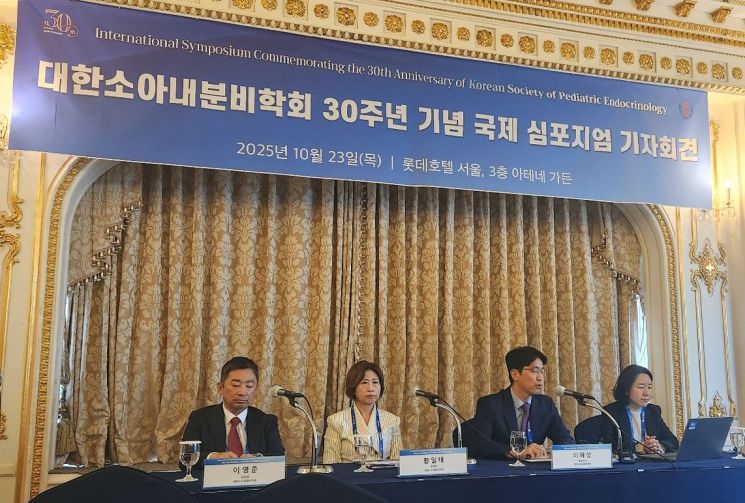 30th Anniversary International Symposium Press Conference of the Korean Society of Pediatric Endocrinology. Yonhap News Agency
Among parents who reported current or past growth-related issues with their children, 47.0% said they had used growth supplements-a higher rate than the overall group. However, many expressed skepticism about the actual effectiveness. Of those who had used growth supplements, 75.7% rated their effectiveness as “average” or “ineffective.”
The survey also examined children’s lifestyle habits, such as electronic device usage, sleep, exercise, and eating patterns. Indicators for managing lifestyle habits that directly impact growth have actually worsened.
Insufficient Sleep and Exercise... 40.2% of High School Girls Eat Two Meals or Less Per Day
Compared to ten years ago, sleep deprivation has not improved. Among elementary school students-at a critical stage for growth-36.3% reported getting less than eight hours of sleep per night. This is an increase from 35.2% in the 2016 survey, indicating that one in three elementary students is not getting enough sleep. According to the Korean Society of Sleep Medicine, the recommended daily sleep duration is 10-13 hours for preschoolers (ages 3-5), 9-11 hours for school-age children (ages 6-13), and 8-10 hours for adolescents (ages 14-17).
Physical activity was also lacking. When asked about their children’s weekly physical activity, 55.3% of respondents said their children exercised fewer than three times per week. The most common reason cited for insufficient physical activity was “the child is too busy” (63.5%).
In the survey on eating habits, another key factor for growth, 19.6% of parents said their children did not eat three meals a day. Among high school girls, 40.2% ate two meals or less per day, and 7.3% of preschoolers skipped breakfast.
Electronic Device Usage Has More Than Doubled in Ten Years
While sleep and exercise were lacking, the time spent using electronic devices such as smartphones and computers has increased compared to ten years ago. The survey found that 51.7% of children used electronic devices for more than two hours per day on weekdays, and 71% did so on weekends.
Among elementary school students, 43.5% used electronic devices for more than two hours per day on weekdays, and 66.5% did so on weekends. This is more than double the 20.4% reported in the 2016 survey. For preschoolers, 31.6% reported using electronic devices for between one and two hours on weekdays.
Desired Height for Children: 180.4 cm for Boys, 166.7 cm for Girls
Parents participating in the survey hoped their sons would reach 180.4 cm and their daughters 166.7 cm in height. This is about 5 cm taller than the average height for people in their twenties, as recorded in the 8th Korean Anthropometric Survey by the Ministry of Trade, Industry and Energy’s National Institute of Technology and Standards in 2022 (174.4 cm for men and 161.3 cm for women).
Lee Haesang, Director of Public Relations for the Korean Society of Pediatric Endocrinology, stated, “If a child is short, parents should first consult a specialist to determine if there is an underlying medical condition. If no significant issues are found, it is important to focus on improving lifestyle habits.” He emphasized, “Rather than other methods, it is crucial to maintain regular meals, exercise, and sufficient sleep.”
Hwang Iltae, President of the society, added, “In clinical practice, I often see parents giving their children several types of supplements. Instead of indiscriminately administering growth supplements, parents should seek a professional diagnosis.”
© The Asia Business Daily(www.asiae.co.kr). All rights reserved.