Amnesty reveals 53 'slave compounds' in Cambodia
Closed-compound organizational bases are interconnected
Signs of spread to Europe and the Americas
"It spreads like a cancer."
Benedikt Hofmann, Deputy Regional Representative for Southeast Asia and the Pacific at the United Nations Office on Drugs and Crime (UNODC), used these words to describe the ecosystem of scam organizations in Cambodia in a report released in April 2025 titled "Global Implications of Scam Centres, Underground Banking and Illicit Online Marketplaces in Southeast Asia." He explained that even when authorities crack down on one area, the roots do not disappear but simply move elsewhere, ultimately transforming the entire region into an interconnected criminal ecosystem.
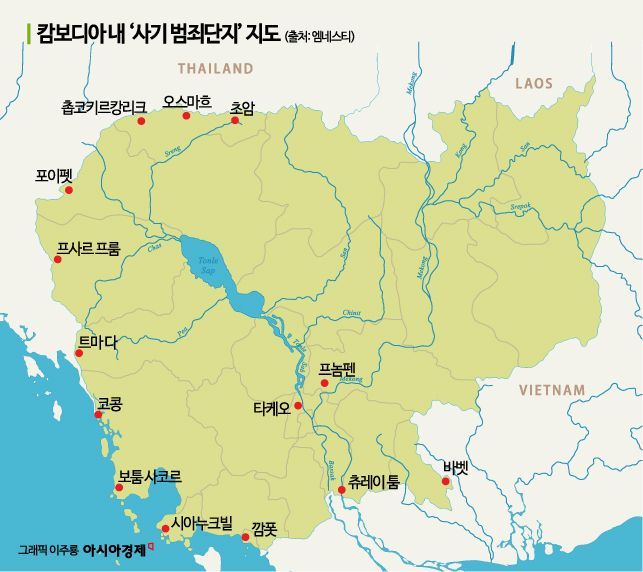
53 Criminal Compounds Across Cambodia... "Cambodian Government Deliberately Neglects the Issue"
In its report, the UNODC pointed out that it is fundamentally difficult to dismantle organizational bases known as closed scam compounds. Even if they are caught in a crackdown, these organizations quickly relocate to new office complexes or industrial parks and resume their activities. The Cambodian government's lack of strong enforcement is also cited as a major factor making eradication difficult.
According to international human rights organization Amnesty International, there are 53 criminal compounds across Cambodia. Amnesty International criticized the Cambodian government for "deliberately neglecting serious human rights violations such as human trafficking, slavery, child labor, and torture."
Recently, there has been a trend of these organizations becoming increasingly interconnected, evolving into an industrial-scale criminal ecosystem. Deputy Representative Hofmann noted, "This is not only a natural expansion as the industry grows and seeks new markets and opportunities, but also a hedging strategy to spread risk in anticipation of intensified crackdowns in the region."
The UNODC estimates that these industrial-scale scam compounds generate approximately 40 billion dollars (about 55 trillion won) in annual revenue. They launder funds through virtual assets and underground banking, with these illicit funds flowing into the global financial network. Amnesty International also pointed out that "underground banking, illegal online marketplaces, and international money transfer networks are the core pillars sustaining the scam economy."
The problem is that such organized crime is now spreading across borders. The UNODC has identified scam centers, money laundering operations, human trafficking organizations, and recruitment networks linked to these crimes not only in Southeast Asia, but also in Africa, South Asia, the Middle East, Pacific island nations, as well as Europe, North America, and South America.
Reuters, AP, and Other International Media Highlight Cambodian Crime; "Korea Issues 'Code Black' Advisory"
As cases of kidnapping, confinement, and scam crimes targeting Koreans in Cambodia have increased, major international media outlets have begun to focus on the issue.
Reuters reported that "South Korea has issued a 'code black' travel ban for certain areas in Cambodia and dispatched a joint response team to the country to facilitate the repatriation of Koreans who have been detained." The Korean government’s joint response team visited Cambodia on October 15, 2025, and is currently discussing the procedures for returning more than 60 Koreans who have been detained locally since July 2025.
In response to international criticism of its domestic criminal structures, the Cambodian government has intensified crackdowns on large-scale online scam organizations and strengthened the repatriation of foreign nationals. AP News reported that, in particular, the Cambodian government expressed its intention to cooperate with the Korean government in relation to the recent case involving the torture and death of a Korean university student.
Touch Sokhak, spokesperson for the Ministry of Interior, stated, "In the past two years, we have deported about 15,000 foreigners involved in online crimes," adding, "We will strengthen our cooperative system with the Korean government to prevent crimes such as online scams and illegal gambling."
© The Asia Business Daily(www.asiae.co.kr). All rights reserved.