Major Securities Firms’ Research Heads Share Outlook for the Market After Record-High KOSPI
Most Year-End KOSPI Forecasts Range Between 3,100 and 3,500
Some Predict a Peak as High as 3,600... Further Gains Possible Through Year-End
With the KOSPI hitting an all-time high for the first time in four years and two months and continuing to set new records for two consecutive days, attention is focused on how long this upward trend will last. Heads of research centers at major securities firms predict that the KOSPI will surpass the 3,500 mark within the year, potentially reaching as high as 3,600. They note that, since policy expectations have already been priced in and the previous peak has been broken, further gains will require supportive policies, a favorable macroeconomic environment, and solid corporate earnings.
According to the Korea Exchange on September 12, the previous day the KOSPI closed at 3,344.20, up 29.67 points (0.90%), setting a new all-time high for the second consecutive day. During intraday trading, it reached as high as 3,344.70.
Park Heechan, head of the research center at Mirae Asset Securities, stated, "The key drivers of the recent stock price rally are expectations of a rate cut by the US Federal Reserve, domestic policy expectations, and either easing concerns or rising optimism regarding semiconductors and artificial intelligence (AI). The sustainability of these factors will be a crucial variable."
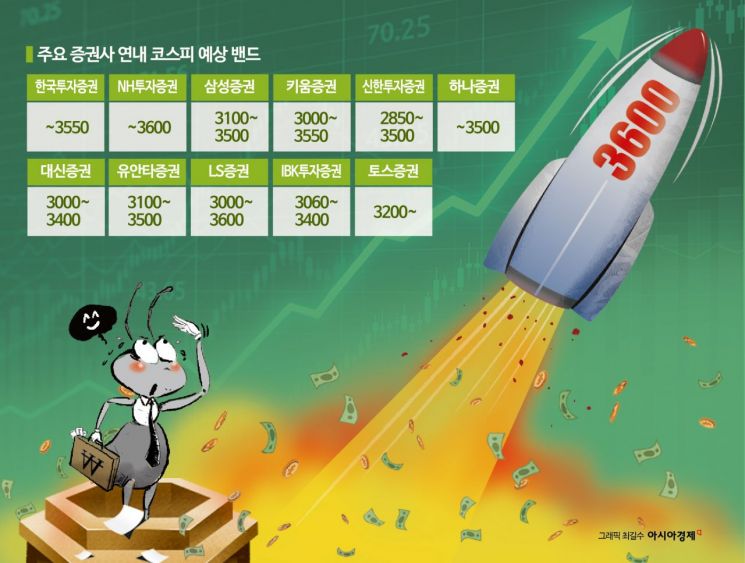
With the KOSPI rising for eight consecutive sessions and hitting new all-time highs every day, there is growing interest in how long this rally can continue. Heads of research centers at major domestic securities firms generally believe the index could rise to the 3,500-3,550 range within the year, with some seeing the possibility of it reaching as high as 3,600. Among the 11 securities firms that provided KOSPI forecast bands, the lowest estimate was 2,850 and the highest was 3,600.
There are also projections that the KOSPI's upward momentum will continue through the first half of next year. Kim Youngil, head of the research center at Daishin Securities, said, "We expect the US rate cut cycle to resume after the September Federal Open Market Committee (FOMC) meeting. Along with the US's accommodative monetary policy, the potential for fiscal expansion and monetary easing, especially in China and other non-US countries, will create a favorable environment in global financial markets. Domestically, as the new government's policies and budget are finalized, industrial policies are expected to be implemented in earnest. The market is likely to move in a positive direction through the end of the year, and the upward trend should continue at least through the first half of 2026."
There is a consensus that further gains will require policy support above all else. The KOSPI's sharp rise in the first half of the year, the correction in August, and the recent breakthrough to a new all-time high were all related to policy factors. In the first half, expectations for new government policies were reflected; in August, the correction was triggered by a tax reform bill that fell short of expectations; and the latest record high was driven by the potential reversal of the unpopular plan to lower the major shareholder capital gains tax. Cho Suhong, head of the research center at NH Investment & Securities, said, "Recently, the KOSPI's sentiment has been driven more by policy momentum than by fundamentals such as earnings. Consistency in policy communication and execution will be key to the Korean stock market's relative performance and valuation re-rating. While there are concerns about the government's stance, considering the structural objectives, the year-end index is more likely to finish above the all-time high than below 3,000. If shareholder returns are strengthened and the separation of dividend income taxation is passed as a reasonable bill, the KOSPI's level at year-end will be higher than now, and the level at the end of the first half of next year will be higher than at year-end."
For the KOSPI to rise further, improvements in fundamentals such as corporate earnings are also necessary. Lee Jonghyeong, head of the research center at Kiwoom Securities, said, "For the KOSPI to reach 4,000 or 5,000 points, there must be significant improvements in fundamentals beyond just policy factors."
Variables that could influence the stock market going forward include the US economic situation and the pace of rate cuts. Yoon Seokmo, head of the research center at Samsung Securities, said, "If US inflation and the Federal Reserve's rate cut pace deviate significantly from market expectations, it could become a variable. While a change in direction is possible, we believe the likelihood is not high." Yoon Yeocheol, head of the research center at Yuanta Securities, commented, "We need to monitor the US employment situation. Currently, a slowdown in US employment indicators is fueling expectations for a rate cut, which is positive for the market, but if the slowdown is severe enough to trigger recession concerns, a rate cut by the Fed could be seen as a response to recession, which may lead to a market correction."
Sectors expected to lead the next market rally include semiconductors, financials, shipbuilding, and defense. Yoo Jongwoo, head of the research center at Korea Investment & Securities, analyzed, "The sectors leading this rally have been semiconductors, holding companies, financials, shipbuilding, and defense. The core drivers of the stock price rally are the advancement of global AI technology and domestic shareholder-friendly policies, such as increased dividends and share buybacks." Yoon Changyong, head of the research center at Shinhan Investment & Securities, said, "Recently, industrials such as shipbuilding and defense have been taking a breather, so attention should be paid to semiconductors and financials for further gains. Following Broadcom's earnings announcement, concerns about AI have eased, leading to a rebound centered on domestic semiconductor companies such as SK Hynix and Samsung Electronics. The contract between Nevious and Microsoft, as well as Oracle's earnings announcement, have also helped restore confidence in AI."
As for investment strategies, a selective approach focusing on stocks with significant discounts relative to their valuations is advised. Lee Younggon, head of the research center at Toss Securities, said, "While it is important to pay attention to existing leading sectors, rather than chasing short-term surges, a strategy of selecting stocks that are significantly undervalued relative to their intrinsic value and valuation is effective. In particular, stocks that are undervalued due to governance issues but show potential for improvement, those with clear cash flow and dividend policies, and sectors at the early stage of an industry turnaround should be the focus for an effective strategy."
© The Asia Business Daily(www.asiae.co.kr). All rights reserved.