President Says at 100-Day Press Conference: "No Need to Insist on It"
Experts: "Only Hinders Stock Market Revitalization... Maintaining the Current Standard Aligns with Government Policy"
"Of course, withdrawing it is the right thing to do." "It was such an unreasonable tax proposal that it could be misunderstood as a deliberate attempt to hinder the revitalization of the stock market."
On September 11, during a press conference marking his 100th day in office, President Lee Jae Myung indicated his intention to withdraw the plan to lower the threshold for major shareholders subject to capital gains tax on stock transfers to 1 billion won. Experts in capital markets and tax law unanimously agreed that it was a "wise decision." They explained that since the current administration is aiming for the KOSPI to reach 5,000 points, there is little reason to push forward with a plan that would dampen market sentiment, especially when the actual tax revenue benefit would be minimal.
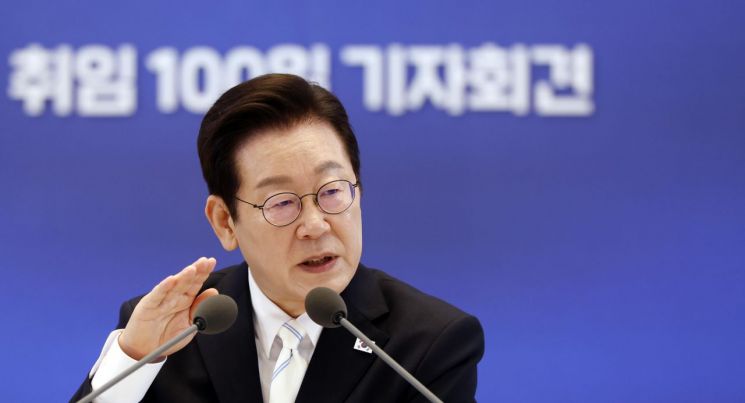
At the press conference that morning, President Lee cited "revitalizing the capital market" as the reason for reversing the decision and maintaining the current threshold of 5 billion won for capital gains tax on stock transfers. He stated, "This is at the core of the government's economic policy, and if it would hinder the revitalization of the stock market, I don't see any reason to insist on it," adding, "I will leave the matter to the National Assembly for discussion."
This effectively signaled the withdrawal of the government’s proposal. It is unusual for a president to step back from a policy that was made public within the first 100 days of taking office. This decision is seen as a serious response to strong market backlash and concerns that it could undermine the policy consistency of the new administration's aggressive measures to boost the stock market.
Seo Joonsik, a former vice president of Shinhan Asset Management and now a professor of economics at Soongsil University, described it as "an unreasonable tax proposal," and positively evaluated the withdrawal, saying, "With little actual tax revenue benefit, it is right to withdraw a measure that would only hinder the revitalization of the stock market." Park Sungwook, a professor of accounting and taxation at Kyung Hee University, also welcomed the decision, stating, "Even if the threshold were lowered to 1 billion won, investors could still avoid the tax by selling in October or November. The proposal would only disrupt the capital market and negatively affect long-term investment." He added, "If the major shareholder threshold were maintained at 1 billion won, many investors would temporarily sell their shares, causing stock prices to drop sharply, especially in October and November. The impact on small-cap stocks and the KOSDAQ would be even greater."
Previously, at the end of July, when the government announced its tax reform plan to drastically lower the threshold for major shareholders of listed stocks from the current 5 billion won to 1 billion won, the domestic stock market capitalization plunged by a staggering 116 trillion won the very next day, August 1. However, after a period of sideways trading, the domestic market began to rise again as rumors of the withdrawal of the 1 billion won threshold emerged. On the previous day, the KOSPI soared to 3,317.77 during trading hours, surpassing the previous all-time high (3,316.08 on June 25, 2021) for the first time in over four years. On this day as well, the index broke through the 3,340 mark early in the session, setting a new record high.
Oh Moonsung, a professor of tax accounting at Hanyang Women's University and president of the Korea Tax Policy Association, commented, "Since the launch of the new administration, the stock market has continued to perform well. This move seems to reflect a desire to maintain that momentum," adding, "The government now has to pay close attention to investors’ psychological confidence." Hong Kiyong, a professor of business administration at Incheon National University and former president of the Korean Association of Taxation, said, "Maintaining the 5 billion won threshold is consistent with the current administration's policy stance. The previous decision to postpone the taxation of financial investment income was also based on the logic that continued undervaluation of the stock market would make it difficult for retail investors. In fact, imposing the financial investment income tax would be a decision more in line with tax equity."
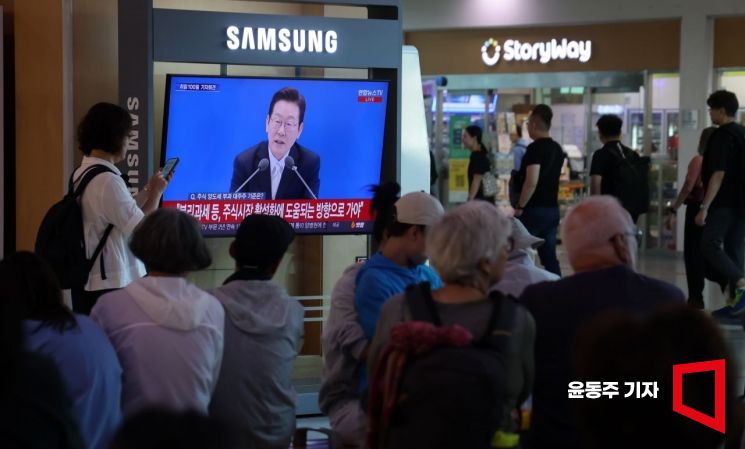 On the 11th, citizens at the Seoul Station waiting room watched the live broadcast of President Lee Jae Myung's 100-day inauguration press conference. 2025.09.11 Photo by Yoon Dongjoo
However, some experts pointed out the need to present a comprehensive tax roadmap that includes capital gains tax, dividend income tax, and financial investment income tax in line with global standards over the long term. Professor Seo stated, "Now is not the right time," but added, "Once the Korea Discount is sufficiently resolved and the price-to-book ratio (PBR) rises to the level of other countries, capital gains tax can be considered together with dividend income tax." He emphasized, "Along with a long-term plan for capital gains tax, there is a need to lower dividend income tax further than the Ministry of Economy and Finance's proposal. We need to discuss comprehensive tax revenue."
Professor Hong also suggested, "To revitalize the capital market, the current policy should be maintained for a certain period, but in the mid- to long-term, measures such as introducing a financial investment income tax should be implemented to meet global tax standards." Currently, Korea's 12-month forward price-to-earnings ratio (PER) is 9.8, which is far below that of the United States (22.5), China (12.3), and Japan (16.1).
© The Asia Business Daily(www.asiae.co.kr). All rights reserved.