Up to 15,000 Professional Work Visas Annually
for Skilled Korean Technicians
Companies Express Crisis Over Detentions
KITA Renews Contract with U.S. Lobbying Firm
Large-Scale Support for Bill Sponsors and Supporters
Rising Interes
The "Partner with Korea Act," which has been stalled in the U.S. Congress for several years, is now facing increased pressure for passage in light of the recent crackdown in Georgia. As a large number of workers have been detained, Korean companies operating in the United States have expressed a sense of crisis, stating that "it is no longer safe to invest locally under these circumstances," and are strongly demanding institutional improvements. Since fundamental questions have been raised regarding worker safety and business continuity, companies believe that further investment will be impossible unless the number of professional employment visas is significantly increased. Korean companies are now intensifying their calls for the passage of the Partner with Korea Act in response to this incident.
According to business circles on September 9, the Korea International Trade Association (KITA) recently renewed its contract with the U.S.-based lobbying firm Thomas Capital Partners for $30,000. Following the renewal, outreach activities targeting lawmakers who support the Partner with Korea Act have reportedly been added as a key task.
The contract amount has also increased compared to before, and the scope of activities has expanded from contacting congressional offices to shaping public opinion, thereby broadening the overall mission. The goal is to provide behind-the-scenes support so that U.S. lawmakers can consistently work toward the passage of the Partner with Korea Act. KITA is also pursuing cooperation with local lawyers and think tanks in Washington, D.C., and is working to establish concrete justifications necessary for the bill’s passage, moving beyond simple monitoring.
In 2024 alone, KITA spent approximately $258,000 on local lobbying in the United States, and already disbursed $204,000 in the first half of this year. As a result, the number of lawmakers supporting the Partner with Korea Act in the 118th Congress increased to 40.
Efforts are also being made at the corporate level. Major conglomerates’ government relations teams have strengthened their Washington, D.C. offices since the inauguration of President Donald Trump, and recently, they have explored various alternatives such as utilizing ESTA and B-1 visas and expanding local hiring through local legal counsel. However, as it is difficult to find a clear solution at the individual company level, companies are now focusing on advocating for institutional measures at the government level.
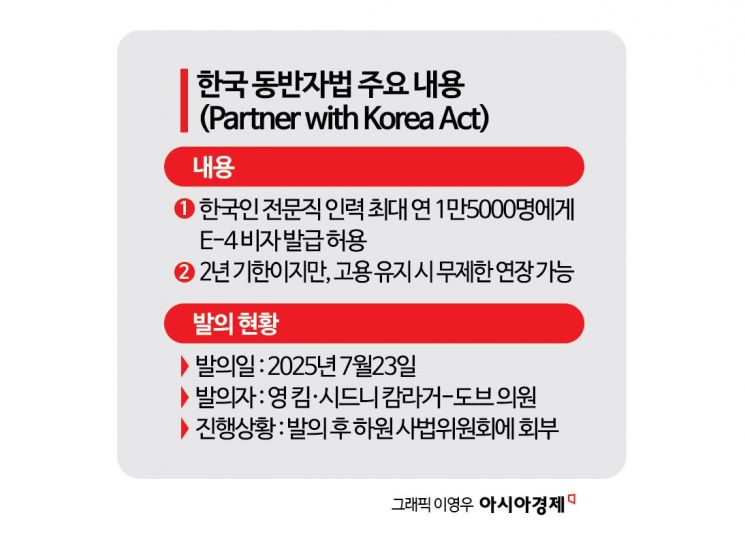
The Partner with Korea Act is centered on allowing up to 15,000 professional employment visas (E-4) to be issued annually to Korean nationals with specialized training. If the bill passes Congress, Korean companies will be able to reduce the time required to dispatch skilled workers to the United States from the current "six months to one year" to "less than one month." The bill was jointly sponsored by Republican Representative Young Kim and Democratic Representative Sydney Kamlager-Dove on July 23, and is now awaiting further legislative procedures for passage.
The recent crackdown has also significantly increased attention on the Partner with Korea Act within the United States. As President Trump mentioned the need for workforce exchanges and some lawmakers have referred to the bill, the legislative environment is changing. Democratic lawmakers belonging to the Congressional Asian Pacific American Caucus (CAPAC) also issued a joint statement, pointing out that "this crackdown is stalling the economy and undermining the trust of global partners," and called on the Trump administration to establish proper procedures. An industry official stated, "The Partner with Korea Act has not attracted much attention, either in Korea or in the United States," but added, "This recent crackdown may signal a shift in the atmosphere."
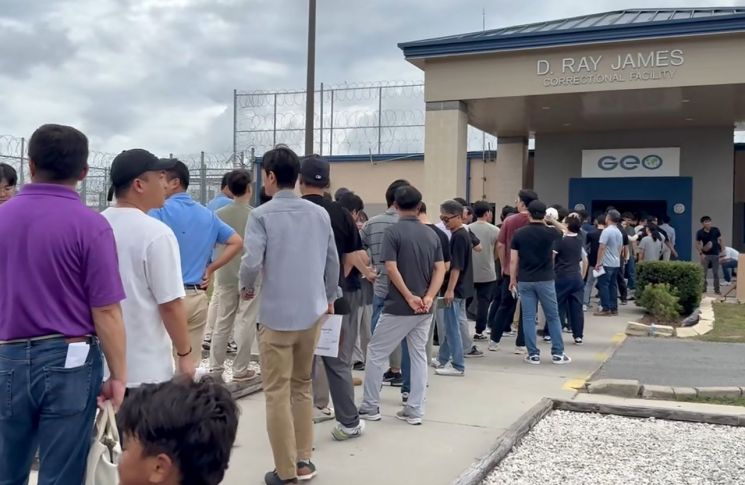 Employees of the affiliated company are waiting for an interview in front of the Immigration and Customs Enforcement (ICE) detention facility in Folkston, Georgia, USA. Photo by Yonhap News Agency
Korean companies maintain that the Partner with Korea Act is absolutely necessary, as it would resolve long-standing inconveniences caused by the inability to address visa issues due to gaps in government diplomacy. When Korea signed the Free Trade Agreement (FTA) with the United States in 2012, disagreements over including provisions for the E-4 visa meant that a "Korea-only employment visa" was not secured. At that time, the U.S. Congress asserted that immigration and visa matters fell under congressional, not executive, authority, resulting in a failure to reach an agreement. In contrast, other countries trading with the United States secured their own professional visas (TN, H-1B1, E-3) when signing FTAs, guaranteeing annual quotas ranging from several thousand to over 10,000. Canada and Mexico can dispatch professional workers without an annual quota through the TN visa. Australia has secured a quota of up to 10,500 E-3 visas annually, while Singapore and Chile have been allocated 5,400 and 1,400 H-1B1 visas, respectively.
Before and after the recent crackdown, Korean companies have strongly asserted that it is difficult to maintain stable business operations in the United States without a special visa program. A U.S. government relations official from a major Korean conglomerate stated, "Our government must step forward and negotiate with the Trump administration to secure country-specific visa quotas." Ultimately, the business community urgently recognizes that institutional measures, such as the introduction of a special visa program, are essential for the stable advancement of Korean companies into the U.S. market.
While it is clear that the Partner with Korea Act holds the key to fundamentally resolving visa issues, there remain significant hurdles to its passage in Congress. The United States operates under a bicameral system, so the bill must pass through committees and secure majority approval in both the House of Representatives and the Senate. Jeong Ingyo, former head of trade negotiations, noted, "As interest has increased, so has opposition within the United States," adding, "Despite much effort and long-term lobbying, the bill has repeatedly failed to meet the requirements for passage and has been automatically discarded." He emphasized, "It is by no means an easy task." Kim Youngman, Director-General for Trade Policy at the Ministry of Trade, Industry and Energy, commented, "It is more realistic to consider what can be done in the short term." Koo Kibo, a professor of global commerce at Soongsil University, stressed, "It is necessary to raise public awareness and support so that the bill can be discussed as it moves from the House to the Senate."
© The Asia Business Daily(www.asiae.co.kr). All rights reserved.