Overhaul of Redevelopment System to Expand Housing Supply
680,000 Units Designated in Greater Seoul
Shortened Project Timelines, Enhanced Profitability,
and Incentives for Public Redevelopment
On September 7, the government announced measures to expand housing supply and decided to overhaul the overall redevelopment project system. Reflecting the fact that project durations of more than 15 years are a constraint on increasing housing supply, the government presented a plan to simplify procedures and reduce project durations by more than three years at maximum.
An official from the Ministry of Land, Infrastructure and Transport explained, "There are a total of 680,000 designated redevelopment units in the Seoul metropolitan area, including 400,000 in Seoul alone, which is twice the scale of the first-generation new towns. We plan to shorten the project duration as much as possible and improve project profitability so that this supply can be delivered quickly and felt by the public."
The government will simplify administrative procedures that typically take a long time, such as securing consent, collecting opinions, and holding general meetings. The procedures for establishing the master plan and the redevelopment plan can be carried out simultaneously, and it will be allowed to conduct resident inspections and local council opinion collection at the same time. If a change to the redevelopment plan is needed before project approval, and the association requests it, the Urban Planning Committee will consolidate its deliberation with the project approval review to be held together.
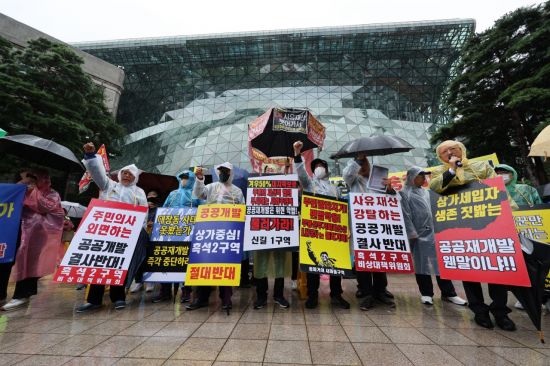 On the morning of the 30th, officials from the Emergency Countermeasures Committee Against Public Redevelopment in 27 districts held a press conference opposing public redevelopment in front of Seoul City Hall. Photo by Yonhap News
Measures will also be implemented to reduce construction cost disputes and internal conflicts within associations. For projects that have completed the permit process, a new Integrated Dispute Committee will be established to manage construction and urban disputes, with an Urban Dispute Committee under its umbrella, which will be granted the authority to mediate construction cost disputes. The First Vice Minister of the Ministry of Land, Infrastructure and Transport will serve as the chair of the Integrated Dispute Committee. The Urban Dispute Committee will have the right to request data from construction companies and its decisions on construction cost disputes will be legally binding. In addition, to shorten the period for management and disposal plans, the government will allow notification of appraisal values and public inspection of management and disposal plans to be conducted before the general meeting, and will stipulate the selection of appraisal firms before project approval notification.
To prevent delays caused by worsening business conditions such as rising construction costs, high-density development will be permitted. In redevelopment, reconstruction, and urban renewal promotion districts, building height limits and green space requirements can be relaxed through deliberation by the Building Committee or Urban Planning Committee. For quasi-industrial areas, the current floor area ratio of the project zone will be recognized in the redevelopment plan, just as in residential areas, without requiring additional public contributions.
The requirements for redevelopment infrastructure that associations receive in exchange for donating roads, parks, and other facilities will also be relaxed. The scope of recognized value for redevelopment infrastructure that project implementers can secure from local governments will now include donated facilities. When easing floor area ratios in urban renewal promotion districts, the purchase price for public rental housing will be raised from the standard construction cost level to 80% of the basic construction cost, which is expected to be about 40% higher than before.
To revitalize public redevelopment projects, the legal cap on floor area ratios will be raised from 1.2 to 1.3 times for public redevelopment and from 1.0 to 1.3 times for public reconstruction. This will be applied temporarily for three years. Rental housing built through public redevelopment projects will be directly owned and operated by entities such as Korea Land and Housing Corporation (LH). In addition, the government will subsidize part of the project implementation fee (about 3% of the total project cost) that residents pay to public implementers. For public redevelopment projects carried out by local public corporations, feasibility reviews will be simplified. Currently, it takes about four months for LH.
In addition, to enhance transparency in redevelopment projects, the government will introduce penalties for fraudulent acts in the electronic voting system, establish an integrated information system for redevelopment projects, and require public lotteries for public rental housing contributions before approval of management and disposal plans when floor area ratios are relaxed. Regarding remodeling projects, when general sales of units larger than 85 square meters are split into two or more units, the number of additional households will be allowed to increase accordingly. Other measures include allowing electronic voting at general meetings, expanding the scope of permit exemptions, and introducing a construction cost verification system.
© The Asia Business Daily(www.asiae.co.kr). All rights reserved.