Renault Korea and Korea LPG Association Sign Agreement on LPDi Hybrid Development
"Innovation in Direct Injection"
Mass-Produced Hybrid Vehicles to Launch in Domestic Market Within a Few Years
A project to develop the nation's first full hybrid LPG vehicle, which offers improved fuel efficiency and lower greenhouse gas emissions compared to conventional LPG models, is now underway.
Renault Korea (CEO Nicola Paris) announced on September 7 that it signed a "LPDi Hybrid Vehicle Mass Production Development Business Agreement" with the Korea LPG Association at the Renault Korea Seoul Office in Gangnam-gu, Seoul, on September 5.
The signing ceremony was attended by key executives, including Nicola Paris, President of Renault Korea, and Hojung Lee, Chairman of the Korea LPG Association. Through this agreement, the two companies plan to jointly cooperate on the development of the nation’s first mass-produced full hybrid vehicle based on an LPG direct injection (LPDi, LPG Direct Injection) engine.
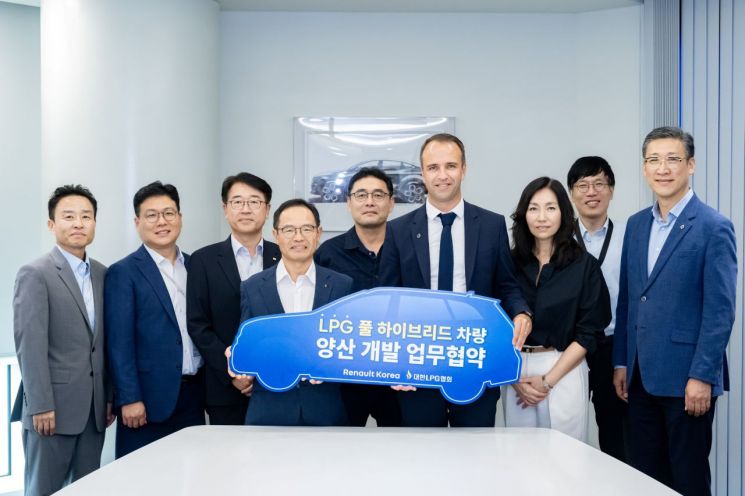 Renault Korea and the Korea LPG Association are holding a signing ceremony for the "Business Agreement for Mass Production Development of LPDi Hybrid Vehicles." (From left in the photo) Deukwon Lee, Executive Director of the Korea LPG Association; Jungwoong Byun, Head of Business Support at SK Gas; Jinman Jeon, Head of External Cooperation at E1; Hojung Lee, Chairman of the Korea LPG Association; Shingil Kang, Director of Architecture & Platform Development at Renault Korea; Nicola Paris, President of Renault Korea; Heejung Sang, Head of Management Strategy at Renault Korea; Hyunseok Joo, Head of Powertrain Development at Renault Korea; Seonggyu Choi, Director of Research at Renault Korea.
The LPG direct injection engine is a fourth-generation system that injects liquid-state LPG directly into the cylinder using a high-pressure fuel pump. While it delivers higher efficiency than existing LPLi engines, it has not yet been introduced in mass-produced passenger vehicles in Korea. Renault Korea plans to combine this LPG direct injection engine with its hybrid E-Tech system, which features a dual parallel-series motor drive, to develop a full hybrid mass production vehicle that maximizes cost efficiency and introduce it to the domestic market within a few years.
In May last year, Renault Korea signed a "Next-Generation Eco-Friendly LPG Vehicle Joint Development Business Agreement" with the Korea LPG Association and has since been working on the production of a hybrid prototype vehicle based on the LPG direct injection engine and conducting preliminary validation. Test results of the prototype vehicle showed that the LPG direct injection full hybrid achieved a significant improvement in fuel efficiency compared to existing LPG vehicles and met the stringent SULEV30 (Super Ultra Low Emission Vehicle) emissions standard.
In 2014, Renault Korea launched the SM5 LPLi, the first domestic vehicle equipped with an LPG donut tank. At the time, the LPG donut tank attracted consumer interest by greatly improving trunk space usability, which had previously been considered a drawback of LPG vehicles. In 2019, the company paved the way for the popularization of LPG SUVs by launching the QM6 LPe, which featured a patented mounting system that enhanced quietness and safety.
© The Asia Business Daily(www.asiae.co.kr). All rights reserved.