Direct Hit to Workforce Risk in U.S. Investments
Stricter Screening Under Trump Administration
Only 131 Monthly Issuances on Average, Jan-May 2025
Low Starting Salaries Disadvantage Korean Firms, High Wages Favor Others
Bill Proposed t
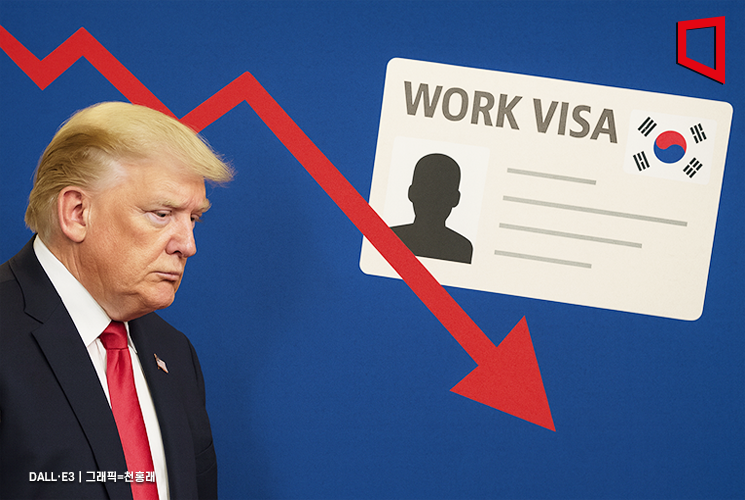
Since the launch of the second Donald Trump administration in the United States this year, there has been a marked decline in the issuance of H-1B (specialty occupation employment) visas for Koreans. The H-1B visa is primarily used by Koreans seeking employment with U.S. companies and is available for positions that require at least a bachelor's degree in a relevant field. Recently, following the U.S. immigration authorities' raid on the Hyundai Motor and LG Energy Solution joint battery plant, concerns have been raised about increasing uncertainty for Korean companies dispatching personnel to their U.S. operations.
According to the "Nonimmigrant Visa Issuance Statistics by Nationality and Visa Type," published monthly by the U.S. Department of State's Bureau of Consular Affairs on September 8, 2025, the average monthly number of H-1B visas issued to Koreans dropped by approximately 37%, from 209 in 2024 to 131 between January and May 2025.
The total number of H-1B visas issued to Koreans in 2024 was 2,506, averaging 209 per month. The year began with 203 visas in January, remained relatively stable with 235 in July and 236 in October, but surged to a peak of 478 in December, just before President Trump’s inauguration, reflecting a short-term spike in demand at a political turning point. However, the situation changed this year, with only 136 visas in January, 109 in February, 110 in April, and just 173 in May, all lingering in the low 100s. The cumulative number of visas issued from January to May this year was 656, down from 795 during the same period last year. This trend reflects a general contraction in visa issuance following the change in administration, as visa screening has become more stringent overall.
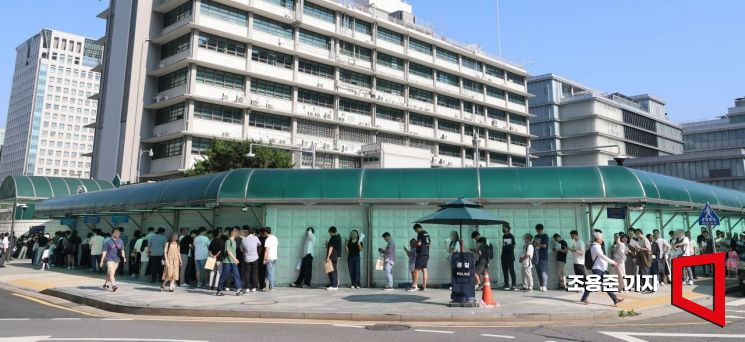 As the U.S. Department of State resumed the visa issuance process for foreign students and trainees, which had been temporarily suspended, a long line of people waiting to obtain visas stretched in front of the U.S. Embassy in Jongno-gu, Seoul on June 23, 2025. Photo by Cho Yongjun
This data compiles the actual number of nonimmigrant visas issued by U.S. embassies and consulates worldwide, broken down by country and visa type. After the U.S. Citizenship and Immigration Services selects H-1B recipients through an annual lottery, the Department of State’s Bureau of Consular Affairs issues visas to the selected individuals via embassies and consulates in each country.
An official from the Korea International Trade Association stated, "Although multiple factors are at play, there is a growing trend to prioritize salary requirements, which may disadvantage Korean companies that typically offer lower starting salaries." The recent focus of U.S. immigration authorities on wage levels has put Korean companies at a disadvantage due to their relatively low entry-level pay, while Indian IT professionals, who make up more than half of all applicants, have an advantage in the lottery by offering higher salaries, further influencing the outcome.
Since the Trump administration resumed in January this year, the overall policy on foreign employment visas, including H-1B, has become even more restrictive. President Trump has criticized the concentration of H-1B visas in certain countries and has pushed for reforms, while the administration is considering more stringent measures to limit the influx of foreign workers, such as weighted lotteries based on wage levels. The screening process for F and J visas, which cover academic and training programs, has also become tougher, and crackdowns on illegal stays have intensified, leading to growing dissatisfaction on the ground.
The Korean government and industry are demanding a separate H-1B track exclusively for Koreans working in strategic sectors such as semiconductors and batteries. U.S. Representative Young Kim has also introduced a bill to allocate 15,000 new visas annually to highly skilled Korean nationals. The Korean business community is raising the visa issue as a key agenda item linked to investments in the United States. At an outreach event in Washington, D.C. last May, Yoon Jinshik, Chairman of the Korea International Trade Association, met with officials from the U.S. Department of Commerce, Congress, and state governments, emphasizing that a stable institutional framework for skilled labor is essential for smooth investment.
Kim Taehwang, a professor of international trade at Myongji University, criticized, "Industrial cooperation between Korea and the United States should not be reduced to mere financial transactions. It is essential to guarantee a quota of employment visas for Korean personnel needed by our companies, and it is unreasonable to treat countries that invest and cooperate with the United States the same as those that do not."
© The Asia Business Daily(www.asiae.co.kr). All rights reserved.