Planted 1,000 Trees Including Siberian Larch, Suited to Local Climate
Kim Youngrok: "A Model Case of International Cooperation in Response to the Climate Crisis"
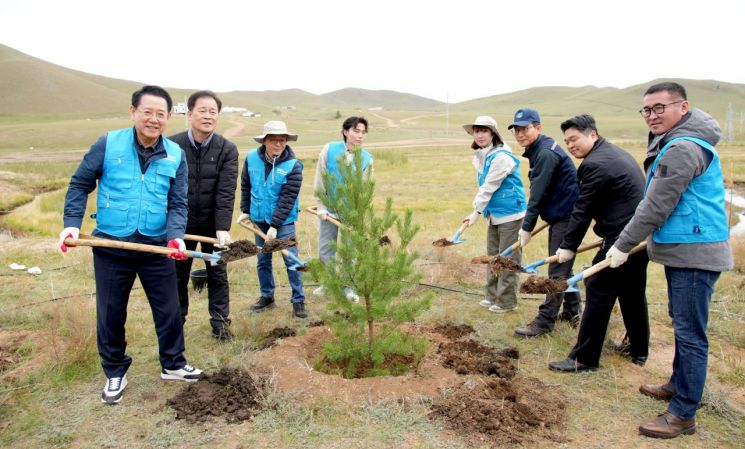 Kim Youngrok, Governor of Jeollanam-do, visiting Mongolia, participated in a tree-planting event for the Forest of Friendship to combat desertification in response to the climate crisis on the 4th (local time) at the Korea-Mongolia Greenbelt project area within Terelj National Park, Ulaanbaatar, together with the Mongolian Forest Agency. Provided by Jeollanam-do
On September 4, Jeollanam-do held a tree-planting event for the creation of the Forest of Friendship to combat desertification in response to the climate crisis, together with the Mongolian Forest Agency, at the Korea-Mongolia Greenbelt project area within Terelj National Park in Ulaanbaatar, Mongolia.
Over 50 officials from both countries participated in the tree-planting event, including Kim Youngrok, Governor of Jeollanam-do; Oyunsanaa, Director of the Mongolian Forest Agency; Lee Jonggeun, Head of the Korea-Mongolia Greenbelt Project Team; and 30 members of the Youth Expedition Team, comprised of Jeollanam-do public officials ranked seventh grade and below.
They planted 1,000 three-year-old saplings, including Siberian larch and Amur maackia, which are locally produced species that thrive in Mongolia's hot, dry climate and poor soil conditions.
Although the work was challenging-clearing rocky ground, planting trees, and watering them by hand with buckets-each tree was planted with care and dedication so that it would grow healthy, help prevent yellow dust, and absorb carbon to overcome the climate crisis.
The yellow dust that reaches Korea mostly originates from the Gobi Desert in Mongolia and the arid regions of northwestern China. With the frequency and intensity of yellow dust increasing due to recent climate change and desertification, this tree-planting event for friendly cooperation holds even greater significance.
In particular, the area where the trees were planted is the 'Public-Private Partnership Participation Forest' zone being developed by the Korea-Mongolia Greenbelt Project Team. The land was provided by the Mongolian government, and the Korea Forest Service established the foundation with public funds.
The 'Public-Private Partnership Participation Forest' serves as an international partnership forest model, with various organizations and companies participating. In Korea, 13 local governments and private companies-including the Ministry of the Interior and Safety, Emart, and IBK Industrial Bank of Korea-are supporting desertification prevention activities as part of their environmental, social, and governance (ESG) initiatives.
Governor Kim Youngrok emphasized, "This tree-planting event is a valuable effort by Jeollanam-do to join the global task of overcoming the climate crisis and preventing desertification. Just as we created a Jeollanam-do garden in New York last year to share our traditional garden culture with the world, this tree planting will also serve as a model case for achieving carbon neutrality through international cooperation."
The Korea-Mongolia Greenbelt Project Team is an intergovernmental cooperation organization established through collaboration between the Korea Forest Service and the Mongolian Ministry of Environment and Tourism. The first phase (2007-2016) involved planting trees over more than 3,000 hectares; the second phase (2017-2021) created an urban forest of 40 hectares; and the third phase (2022-present) is leading forest restoration and wildfire prevention pilot projects, spearheading forestry cooperation between the two countries.
Currently, Mongolia has set a national goal of planting 1 billion trees by 2030 and is investing more than 1% of its annual GDP in forest restoration efforts in desertified areas.
Jeollanam-do is also pursuing a "500 Million Tree Planting Plan" by 2050. From 2015 to 2024, the first phase achieved 117% of its target by planting and managing 117 million trees, surpassing the goal of 100 million. For the second phase, the province plans to plant 200 million trees by 2034.
© The Asia Business Daily(www.asiae.co.kr). All rights reserved.