Global e-Mobility Council Holds Joint Forum on the Great Transition to Electrification
"Electric Vehicle Safety Management Must Be Expanded to Cover the Entire Lifecycle"
There are calls to further refine the safety management system in order to increase the adoption of electric vehicles and improve user awareness. As the number of electric vehicles on the road grows, safety has emerged as a key issue not only during the manufacturing and battery production stages, but also throughout the operation of these vehicles.
At the 'Great Transition to the Electrification Era 2025' forum held at Jeju Shinhwa World on July 8, Park Yongseon, Director of the Automobile Policy Division at the Ministry of Land, Infrastructure and Transport, stated, "Going forward, we will develop safety management policies for electric vehicles by dividing them broadly into the manufacturing and operational stages." He added, "We are considering not only making safety management mandatory, but also introducing measures to encourage voluntary participation by manufacturers and users."
One area where safety measures have been made mandatory is the introduction of a battery certification system. While it is common for automakers to establish their own safety standards, a pre-certification system for batteries was introduced this year. Full implementation is planned for next year. Under this system, vehicles will only be allowed to launch if they pass safety standards before release.
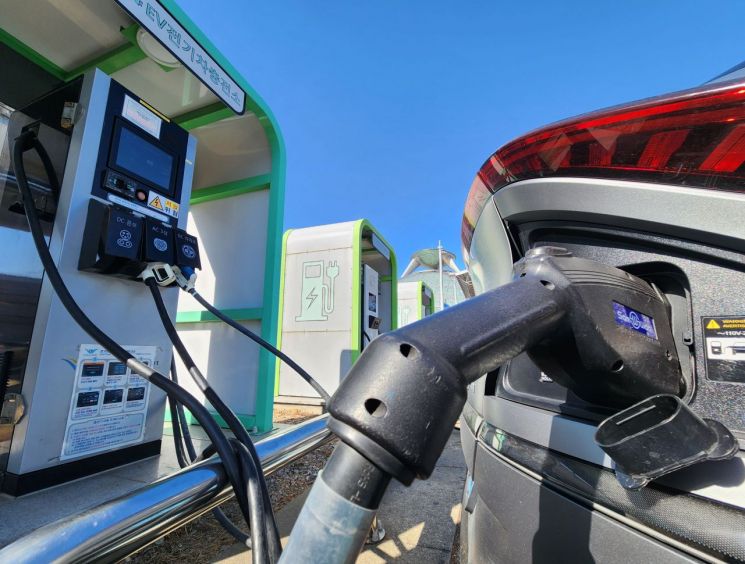 An electric vehicle is charging at a charging station in Incheon International Airport. Photo by Yonhap News
Additionally, the government plans to strengthen the Battery Management System (BMS) criteria in the Korea New Car Assessment Program (KNCAP) to encourage manufacturers to produce safer vehicles. There is also a system that reduces fines for manufacturer violations based on the development and deployment level of BMS.
The government, in cooperation with Hyundai Motor, Kia, and BMW, conducted a pilot project this year involving 40,000 vehicles, in which notifications are sent directly to fire authorities in the event of battery abnormalities. Next year, the scope of this project will be significantly expanded. It is reported that the government is considering increasing the number of participating vehicles to 100,000, more than double this year's figure. While preventing electric vehicle fires is crucial, it is equally important to ensure rapid initial response in the event of a fire, as this can significantly reduce damage.
Park emphasized, "The future policy direction is focused on establishing safety throughout the entire electric vehicle ecosystem." He continued, "We will establish a lifecycle management system from battery manufacturing to disposal, and enhance effectiveness by designing flexible policies that reflect feedback from consumers and the field."
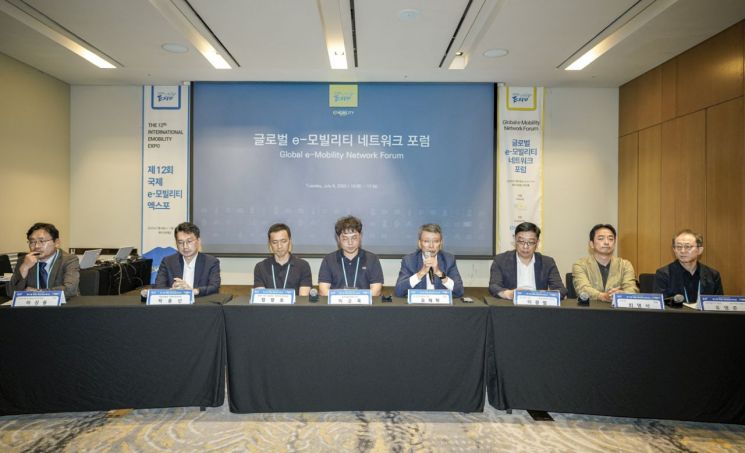 At Jeju Shinhwa World on the 8th, presenters and panel participants are discussing electric vehicle safety at the 'Great Transition to the Electrification Era 2025' forum. Photo by Korea Automobile Journalists Association
Automakers also regard battery safety management as the most important factor in the adoption of electric vehicles. In addition to ensuring safety during production, they are working to increase consumer acceptance by continuously tracking and managing vehicles after sale and utilizing the accumulated data.
Jung Changho, Head of Battery Performance Development at the Hyundai Motor and Kia Technical Research Institute, stated, "Through repeated in-house research at the battery cell level, we have now acquired enough know-how in safety and quality to enable in-house mass production." He added, "We conduct constant monitoring of the BMS, diagnosing not only during parking but also throughout charging and driving. We also detect potential issues such as micro-short circuits that may occur after long-term use, and bring vehicles in for detailed inspection at service centers as a preventive measure."
He further emphasized, "We have set the establishment of a multi-layered safety net encompassing both hardware and software as our basic direction. By ensuring absolute customer safety through this multi-layered safety net, we aim to achieve differentiation in battery technology."
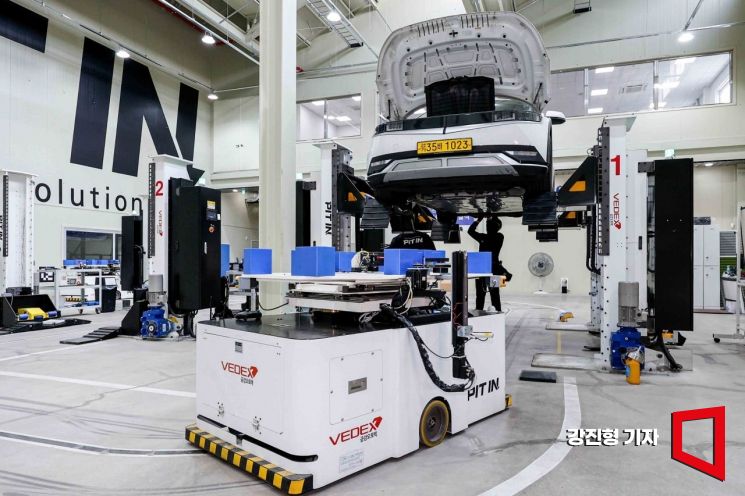 At the Pitin headquarters in Anyang, Gyeonggi, mechanics are replacing electric vehicle battery packs. Photo by Kang Jinhyung
Related research and development efforts are also being pursued to enhance safety. Lee Jongwook, a professor at Korea University of Technology and Education, stated, "Recent technological development aims to strengthen safety throughout the entire lifecycle, from fire prevention to suppression after occurrence, through a multi-layered approach." He added, "Efforts are being made not only to use BMS for prevention, but also to develop abnormality detection and warning systems, enhance the thermal stability of battery cell components, and create technologies to prevent the spread of fires inside battery packs."
There were also calls for the government to comprehensively revise safety-related standards. Choi Youngseok, a professor at Halla University’s Department of Future Mobility Engineering, said during the discussion, "Until now, the Ministry of Environment has focused on promoting the adoption of electric vehicles, but now it is time to focus on industrialization based on the vehicles that have already been adopted." He continued, "Instead of simply providing subsidies for new car purchases, it is necessary to take an industrial promotion approach by linking various upstream and downstream industries." He also advised that cooperation among government ministries is needed to achieve this.
Lee Kwangbeom, an advisor at the law firm Sejong, pointed out, "Currently, BMS notifications after parking are set differently by each manufacturer, so there is a need for more detailed management, such as establishing general standards." This event was hosted by the Global e-Mobility Association Network (GEAN) and jointly organized by the International e-Mobility Expo Organizing Committee, the Korea Automobile Journalists Association, and the Korea Automobile Mobility Safety Association. It was held as an official pre-event for the International e-Mobility Expo, which begins on July 9.
© The Asia Business Daily(www.asiae.co.kr). All rights reserved.