"Sharp Divide in Historical Perceptions Between Conservative and Progressive Camps"
"Evaluations and Interpretations of the Past... Korean Society Remains Polarized"
As the construction of a statue of former President Park Chunghee has sparked sharply divided opinions between conservative and progressive camps, Japanese media have also focused attention on the issue.
On July 7, the Mainichi Shimbun reported, "In South Korea, the movement demanding the removal of the statue of former President Park is intensifying, clearly exposing the historical perception gap between conservative and progressive camps."
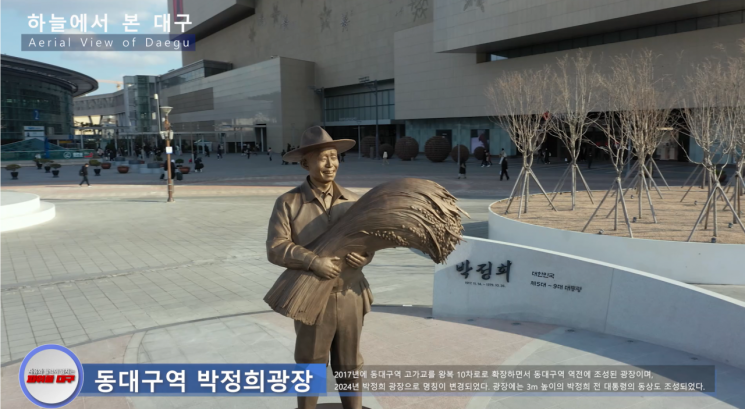
In front of the North Gyeongsang Provincial Government building in Gumi, North Gyeongsang Province, Park's hometown, a statue completed in December last year now stands. Kim Hyungki, professor emeritus at Kyungpook National University, who led the construction of the statue, told the Mainichi Shimbun, "President Park was a leader who laid the foundation for the Republic of Korea, yet he has not received a proper evaluation," adding, "The statue was erected as a symbolic gesture to inform future generations of his achievements."
The Mainichi Shimbun introduced Park as the figure who, through the normalization of diplomatic relations with Japan in 1965, secured $500 million in economic cooperation funds from Japan and, based on this, pursued export-oriented industrialization that led to the rapid economic growth known as the 'Miracle on the Han River.' However, the paper also noted, "He seized power in a military coup in 1961, maintained a long-term dictatorship, and harshly suppressed democratization movements, making him the center of controversy to this day."
Professor Kim argued that such rule was inevitable in order to protect liberal democracy amid confrontation with North Korea. He further stated, "Park Chunghee is the 'Baekdudaegan' of Korea, who ended 5,000 years of poverty." The newly erected statue was made slightly taller than the statue of Admiral Yi Sunshin, a hero of the Imjin War, to add symbolic significance.
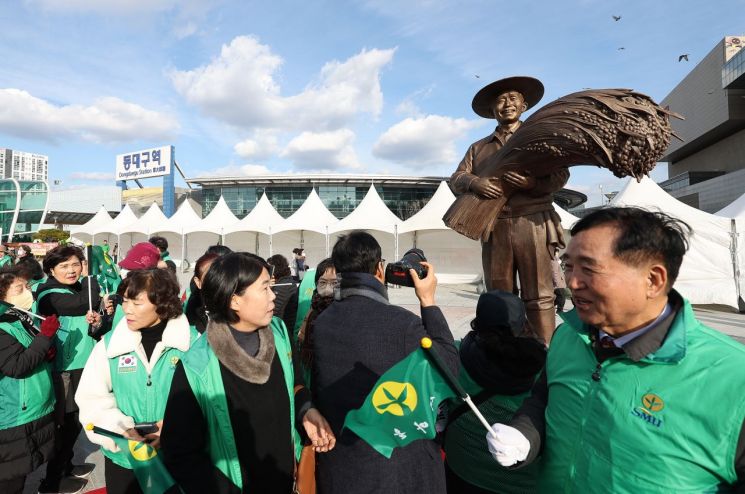
There are also strong opposing voices. Um Changok, professor emeritus at Kyungpook National University, countered in an interview with the Mainichi, "How can a pro-Japanese collaborator who served as an officer in the Manchukuo Imperial Army under Japanese rule become the 'Baekdudaegan' of Korea?" He further emphasized that Park "collaborated with Japan during the colonial period and was a dictator who suppressed democratization," insisting that "erecting his statue in this era goes against the spirit of the times." Um identified former President Kim Daejung as the 'true Baekdudaegan' in his view. Kim Daejung led the democratization movement under Park Chunghee's regime and, in 2000, held a historic inter-Korean summit with National Defense Commission Chairman Kim Jongil, for which he was awarded the Nobel Peace Prize. Professor Um argued, "President Kim Daejung inherited the spirit of the independence activists and restored democracy."
The Mainichi also noted that Park graduated from the Manchukuo Military Academy and served as a military officer in Manchukuo, a puppet state of Japan, stating that this is "at the core of the 'pro-Japanese collaborator' controversy."
The paper further reported, "Currently, there are at least 60 statues of former presidents in South Korea, with Park Chunghee accounting for the largest number at 16."
The Mainichi pointed out that differences in historical perception in South Korea are also intertwined with regionalism. The Yeongnam region, including North Gyeongsang and Daegu, where support for Park is strong, and the Honam region, including Gwangju and South Jeolla, which is Kim Daejung's political base, remain politically and emotionally divided.
This year marks the 60th anniversary of the normalization of diplomatic relations between Korea and Japan under the Park Chunghee regime, as well as the 80th anniversary of the end of Japanese colonial rule. The Mainichi concluded, "Evaluations and interpretations of the past continue to divide Korean society," and added, "The question of whether Park was a 'hero or a dictator' remains a hotly debated issue even today."
© The Asia Business Daily(www.asiae.co.kr). All rights reserved.