Seminar Held and Report Published on Survey of 386 Listed Companies
"One in Three Companies Considering Applying AI to Internal Accounting Management System"
It has been suggested that, for effective corporate internal control, not only should artificial intelligence (AI) be utilized, but internal control must also be linked to business strategy and risk assessment, and a company-wide integrated internal control system should be established.
On June 20, Samil PwC announced that it held the "Internal Control Future Strategy Seminar" under the theme "AI-Driven Internal Control Innovation" at the Amore Hall on the second floor of its headquarters in Yongsan-gu, Seoul, on June 19. The seminar was organized to share trends in internal accounting management systems over the past six years, corporate response strategies, and cases of AI integration, as well as to present the direction of future-oriented internal control. The event was held both offline and online, with more than 700 corporate representatives in attendance.
In the first session, Partner Sungjae Lim of Samil PwC, who gave a presentation on "Direction and Trend Analysis of Internal Control Evolution," emphasized, "To operate internal control properly, it is important to link it not only with financial statements but also with business strategy and risk assessment." He added, "In particular, the effectiveness of internal control increases significantly when data analytics are actively adopted." Lim also mentioned, "Internal control focused on effectiveness, which combines systems, people, and technology, is directly connected to corporate sustainability."
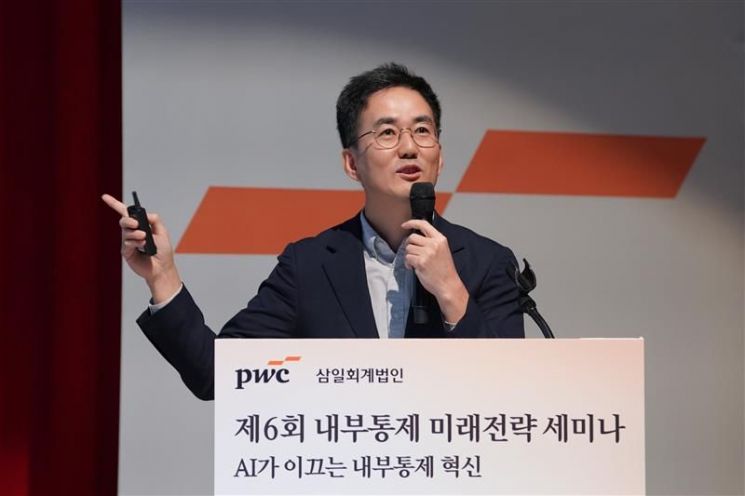 On the 19th, at the 6th Internal Control Future Strategy Seminar held at the Samil PwC headquarters in Yongsan-gu, Seoul, Partner Sungjae Lim gave a presentation on the topic "Direction and Trend Analysis of Internal Control Evolution." Samil PwC
The traditional static approach to risk management is now shifting to focus on change management, emphasizing monitoring (design and operational evaluation), and centering on enterprise-wide risk management systems. According to a PwC survey, companies that operate integrated internal controls have reduced profit volatility and increased management credibility. Partner Doosam Kim stated, "Integrated internal control has a positive impact on cost reduction and improved operational efficiency," and added, "When internal controls for operations, regulatory compliance, and financial reporting are integrated from an enterprise risk perspective, rather than being operated separately, it becomes possible to effectively respond to fraud risks." He further noted, "Efficient and non-redundant integrated internal control is no longer a choice but a matter of survival."
In the second session, Partners Yeohyun Yoon and Sujeong Jung gave a joint presentation on "Internal Control Innovation Driven by Data and AI," showcasing the AI-based internal accounting management system (K-SOX) solution and lease solution, which drew significant attention. The K-SOX AI solution developed by Samil PwC is a technology that automates internal control evaluations, simultaneously enhancing efficiency and effectiveness. The Lease AI solution is expected to revolutionize companies' financial processes by providing one-stop processing from contract analysis to lease accounting.
Partner Jung introduced concerns about balancing performance and security when adopting AI in companies, and advised, "Quality issues related to content, data, and supporting evidence, as well as AI's inherent limitation of hallucination, can degrade K-SOX performance." She recommended, "Organizations should identify the environment that suits them and carefully consider where to apply AI in order to find a strategic balance."
Partner Yoon then discussed the impact of AI adoption on K-SOX and AI-related risks, stating, "The introduction and expansion of AI will change not only work processes and procedures but also sources of anxiety, which means that approaches to addressing and managing anxiety will also change." He further predicted, "AI will have a broad impact on areas such as board reporting and governance functions."
During the seminar, the results of a survey analyzing 386 listed companies subject to internal accounting management system audits (conducted jointly with the Korea Listed Companies Association and KOSDAQ Association) were also shared. A report titled "Internal Control Future Strategy: AI-Driven Internal Control Innovation," which includes these findings, was also published.
According to the report, since the introduction of internal accounting management system audits, about 71% of companies responded that they are confident that the system is effectively controlling financial risks (with about 17% being very confident and about 54% somewhat confident).
Additionally, the key priorities for enhancing the effectiveness of the internal accounting management system were identified as "active interest and support from management" and "increased awareness and understanding of the importance of internal control among employees," both ranked as the top priorities. Continuous training for employees (third) and an increase in dedicated internal control personnel (fourth) followed. The report analyzed, "To enhance the effectiveness of the internal accounting management system, the attention of all members is necessary, which is particularly aligned with the recent trend emphasizing the roles and responsibilities of management."
With various innovations using AI being attempted recently, technological advances are now suggesting new directions for internal control. In this context, about 32% of respondents said they are "considering the use of AI to improve the efficiency and advancement of the internal accounting management system." The most anticipated benefit from adopting AI was "reduction in work processing time and cost savings," cited by more than 70%. On the other hand, the main obstacles to AI adoption were identified as "the burden of introduction and maintenance costs," followed by concerns about AI's accuracy and reliability, lack of technical understanding among internal staff, and potential conflicts with regulatory and legal requirements.
The report referenced various recent cases of risk management failures both domestically and internationally, diagnosing "a situation in which the necessity of enterprise risk management is being emphasized." Accordingly, it focused on how integrating internal controls for financial reporting, operations, and regulatory compliance can be effective in responding to fraud risks. In fact, the proportion of respondents who answered positively to this question reached 71%, a 17 percentage point increase from 54% in 2023.
Partner Sungjae Lim stated, "In a business environment where uncertainty has become routine and in an era of technological revolution represented by AI, corporate internal control systems must evolve from being mere regulatory compliance tools to becoming core infrastructure for value creation." He further emphasized, "AI-driven internal control innovation will be at the heart of this evolution." Lim added, "With the strengthening of governance, risk analysis and internal control will become core functions that management and the board of directors must strategically lead."
© The Asia Business Daily(www.asiae.co.kr). All rights reserved.