Collecting a Cartful of Waste Paper All Night Earns Only 1,000 Won
Average Waste Paper Price Drops from 140 Won to 80 Won Nationwide
At around 5 a.m. on the morning of the 10th, at a junk shop in Sindang-dong, Jung-gu, Seoul, carts filled with waste paper and scrap metal were lined up around the shop, which had not yet opened. At the end of an alley, where there were hardly any pedestrians or vehicles at this early hour, Kim Mikyung (68) was pulling a cart loaded with waste paper. Kim said, "The junk shop opens at 5:30 a.m., so I leave my cart nearby and keep collecting waste paper," and then set out again with an empty cart to continue her work.
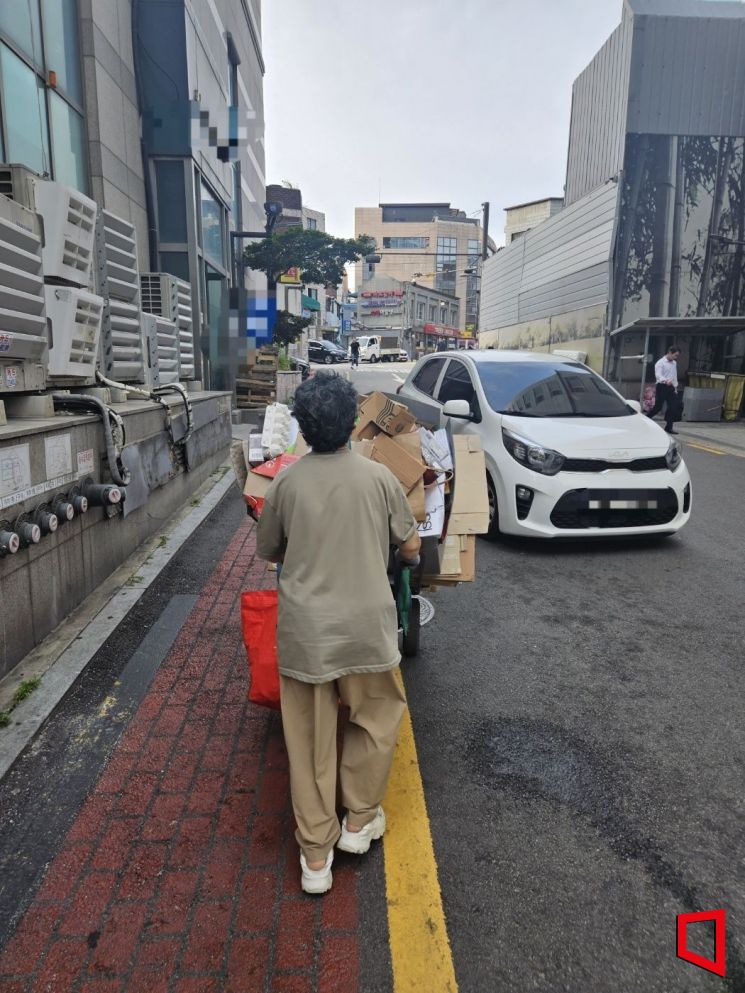 On the morning of the 10th, an elderly man was pulling a cart loaded with scrap paper in Sindang-dong, Jung-gu, Seoul. A vehicle coming from the opposite direction is seen maneuvering to avoid the cart. Photo by Seungwook Park
Collecting Waste Paper All Night Earns 24,400 Won
Kim headed to recycling stations at villas and officetels in the Sindang-dong and Hwanghak-dong areas. Since apartment complexes often have their own garbage collection trucks, she has no choice but to search the alleys for waste paper and scrap metal. The amount she received from the junk shop for the cart piled high with waste paper was just over 1,000 won. In this area, waste paper such as boxes is bought at 40 won per kilogram. Heavier paper, such as newspapers or books, and cans are bought at 80 won per kilogram, but on this day, only empty boxes were to be found on the streets.
The price of waste paper continues to fall. Although prices vary by region, people like Kim, who work near their homes, find it difficult to travel to places that pay more. According to data compiled by the Korea Environment Corporation, the nationwide average price for waste paper this year is about 82 won, a significant drop from 142 won in 2022. Kim said, "The price of waste paper keeps falling, so it's getting harder to make a living," and added, "There are places that pay more, but since most of us don't have cars and walk everywhere, it's hard to work anywhere other than near home."
In order to earn even a little more, Kim has chosen to live differently from others. Every single day, without exception, she leaves home at 6 p.m. and starts collecting waste paper, returning home only at noon the next day. As a result, she can only have a meal after returning home once a day. During the day, there are many elderly people collecting waste paper, so it's common to return empty-handed even after spending all day on the streets. Kim said, "If I go out after sunrise, others collect the waste paper in the blink of an eye, so I have to work harder and move faster than everyone else."
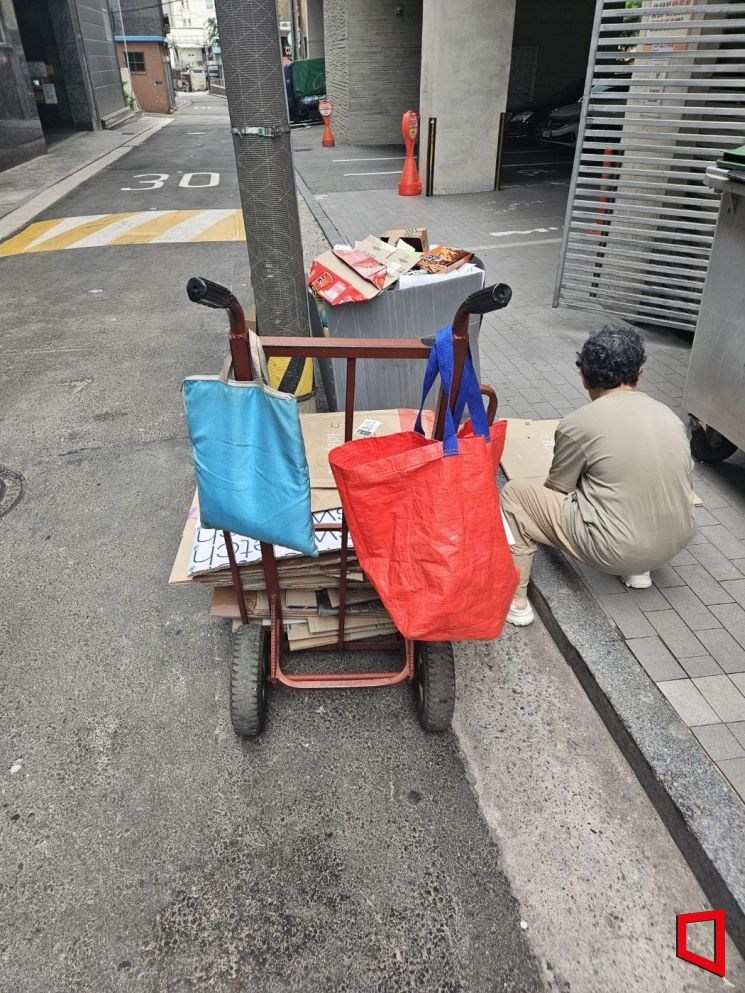 On the morning of the 10th, an elderly man is collecting scrap paper in the Hwanghakdong area of Junggu, Seoul. Photo by Seungwook Park
There is also less risk of accidents late at night. When pulling a cart loaded with waste paper, the view is often blocked, making it easy to bump into pedestrians or miss oncoming vehicles. Kim said, "The roads are bumpy, and the waste paper piled on the cart blocks my view, so I often don't see pedestrians or cars," adding, "At least at night, there are no people or cars, so I can move around more safely and comfortably."
In fact, when a reporter tried pulling a cart filled with waste paper from a villa in Hwanghak-dong to a junk shop 500 meters away during the morning rush hour, there were many close calls with other citizens. The high pile of waste paper blocked the view ahead, and the wide load made it impossible to see to the sides. The cart frequently got stuck on the sidewalk blocks throughout the journey. The reward for this arduous trip was a mere 500 won.
On this day, Kim settled accounts at the junk shop at 10:30 a.m., earlier than usual. The day before, she had worked until 2 p.m. instead of noon. After spending about 16 hours on the streets, Kim earned 24,400 won for the day.
Only 99 Out of 229 Local Governments Have Elderly Poverty Support Ordinances
According to a survey released by the Ministry of Health and Welfare in July last year, there are a total of 14,594 elderly people collecting waste paper nationwide. However, since each person has different distances, routes, and working hours, it is difficult to accurately track the situation each year. Their average monthly income, including basic living allowances and the basic pension, is 760,000 won, which is less than half the average monthly income for elderly people, which was 1.8 million won as of 2023. The vast majority are recipients of basic living allowances or the basic pension.
However, there is still a lack of active support for elderly people who collect waste paper. Local governments such as Seoul and Incheon provide public jobs for them, but only 32.3% (4,787 people) of the 14,594 elderly collectors benefit from these programs. Many choose to collect waste paper instead of public jobs due to a lack of information about public job programs or restrictions on working hours. There is also no legal support system in place. Job programs and protective equipment for elderly waste paper collectors are based on local government ordinances, but only 99 out of 229 local governments nationwide have enacted such support ordinances.
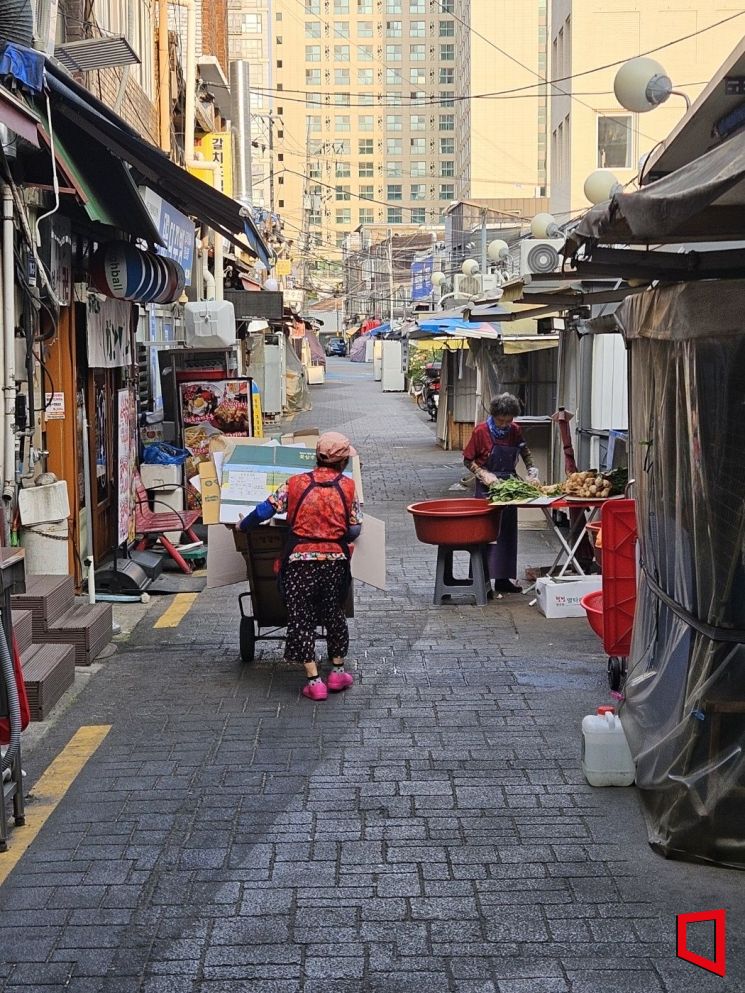 On the morning of the 10th, an elderly man was pulling a cart loaded with waste paper at Sindang Jungang Market in Jung-gu, Seoul. Photo by Seungwook Park
Experts advise that government support is necessary to solve elderly poverty. Heo Junsu, professor of social welfare at Soongsil University, said, "Since there are local governments with low fiscal independence, support for elderly waste paper collectors should come not only from local ordinances but also from the central government," adding, "It is not enough to simply provide public jobs. Since many elderly people are unaware of these jobs, the government should increase policy promotion and expand the budget so that more people can be connected to public jobs." He continued, "Of this year's 27 trillion won welfare budget for the elderly, 80% comes from the national government and the rest from local governments, with 22 trillion won allocated to the basic pension. For small local governments with low fiscal independence, supporting only the basic pension leaves too little budget to provide practical support for elderly waste paper collectors."
Jung Soondul, professor of social welfare at Ewha Womans University, also said, "In reality, it is difficult to periodically identify and support only elderly waste paper collectors," but emphasized, "Since the vast majority of them are elderly living alone or recipients of basic living allowances, support should be strengthened as part of efforts to address elderly poverty."
© The Asia Business Daily(www.asiae.co.kr). All rights reserved.