Rampant Origin Laundering Schemes,
U.S. Inflation Persists... Rate Cuts Out of Reach
Recently, illegal intermediary agencies specializing in origin laundering have been experiencing unprecedented prosperity in China. This is because Chinese exporters are seeking ways to circumvent U.S. tariffs, which have soared to a combined total of 145%.
According to foreign media reports, posts and videos promoting third-country transshipment origin laundering methods by logistics intermediaries are rapidly increasing on Chinese social media. These advertisements claim that changing the country of origin to Southeast Asian countries such as Malaysia or Vietnam can help avoid U.S. tariffs, and they even disclose specific methods for laundering origins, raising concerns.
Some companies are introducing methods that involve swapping goods at sea using vessels registered under different nationalities in the international waters of Southeast Asian countries. Other companies advertise that goods can first be transported to their own factories or partner companies in Southeast Asia, have their origin changed, and then be re-exported to the U.S. to avoid tariffs.
These methods are similar to those used by Russia to evade sanctions and export oil. Chinese export companies are inevitably interested in such illegal methods because the export tariff to the U.S. reaches 145%. If companies pay this full tariff, there is nothing left for them after export.
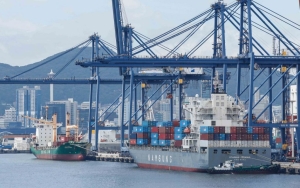
![Boom in China's 'Origin Laundering' Industry Amid 145% U.S. Tariffs... Disguising as Southeast Asian Products [AK Radio]](https://cphoto.asiae.co.kr/listimglink/1/2025050916231051197_1746775391.jpg) Containers loaded for export at Shanghai port in China on the 9th. As U.S. tariffs on Chinese goods have soared to 145%, cargoes that have given up on exporting to the U.S. are piling up. Photo by AFP Yonhap News
Containers loaded for export at Shanghai port in China on the 9th. As U.S. tariffs on Chinese goods have soared to 145%, cargoes that have given up on exporting to the U.S. are piling up. Photo by AFP Yonhap News
The Chinese government is also aware that these practices could worsen trade friction with the U.S., but it is reportedly unable to crack down immediately as export companies are facing the risk of closure. In fact, trade associations in China are even introducing intermediary agencies that provide origin laundering services to trading companies.
The U.S. and China are scheduled to begin negotiations on trade issues in Switzerland starting on May 10 (local time). The issue of origin laundering is expected to be a major agenda item at this meeting. The U.S. government is likely to insist that China crack down on origin laundering, while the Chinese government is expected to appeal to the difficult situation facing its domestic companies. As long as the gap between the two sides remains unbridged, the boom for illegal intermediaries is expected to continue for the time being.
The problem is that not only Chinese exporters to the U.S., but also American companies exporting to China, are suffering significant losses. China is imposing a 125% retaliatory tariff on exports from the U.S. In particular, the electric vehicle and semiconductor industries, for which China is a major market, are facing severe difficulties.
The Chinese government recently announced that it would determine the origin of semiconductors based on the country of wafer production. Companies that place wafer orders with Chinese foundries and have their products manufactured there will be exempt from tariffs. As a result, while U.S. semiconductor companies are being hit hard, companies such as TSMC of Taiwan and Samsung and SK Hynix of South Korea have secured a more advantageous position than their U.S. counterparts in exports to China.
There is growing concern in the U.S. that if excessive tariff barriers between the two countries are maintained for a long time, both sides will suffer. The U.S. started the trade war with China to reduce its trade deficit, but mutual retaliatory tariffs have only worsened inflation in both countries, with no substantial gains, according to critics.
![Boom in China's 'Origin Laundering' Industry Amid 145% U.S. Tariffs... Disguising as Southeast Asian Products [AK Radio]](https://cphoto.asiae.co.kr/listimglink/1/2025050915322351068_1746772343.jpg)
One of the biggest victims of the current tariff war is electric vehicle companies such as Tesla. Most of the raw materials for batteries, as well as the batteries themselves, essential for electric vehicle production, are manufactured in China. Importing these into the U.S. incurs a 145% tariff, and exporting completed electric vehicles back to China faces a 125% retaliatory tariff, creating a double burden.
The U.S. trade deficit has actually widened, surpassing $140 billion (approximately 195 trillion won) in March. The share of imports from China has dropped from over 20% to about 12%, but this is interpreted as an increased burden on U.S. consumers, as they can no longer use inexpensive Chinese imports.
Across the U.S., anti-Trump protests driven by economic hardship are spreading, with reports that the number of participants has exceeded 10 million. President Trump pledged price stability and improvement of ordinary people's livelihoods as part of his second-term campaign promises, but the U.S. Federal Reserve has decided to freeze interest rates due to serious inflation concerns.
Such high interest rate policies are placing a heavy burden on U.S. companies and households with debt, and concerns about an economic downturn are mounting. In addition, the U.S. unemployment rate, which had been relatively stable, is now on the rise, raising fears of stagflation.
The U.S.-China trade dispute is not just an issue for the two countries, but is expected to deal a major blow to the South Korean economy as well. In particular, South Korea is currently facing political instability and a presidential election, making it difficult to actively respond to trade negotiations with the U.S. and China. As a result, South Korean export companies are also facing difficult circumstances. There is a growing call for the ongoing Switzerland negotiations between the U.S. and China to produce a breakthrough, so that South Korea and other countries can respond appropriately in a more favorable environment.
© The Asia Business Daily(www.asiae.co.kr). All rights reserved.