US Secretary of Defense Visits Japan and the Philippines, Stresses Alliance
US Maintains Policy of Strategic Ambiguity
"China's Invasion of Taiwan" Designated as Top and Sole Priority
As the United States expressed its willingness for military intervention in the Taiwan Strait, the Taiwan issue has emerged as a new factor deepening the US-China conflict, following tariffs. Experts are concerned that if security cooperation between the US and Pacific allies strengthens, uncertainty over the South China Sea and Taiwan issues will increase further.
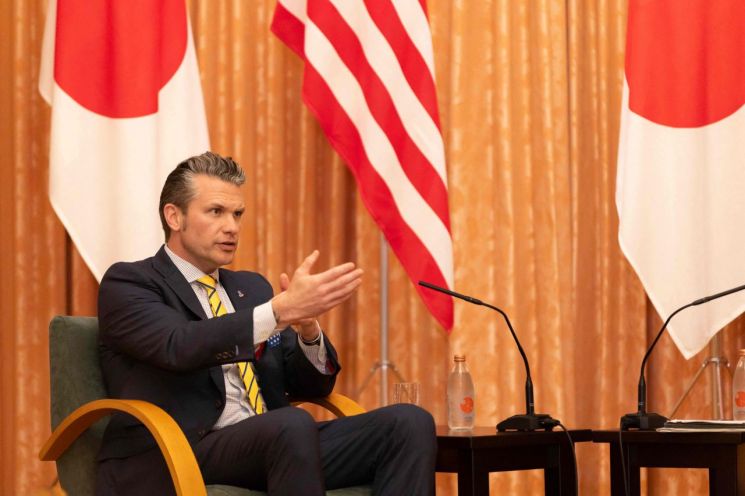
US Secretary of Defense Pete Hegseth embarked on his first Asia tour since taking office, stopping by the Philippines and Japan to emphasize the importance of alliance relationships. On the 30th, during a meeting with Japanese Prime Minister Ishiba Shigeru, he said, "Japan is our essential partner in deterring the Chinese Communist Party's military attacks, including in the Taiwan Strait."
Earlier, on the 28th, immediately after talks with the Philippine Secretary of Defense, Secretary Hegseth held a press conference where he stated, "We will build the deterrence necessary to prevent war with the Philippines, Japan, Australia, South Korea, and others," adding, "Both sides will actively communicate, reflecting a strong alliance and power especially against the Chinese Communist Party's offensives." On the same day, the Philippines and Japan conducted joint naval exercises with US forces in the disputed South China Sea, drawing strong criticism from China, which has frequently clashed in the region.
Professor Zhuo Feng of Nanjing University told Hong Kong's South China Morning Post (SCMP), "The close joint military movements of the US and Japan aim to intervene in regional issues," explaining, "Secretary Hegseth's recent remarks show that the strategic confrontation between Beijing and Washington in the Taiwan Strait is intensifying."
Tensions between the US and China in the Taiwan Strait are escalating. Since 2021, China has increased its defense budget by about 20%, and the US warned in 2027 about the possibility of a Taiwan contingency. After the inauguration of the Donald Trump administration, when the US State Department removed the phrase "does not support Taiwan independence" from the "US-Taiwan Relations" page, China urged both countries to adhere to the "One China Principle" and stop interfering in internal affairs.
Since the first term of the Trump administration, the US has maintained a policy of "Strategic Ambiguity" regarding military intervention in the Taiwan Strait in case of conflict. The Strategic Ambiguity policy refers to the US deliberately keeping its stance unclear on the Taiwan issue. By not clearly stating whether it would militarily intervene if China invades Taiwan, the US intends to deter both China and Taiwan.
However, recent changes in the US stance have been detected. The Washington Post (WP) reported on the 30th that the Donald Trump administration has designated "China's invasion of Taiwan" as the top and sole priority for US response and has begun a comprehensive reorganization of US military strategy. The directive signed by Secretary Hegseth includes focusing US military capabilities on countering China to ensure victory in any potential conflict.
Professor Zhao Minghao of Fudan University said, "This move suggests that a military-first strategy will become a prominent theme in the US Indo-Pacific strategy," interpreting that "the Trump administration's main focus is shifting toward the Asia-Pacific region, especially against China."
Some argue that this US security perspective contradicts the US-first doctrine. Speculation also exists that there may be disagreements within the Trump administration regarding Asia-Pacific military policy. China's state-run media Global Times pointed out, "Secretary Hegseth's directive seriously conflicts with the US America First doctrine," noting, "This difference reveals internal ideological conflicts between traditional elite factions and America First factions within the administration, posing risks of policy inconsistency."
© The Asia Business Daily(www.asiae.co.kr). All rights reserved.