"Some Passengers Require Medical Batteries"
"Safety Regulations Needed for Immediate Fire Suppression"
The cause of the fire on the Air Busan passenger plane at Gimhae Airport is being attributed to a 'portable auxiliary battery' (lithium-ion battery). However, a related expert emphasized that since there are passengers who need medical auxiliary batteries, a complete ban on bringing them onboard cannot be imposed, and passengers carrying auxiliary batteries need to exercise caution.
Professor Jung Yoon-sik, a former pilot and professor in the Department of Aviation Operations at Catholic Kwandong University, said on the morning of the 31st on CBS Radio's "Kim Hyun-jung's News Show," "There are passengers who must carry medical batteries, such as those for electric wheelchairs or pacemakers," adding, "I think at least some standards should be established for allowing auxiliary batteries on board, permitting those above a certain standard, or applying safety regulations such as storing batteries next to a fire suppression tank to prepare for accidents."
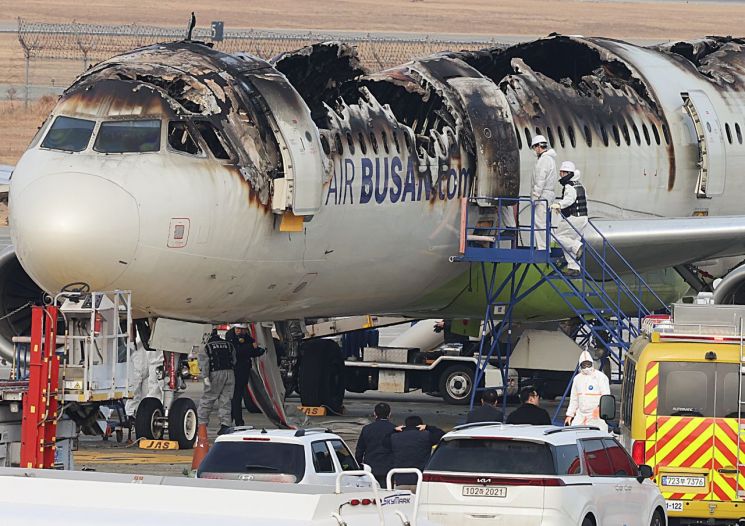 On the morning of the 31st at Busan Gimhae International Airport, the joint investigation team, including the Ministry of Land, Infrastructure and Transport's Aviation and Railway Accident Investigation Board and the French Bureau of Enquiry and Analysis for Civil Aviation Safety (BEA), conducted a safety inspection ahead of the joint fire investigation on the Air Busan aircraft that caught fire on the 28th. Photo by Yonhap News
On the 28th, a fire broke out on an Air Busan aircraft carrying 176 passengers and crew at Gimhae Airport. The fire started inside the tail section of the aircraft, producing thick smoke and flames, and all passengers and crew escaped by opening the emergency exit door and using the emergency slide. There were no casualties.
The auxiliary battery is being pointed to as the cause of this fire. A passenger on the Air Busan flight said to Yonhap News, "There was a 'tadak tadak' sound from the overhead bin where carry-on luggage is stored, and shortly after, smoke appeared," adding, "I wonder if it was an auxiliary battery or an electronic device related to the 'tadak tadak' sound."
Currently, the International Air Transport Association (IATA) and others regulate that auxiliary batteries with a lithium content of 2g or less and a capacity of 100Wh or less can be carried by passengers in the cabin. However, batteries exceeding 100Wh but not exceeding 160Wh can only be brought onboard up to two units and are prohibited in checked baggage.
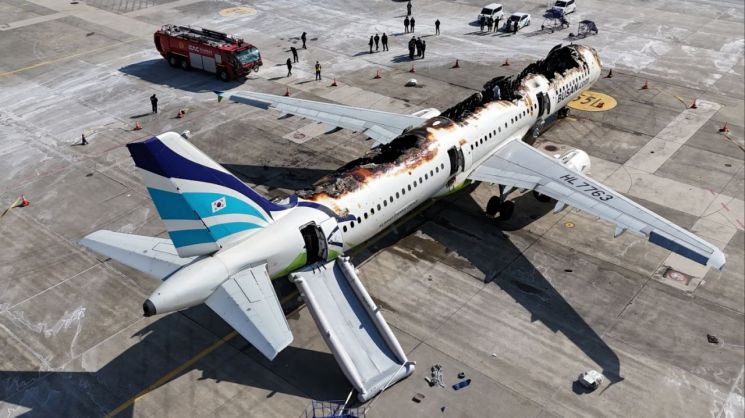 The Aviation and Railway Accident Investigation Board (ARAIB) under the Ministry of Land, Infrastructure and Transport announced on the 30th that it will set the schedule for on-site investigation after conducting a risk management assessment of the accident aircraft with the French Bureau d'Enqu?tes et d'Analyses (BEA). Yonhap News
Auxiliary batteries are vulnerable to external shocks; if the separator inside is damaged by impacts such as dropping, explosions or fires can occur. Overheating or defects in the battery itself can also cause auxiliary battery fires. The smoke that occurred inside the Air Busan BX142 flight moving for takeoff at Gimhae Airport last December was also reported to have originated from a passenger's portable phone auxiliary battery. At that time, the crew extinguished the smoke with a fire extinguisher, but the passenger carrying the auxiliary battery suffered burns on their hand.
Professor Jung emphasized that it is important to keep auxiliary batteries within reach inside the cabin. He explained that some auxiliary batteries cannot be loaded as cargo, saying, "This deeply implies that passengers must manage hazardous materials themselves." He added, "It is appropriate to keep lithium-ion or lithium metal batteries that supply power to auxiliary batteries or electronic devices on a visible table or under the seat."
© The Asia Business Daily(www.asiae.co.kr). All rights reserved.