Urgent Breaking News on Yoon Impeachment Approval
Bloomberg: "Korean Financial Market Will Find Stability"
Guardian Reporter: "Sigh of Relief"
"South Korea's financial market will regain stability" (Bloomberg) "A sigh of relief" (The Guardian, UK)
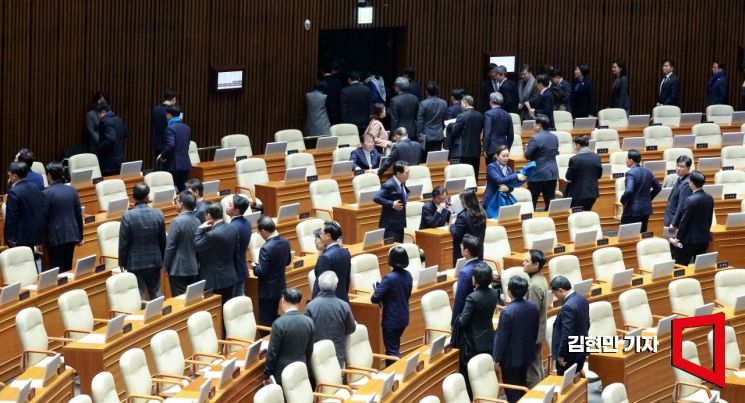 On the 14th, after the impeachment motion against the President (Yoon Seok-yeol) was passed at the 4th plenary session of the 419th National Assembly (extraordinary session) held at the National Assembly, opposition party members are leaving. Photo by Kim Hyun-min
When the National Assembly passed the impeachment motion against President Yoon Suk-yeol on the 14th, media outlets around the world quickly reported the news.
First, the AP and AFP news agencies reported that the National Assembly approved the impeachment motion against President Yoon with 204 votes in favor and 85 against. Earlier, these outlets provided real-time breaking news coverage of the entire process, from the People Power Party's stance of participating in the plenary vote but maintaining opposition to the motion, to the submission and voting of the impeachment motion in the plenary session.
CNN stated, "President Yoon's exercise of authority will be suspended until the Constitutional Court's final ruling." It added, "This is the second time in the past decade that a South Korean president has faced impeachment proceedings during their term (following former President Park Geun-hye)."
The New York Times (NYT) explained, "(With the passage of the impeachment motion) according to the Constitution of the Republic of Korea, Prime Minister Han Duck-soo has assumed presidential powers." The NYT also reported the reaction at a rally near the National Assembly in Yeouido, Seoul, where crowds cheered the passage of the impeachment motion.
Japanese and Chinese media also broke the news of the impeachment motion's passage against President Yoon. Japan's public broadcaster NHK reported, "The current impeachment motion does not include the phrase from the first motion accusing him of 'persisting in a Japan-centered bizarre foreign policy.'"
The Nihon Keizai Shimbun (Nikkei) assessed, "The political confusion in South Korea will continue, affecting diplomacy and security policies including South Korea-Japan relations and North Korea measures."
However, according to Kyodo News, Japanese Prime Minister Shigeru Ishiba, who met reporters before the vote on the second impeachment motion, said he was "watching with serious interest" regarding the vote but emphasized that the importance of South Korea-Japan relations remains unchanged.
Chinese state media such as Xinhua News Agency and others have been reporting on the impeachment situation in South Korea almost in real time, not only covering the passage of the impeachment motion but also the unusual political turmoil. On the same day, the largest Chinese portal Baidu ranked "Yoon Suk-yeol impeachment motion passed, immediate suspension of presidential duties" as the number one search term. A Korean National Assembly live viewing site in China attracted over 100,000 netizens.
Media outlets worldwide, including Europe, the Middle East, and Russia, also reported the impeachment news of President Yoon as a major headline on their homepages. Raphael Rashid, a reporter for The Guardian in the UK who has covered South Korea for 10 years, emphasized in a report posted on the homepage that day, "I breathed a sigh of relief when the impeachment vote results came out." He added, "If martial law had remained in place, journalism would have been the first victim."
Bloomberg News forecasted that the passage of the impeachment motion against President Yoon could restore stability to South Korea's financial market. According to a Goldman Sachs report cited by Bloomberg, after the impeachment of then-President Park Geun-hye in 2017, the KOSPI rose more than 20% over six months.
© The Asia Business Daily(www.asiae.co.kr). All rights reserved.