Real Estate R114
Seoul Apartment Sales Up 0.01%, Jeonse Up 0.01% 'Stable Slight Increase'
Sales Demand Weakened by Loan Regulations Shifts to Jeonse and Monthly Rent Market
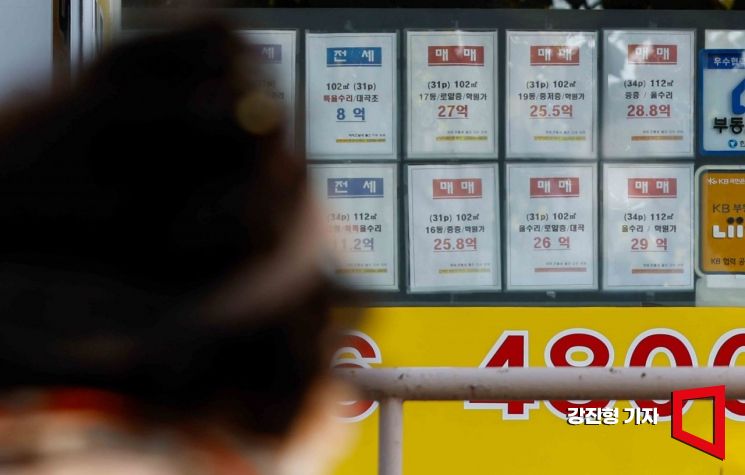 On the 24th, as apartment transactions shrink due to loan regulations and other factors, listings continue to accumulate. Sale and jeonse (long-term lease) flyers are posted at an apartment complex real estate in Gangnam-gu, Seoul. Photo by Kang Jin-hyung
Apartment sale prices in Seoul and the metropolitan area continue to show a slight upward trend. According to Real Estate R114 on the 16th, due to the government's comprehensive loan regulations, the volume of apartment sales transactions in Seoul during September and October dropped to about half of the levels seen in July and August, indicating a cooling market sentiment that is also reflected in price fluctuations.
However, since demand has not been naturally dispersed through new supply, the unmet demand is shifting to alternative rental markets such as jeonse (long-term lease) and monthly rent leases. Looking at rental-related data, while sales transactions have contracted, there are signs that the volume of jeonse transactions is increasing.
In particular, the monthly rent price index is breaking record highs every month. Examining the apartment monthly rent indices for Seoul from the country's three major price survey institutions, Real Estate R114 recorded 150.29 (October), KB Kookmin Bank 117.9 (October), and Korea Real Estate Board 103.56 (September). Although each institution uses different reference points and survey methods, all have reached all-time highs since their respective surveys began.
This week, Seoul apartment sale prices rose by 0.01%, slowing by 0.02 percentage points compared to the previous week. Reconstruction apartments increased by 0.02%, while general apartments rose by 0.01%. New towns and Gyeonggi/Incheon showed limited movement, remaining flat at 0.00%.
Among Seoul's 25 districts, most recorded no change (0.00%), while six districts?Seocho (0.03%), Gwangjin (0.03%), Seongdong (0.02%), Mapo (0.02%), Dongdaemun (0.02%), and Gangnam (0.01%)?saw increases. In Seocho-gu, Banpo Mido 1st Complex in Banpo-dong, which is undergoing reconstruction, rose by 30 million KRW, and in Gwangjin-gu, Gwangjang Hyundai Parkville in Gwangjang-dong increased by 10 million KRW.
New towns showed flat prices (0.00%) across both first and second phases. In Gyeonggi and Incheon, prices rose in Icheon (0.10%), Uijeongbu (0.03%), Hwaseong (0.02%), and Uiwang (0.01%).
Jeonse prices also showed limited movement at a firm level. Seoul rose by 0.01% compared to the previous week. New towns remained flat (0.00%), while Gyeonggi and Incheon increased by 0.01%.
A Real Estate R114 official explained, "Major banks are now evaluating individual borrowers' home ownership and registration status more strictly than before for jeonse deposit loans, leading to a reduction in liquidity."
Within Seoul, individual districts rose in the following order: Yeongdeungpo (0.04%), Mapo (0.04%), Dongdaemun (0.04%), Gangnam (0.03%), Seongdong (0.02%), and Guro (0.01%). In new towns, Sanbon fell by 0.01%, while other areas remained flat (0.00%). In Gyeonggi and Incheon, prices increased in Suwon (0.09%), Uijeongbu (0.05%), Hwaseong (0.01%), Namyangju (0.01%), Gwacheon (0.01%), and Incheon (0.01%). Conversely, Pyeongtaek fell by 0.04%.
The Real Estate R114 official also stated, "The contents related to the improvement of the 'reconstruction fast-track' safety inspection procedures announced in the government's January 10 measures passed the National Assembly plenary session on the 14th. Since the law will be enforced six months after its promulgation, from June 2025, apartments over 30 years old can begin reconstruction without passing the safety inspection process."
He added, "Safety inspection is the first gate in the reconstruction process, and if an apartment does not receive a grade of D or lower, reconstruction cannot proceed. However, going forward, the safety inspection (renamed 'reconstruction inspection' after the law's enforcement) only needs to be passed before the project implementation approval. After the law revision, the reconstruction project period, which previously took an average of 10 to 13 years, is expected to be shortened by 2 to 3 years."
He continued, "Since the shortening of the project period is directly related to total project costs and members' contributions, it is expected that the consent process for reconstruction projects of aging apartments will proceed more smoothly."
© The Asia Business Daily(www.asiae.co.kr). All rights reserved.