China-Australia Trade Volume Hits Record High Last Year
Reconciliation Mood with Tariff Removal After Australian Labor Party Takes Power
"Greed to Catch Two Rabbits" Also Criticized
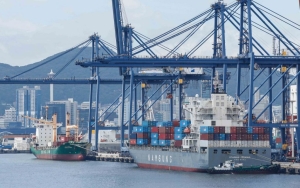
China and Australia, positioned at opposite ends of international security, have achieved a record-breaking trade volume. This is a result of a reconciliation mood fostered since the recent rise to power of the Australian Labor Party government. However, some critics argue that Australia's attempt to maintain close security ties with the United States while also promoting trade with China is an incompatible diplomatic strategy.
According to major foreign media on the 17th (local time), Australia's trade volume with China last year reached a record high of 145 billion dollars (approximately 163 trillion won). This is even higher than the level in 2019 (about 153 trillion won), before the COVID-19 pandemic and China's retaliatory tariffs against Australia. China also remained Australia's largest trading partner.
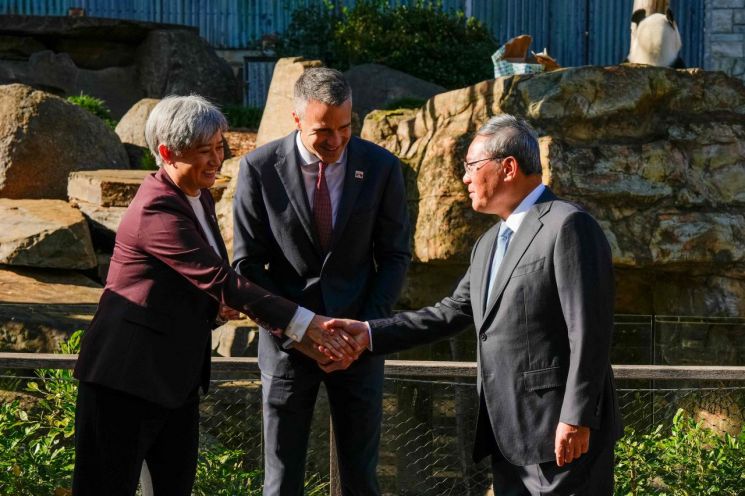 On the 16th (local time), Chinese Premier Li Chang (right) visited Australia.
 [Photo by Yonhap News]
In particular, the rise in prices of iron ore, Australia's largest export product, along with the rebound in travel and tourism services that had been sluggish due to the COVID-19 pandemic, drove the recovery of trade volume. Hans Hendrischke, a professor of Chinese Business at the University of Sydney, evaluated, "Despite all the noise, the economic relationship (between the two countries) is growing very strongly."
The normalization of trade relations between China and Australia is a relatively recent development. As late as 2018, Australia excluded Chinese telecommunications company Huawei from participating in its 5G network projects, and in 2020, it provoked China by demanding an international investigation into the origins of COVID-19. In response, China imposed retaliatory tariffs on about ten Australian products including wine, beef, barley, and coal, causing Australia losses amounting to 20 billion Australian dollars (approximately 18 trillion won).
However, with the Australian Labor Party government taking office in 2022, the frozen relations between the two countries began to thaw. After Australian Prime Minister Anthony Albanese visited China last year, the retaliatory tariffs on Australian wine, a symbol of the trade conflict, were lifted. Currently, Chinese Premier Li Qiang is visiting Australia for the first time in seven years, undertaking a four-day schedule. Premier Li reportedly emphasized that the two countries can achieve mutual success through cooperation spanning the Pacific, transcending their differences.
Nevertheless, there are also concerned voices about the economic closeness between the two countries. Australia, a member of the AUKUS and QUAD security alliances, is criticized for pursuing trade growth with China while pressuring China as a U.S. security ally, which is seen as a contradictory move. In particular, with tariff barriers between the two countries removed, Australian iron ore and lithium?key components for electric vehicle batteries?are flowing cheaply into China, which analysts say contradicts the recent European Union (EU) imposition of heavy tariffs on Chinese electric vehicles.
A former Australian government advisor stated, "Australia wants comprehensive military deterrence against China while desperately seeking access to the Chinese market to sell its iron ore and wine," adding, "This 'cakeism' approach will continue to face difficulties." Cakeism refers to trying to have mutually exclusive choices simultaneously. It is derived from a British proverb meaning one cannot have their cake and eat it too.
© The Asia Business Daily(www.asiae.co.kr). All rights reserved.