Controversy Over Openly Demanding Money and Gifts from Patients
Professor A Admits Violation of Kim Young-ran Act... Legal Dispute with Mr. B's Side
A professor at a prestigious university medical school has been revealed to have demanded gifts from patients and received large sums of money. It is currently known that investigations are being conducted by the Ministry of Health and Welfare and the Anti-Corruption and Civil Rights Commission.
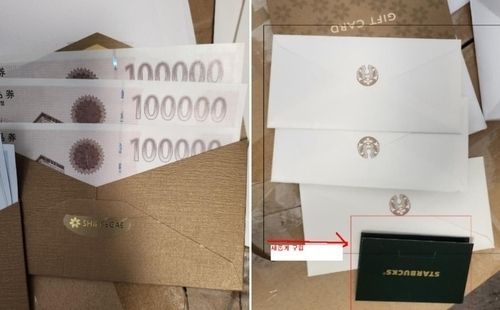 A professor at a prestigious medical school in Korea is reported to have received expensive gift certificates and premium Korean beef gift sets from patients dozens of times over several years. The photo shows a portion of the gift certificates received by the professor.
 [Photo by Yonhap News]
Yonhap News reported on the 11th that “Professor A received large amounts of gift certificates and presents from patient B, who underwent surgery for bile duct cancer in November 2020, and B’s guardian C, through frequent contact.” Professor A is said to be employed at one of the top-ranked prestigious university medical schools in Korea.
According to the report, Professor A gave patients his personal mobile phone number, telling them to contact him whenever they needed anything. Later, as B’s health deteriorated, the relationship between the two parties severely worsened. During this process, B exposed Professor A’s misconduct.
B is a woman in her 60s who, after surgery, contracted pancreatitis in November 2022, about two years later, and was diagnosed with ampullary cancer, a type of bile duct cancer, in July last year. The cancer had recurred. As the pain worsened due to the combination of pancreatitis and cancer, B called Professor A to seek help. Feeling that Professor A was unfriendly and insincere in his response, B became disappointed and angry.
On the other hand, Professor A was reportedly busy with many surgeries and medical appointments and had not found an appropriate treatment method.
B’s younger sister, C, reported Professor A to the Ministry of Health and Welfare and the Anti-Corruption and Civil Rights Commission for violations of the Improper Solicitation and Graft Act (Kim Young-ran Act) and the Medical Service Act. Subsequently, Professor A sent a letter to C admitting to violating the Kim Young-ran Act and apologizing, which led to all reports being withdrawn.
The relationship between them seemed to improve as Professor A received large amounts of gift certificates and meals from B again. However, as B’s health deteriorated, the two parties faced another breakdown. Ultimately, B’s younger sister C filed additional reports with the Anti-Corruption and Civil Rights Commission and the hospital in March, compiling more evidence of Professor A’s misconduct. Professor A then accused B and others of stalking him, leading to a legal dispute.
Received Over 7 Million Won in Gift Certificates and Korean Beef
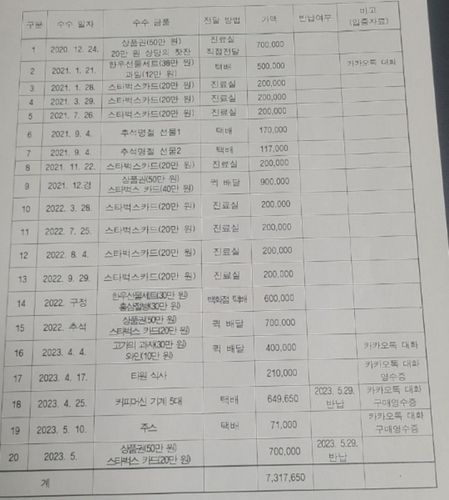 Details of Professor A's violation of the Improper Solicitation and Graft Act (Kim Young-ran Act) reported to the Anti-Corruption and Civil Rights Commission.
 [Photo by Yonhap News]
According to call recordings, KakaoTalk conversations, and gift lists reported by C to the Anti-Corruption and Civil Rights Commission and the hospital, Professor A received a total of approximately 7.3 million won worth of money and gifts over 20 occasions, including a 500,000 won gift certificate and tea cups worth 200,000 won on December 24, 2020, in the consultation room.
On January 21, 2021, a Korean beef gift set (380,000 won) and fruit (120,000 won) were delivered to his home in Gangnam, Seoul. In January, March, and July of the same year, he received Starbucks card gift certificates worth about 200,000 won each in the consultation room. In December of the same year, he received department store gift certificates (500,000 won) and Starbucks cards (400,000 won) by courier at his residence.
During holidays such as Lunar New Year and Chuseok, he received gifts worth 600,000 to 700,000 won, including Korean beef, red ginseng, and gift certificates. Professor A also reportedly invited B and others to dinner, dining on course meals costing 70,000 won per person at a high-end Chinese restaurant near the university.
In April last year, Professor A requested five coffee machines to be sent to the school. B immediately sent coffee machines worth about 650,000 won by courier. However, as their relationship worsened, B demanded the return of the coffee machines, which were returned. Professor A also returned department store gift certificates (500,000 won) and Starbucks gift cards (200,000 won) received in May last year at B’s request.
When the relationship with B’s side soured and he was investigated for violating the Kim Young-ran Act, Professor A reportedly sent an apology email to C. In the email, he wrote, “I apologize for causing unnecessary misunderstandings and discomfort to patients and guardians. Under the Kim Young-ran Act, I should not have accepted any gifts.”
He continued, “However, I thought it was better to gratefully accept the heartfelt gifts given within an appropriate range as the attending physician responsible for the patient’s recovery and management, rather than firmly rejecting the sincere gratitude shown by patients and guardians, as it would make their hearts more comfortable,” thus admitting to violating the Kim Young-ran Act.
Sent Apology Email to Patient’s Side
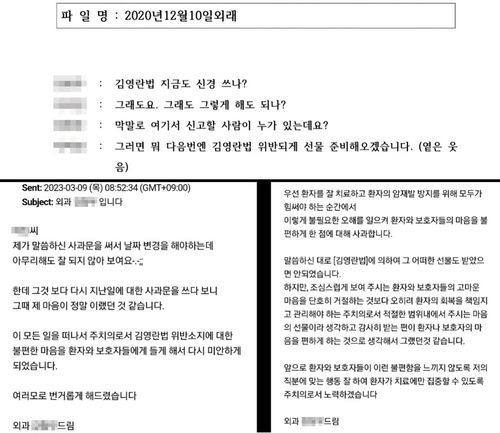 Professor A's apology email written after an internal hospital audit revealed bribery following a patient's report.
 [Photo by Yonhap News]
In an explanation sent to Yonhap News, Professor A admitted to violating the Kim Young-ran Act, stating, “I received holiday gifts and other presents as a token of gratitude for medical care from a person presumed to be the informants (B and C), but returned some gifts at their request.”
However, he claimed, “I did not have inappropriate contact with the person presumed to be the informants (B and C). Most of my responses were as a doctor to their requests. I never provided unfair medical favors.”
He added, “Due to continuous and excessive contact from unidentified acquaintances claiming to be related to the informants, including the person presumed to be the informants, and repeated complaints and certified mail deliveries from the person presumed to be the informants, I found it difficult to endure and filed a criminal complaint with the help of my lawyer.”
However, he said he would make a judgment after seeing the results of the lawsuit between Professor A and B’s side.
Meanwhile, B’s stalking allegations were dismissed by the police, but Professor A appealed, and the trial is ongoing.
B points out that there is ample clear evidence against Professor A, and delaying his disciplinary action is a case of “protecting one’s own.” The Anti-Corruption and Civil Rights Commission also received the case in March and is investigating.
© The Asia Business Daily(www.asiae.co.kr). All rights reserved.