Prediction Survey by Three Major Terrestrial Broadcasters Fails to Forecast Seat Numbers
JTBC's Prediction Falls Within Actual Seat Number Range
The general election once again confirmed the old saying that it is the "graveyard of exit polls." The exit polls conducted by the three major terrestrial broadcasters, which invested 7 billion won, accurately predicted the overall election results but failed to forecast the number of seats. In contrast, JTBC, which conducted a "predictive survey" through opinion polls and meta-surveys, successfully predicted the election results this time, attracting attention.
According to the National Election Commission on the 12th, in this general election, the People Power Party and the proportional representation party Kukmin Mirae secured a total of 108 seats, while the Democratic Party and the proportional representation party Democratic Union secured a total of 175 seats. This differed from the exit poll estimates by the three broadcasters. The combined predictions of the three terrestrial broadcasters estimated that People Power Party and Kukmin Mirae would win 85 to 105 seats, and the Democratic Party and Democratic Union would win 178 to 197 seats. There was a significant difference in seat forecasts.
What drew attention was that JTBC, a comprehensive programming channel, conducted a "predictive survey" separately from the exit polls, which turned out to be more accurate. JTBC predicted right after the three terrestrial broadcasters announced their exit poll forecasts that People Power Party and Kukmin Mirae would win 87 to 111 seats, and the Democratic Party and Democratic Union would win 158 to 193 seats, and the actual election results fell within this predicted range.
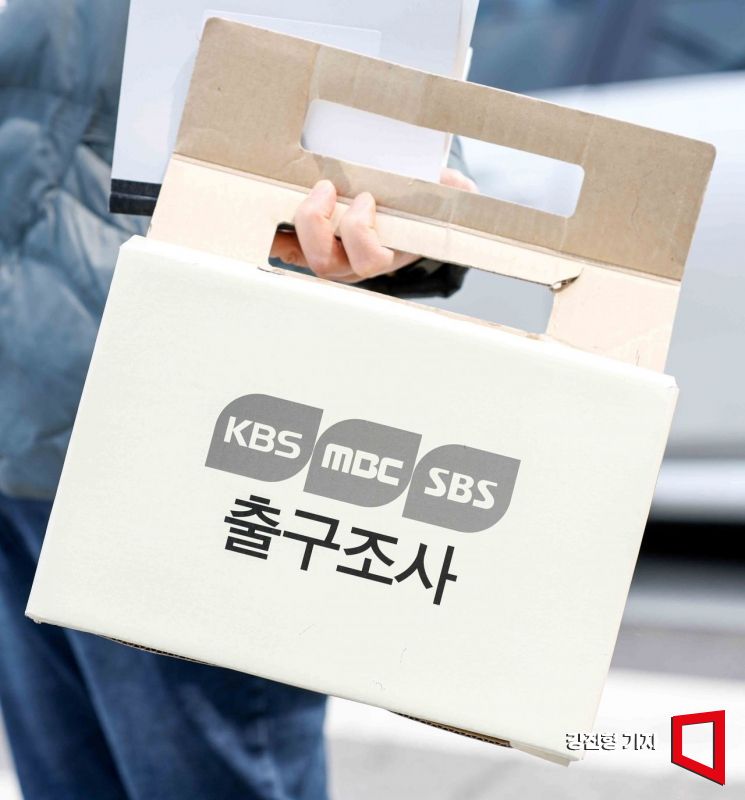 On the 10th, the day of the 22nd National Assembly election, exit poll workers from a broadcasting company are conducting exit polls on voters who have finished voting at a polling station in Seoul. Photo by Kang Jin-hyung aymsdream@
Park Geon-young, CEO of MetaVoice, which was responsible for JTBC's predictive survey, explained, "We reflected the published opinion polls after synthesizing four trends from recent election results such as the 2020 general election and the 2022 presidential election, and conducted additional opinion polls in areas that were still difficult to understand." He added, "While exit polls refer to past data, MetaVoice conducted meta-analysis this time." Park said, "This election especially had forecasts that the opposition would do well, so conservative voters might have been reluctant to respond, and exit polls may not have adequately adjusted for this." Additionally, MetaVoice conducted separate opinion polls in 30 areas where it was difficult to predict the outcome to grasp the situation.
However, the predictive survey also faced difficulties in the Busan, Ulsan, and Gyeongnam (PK region) voter sentiment, where the largest discrepancies were seen in this exit poll. A MetaVoice official stated, "The fact that the Democratic Party won fewer PK seats in the actual count was not predicted," and evaluated, "The ruling party's last-minute plea to block the constitutional amendment line seems to have influenced conservative voters."
© The Asia Business Daily(www.asiae.co.kr). All rights reserved.