High Prices Are the Main Cause
Imported Fruit Bananas Are Also the Most Expensive in the World
A survey revealed that the per capita fruit consumption of Koreans has sharply declined by nearly 20% over the past 15 years.
According to the Ministry of Agriculture, Food and Rural Affairs' '2023 Major Agricultural Statistics' and the Korea Rural Economic Institute's 'Agricultural Outlook 2024 Report' released on the 10th, the annual per capita fruit consumption peaked at 67.9 kg in 2007 and then gradually decreased. It entered the 50 kg range from 2018 and dropped to 55.0 kg in 2022, a 19% decrease compared to 2007.
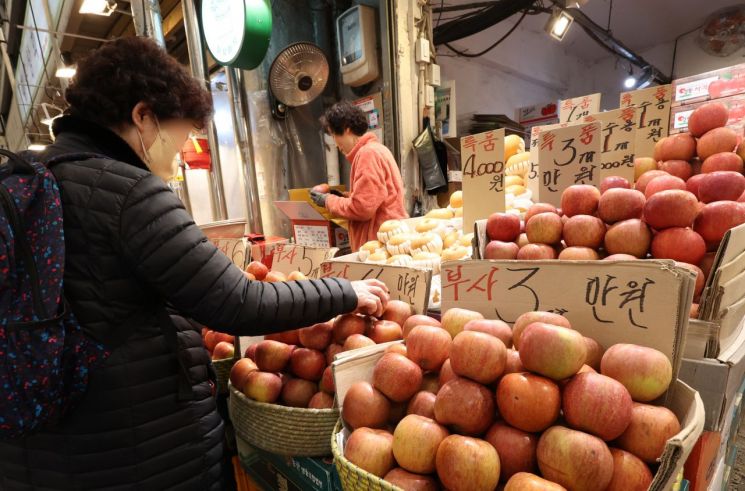
In particular, the decline in the six major fruits, including apples, was noticeable due to reduced production. The annual per capita consumption fell from 41.4 kg in 2014 to 36.4 kg in 2022.
The population consuming the recommended daily amount of 500 g of fruits and vegetables was only about 2 out of 10 people. The proportion of people aged six and above consuming 500 g or more of fruits and vegetables daily dropped by approximately 16 percentage points, from 38.6% in 2015 to 22.7% in 2022.
High prices were cited as the biggest cause. Fruits in South Korea are among the most expensive worldwide. According to the global research firm Numbeo, the price of apples sold domestically (6.81 USD/kg) ranks first in the world. Imported fruits like bananas (3.45 USD/kg) are also sold at the highest prices in South Korea.
According to the consumer price trend for February announced by Statistics Korea on the 6th, the fresh food index rose 20.0%, influenced by a 41.2% increase in fresh fruit prices compared to the previous month. This was the largest increase in fresh fruit prices in 32 years and 5 months since a 43.9% rise in September 1991.
The dominant outlook is that price increases will continue, which is even more problematic. It is forecasted that apple orchards covering the area of 4,000 soccer fields will disappear by 2033, causing prices to keep rising. According to the Korea Rural Economic Institute's Agricultural Outlook 2024 Report, the apple cultivation area this year is expected to decrease by about 1% annually from 33,800 hectares this year to 30,900 hectares in 2033. This means that over nine years until 2033, the apple cultivation area will shrink by 2,900 hectares (8.6%), equivalent to the area of 4,000 soccer fields (0.714 hectares each).
Although the government expects the prices of agricultural and livestock products to gradually improve after March, it forecasts that apple and pear prices will remain strong until the new fruit harvest due to insufficient storage. Park Su-jin, Director of the Food Policy Office at the Ministry of Agriculture, Food and Rural Affairs, said, "To stabilize grocery prices as soon as possible, we will focus all available policy measures on expanding supply through support for producer delivery prices, consumer discounts, and tariff quotas centered on fruits and vegetables until alternative fruits such as chamoe are fully harvested."
© The Asia Business Daily(www.asiae.co.kr). All rights reserved.