Supreme Court Sentencing Commission to Review Sentencing Guidelines Today at 3 PM
Business Community Focused, Legal Sector Expects "Sentencing Guidelines to Rise"
Calls for Corporate 'Carrots' Also Raised
On the 8th, the business community's attention is expected to focus on the Supreme Court. The Supreme Court Sentencing Commission will hold its first regular meeting of the year at 3 p.m. in the Supreme Court conference room to deliberate on whether to raise the sentencing guidelines for technology leakage crimes. Thirteen members, including Chairman Lee Sang-won, will attend the meeting to exchange opinions. The results of the deliberation will be announced the following day.
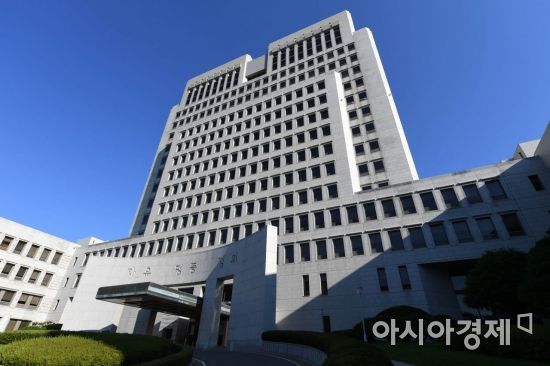
The legal community highly anticipates that the commission will raise the sentencing guidelines for technology leakage crimes through this meeting. This is because the business community has recently strongly emphasized the seriousness of technology leakage crimes, and there is a growing social consensus that the level of punishment should be increased. Courts across the country have also been unhesitant in imposing prison sentences on defendants standing trial for technology leakage charges.
Former Minister of Trade, Industry and Energy Bang Moon-kyu emphasized at the end of last year that "strict punishment for leakers is important to protect industrial technology." Our Industrial Technology Protection Act stipulates that in cases of overseas technology leakage, the maximum penalty is imprisonment for up to 15 years or a fine of up to 1.5 billion won, and for national core technologies, imprisonment of at least 3 years or a fine of up to 1.5 billion won. However, the sentencing guidelines set by the Supreme Court have been criticized as grossly insufficient, ranging from 1 year to 3 years and 6 months imprisonment, compared to the statutory maximum sentence.
Technology Leakage Continues to Flourish and Diversify
Due to ongoing technology leakage crimes in the new year, the business community faces significant threats. On the 3rd, it was confirmed that the design drawings of the submarine "DSME1400," developed by Daewoo Shipbuilding & Marine Engineering (now Hanwha Ocean), were leaked to Taiwan, prompting the Gyeongnam Provincial Police Agency's Industrial Technology Security Investigation Unit to launch an investigation. Two individuals, including Mr. A, were found to have stolen the drawings while working at Daewoo Shipbuilding & Marine Engineering and, after moving to a submarine development consulting company, transferred the drawings to Taiwan. The drawings were used by the Taiwanese government to develop its first indigenous submarine, "Hai Kun." On the same day, former Samsung Electronics manager Mr. Kim and former manager Mr. Bang from a partner company were indicted and detained on charges of unauthorized leakage of Samsung Electronics' core technology to the Chinese company Changxin Memory Technologies (CXMT). They reportedly received hundreds of millions of won in bribes and provided information on Samsung Electronics' 18nm DRAM semiconductor process to the Chinese company.
The legal community is particularly concerned that technology leakage has recently become more sophisticated and diversified in its methods. Besides transmission by technicians, the media used for leakage have diversified, and the compensation received has expanded to include cryptocurrencies. Various statistics also reflect the seriousness of the situation. According to the "Status of Overseas Leakage of National Core Technologies" data submitted by the National Intelligence Service to Ahn Cheol-soo, a member of the People Power Party, in August last year, 128 cases of industrial technology were leaked overseas from 2017 to June 2023, of which 30.4% were core technologies. This means that about 21 technologies are leaking overseas annually.
A business community official pointed out, "Technology leakage crimes have significant damage and ripple effects, and depending on the circumstances of companies, it is a matter of life and death that can put their survival at stake."
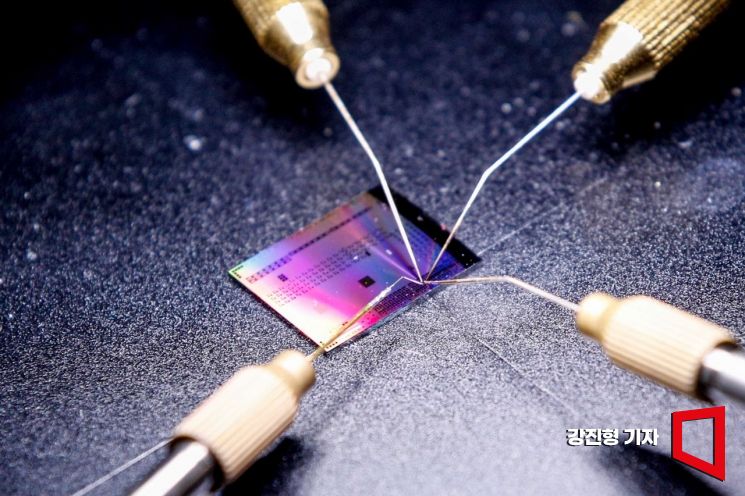 Semiconductor technology, which has become a major target for technology leakage. Photo by Jinhyung Kang aymsdream@
"Carrots as well as Sticks Are Needed"
Yeon Won-ho, head of the Economic Security Team at the Korea Institute for International Economic Policy (KIEP), argued that "carrots as well as sticks are needed to prevent technology leakage." While it is certainly necessary to strengthen punishments as sticks, equally important are inducements. Yeon said, "I don't think technology leakage has occurred simply because there were no punishment regulations," adding, "Companies should also consider ways to improve treatment and compensation for technicians."
In particular, there are many voices in the business community calling for better treatment of senior technicians approaching retirement age. These individuals often have the highest proficiency in key technologies within companies but face shrinking positions due to wage peak systems and mandatory retirement pressures, making them vulnerable to the temptation of leakage.
Some suggest paying close attention to Samsung Group's "Samsung Master Craftsman" system, implemented since 2019. The Samsung Master Craftsman system selects the company's top technical experts and guarantees incentives, master allowances, and post-retirement employment. Most selected are senior technicians in their late 50s. From 2019 to 2024, 54 individuals have been selected. A Samsung official said about the Samsung Master Craftsman system, "It is a system that values both technology and people, and it can be said to have aspects that help prevent technology leakage."
© The Asia Business Daily(www.asiae.co.kr). All rights reserved.