"Over 20% Shortage of Production Workforce by 2040"
Japanese Business Circles Point Out "Immigration Barriers Must Be Lowered Further"
The Japanese government has adopted the slogan "A country chosen by foreign talent" as its immigration policy motto for this year. This expresses its determination to completely transform from a closed, ethnically homogeneous society?infamous worldwide?into a country where foreign workers voluntarily choose to immigrate. It is the first time since the opening of its ports in 1854 that the government itself has decided to fully open its doors to foreign immigration.
The reason behind this historic decision by the Japanese government lies in its desperate attempt to mitigate the declining working-age population through immigration policy, as measures addressing low birth rates alone are insufficient. In Japan, where the trend of low birth rates and aging population has continued for over 30 years, bleak forecasts predict that within the next 20 years, the workforce for manufacturing, office jobs, and even basic infrastructure maintenance will all decrease by more than 20%.
As a result, Japan’s business community is strongly urging the government to open immigration policies more quickly. In fact, voices are also emerging in South Korea?where the low birth rate problem is even more severe than in Japan?calling for reference to Japan’s policy examples and for swift action.
Severe Labor Shortage...Nation Could Paralyze Without Foreigners
According to a recent population dynamics survey released by Japan’s Ministry of Internal Affairs and Communications, as of January 1 this year, Japan’s population decreased by more than 800,000 compared to the previous year. The ministry predicted that if this trend continues, 8 million people?the equivalent of Osaka’s current population?will disappear within the next 10 years.
There are also predictions that by 2040, all manufacturing, office work, and infrastructure in Japan could come to a halt. According to the research organization Recruit, by 2040, when the current secondary baby boomer generation known as the "Dankai Junior" reaches 65 years or older, labor shortages will appear across all sectors, with a shortage of more than 11 million workers.
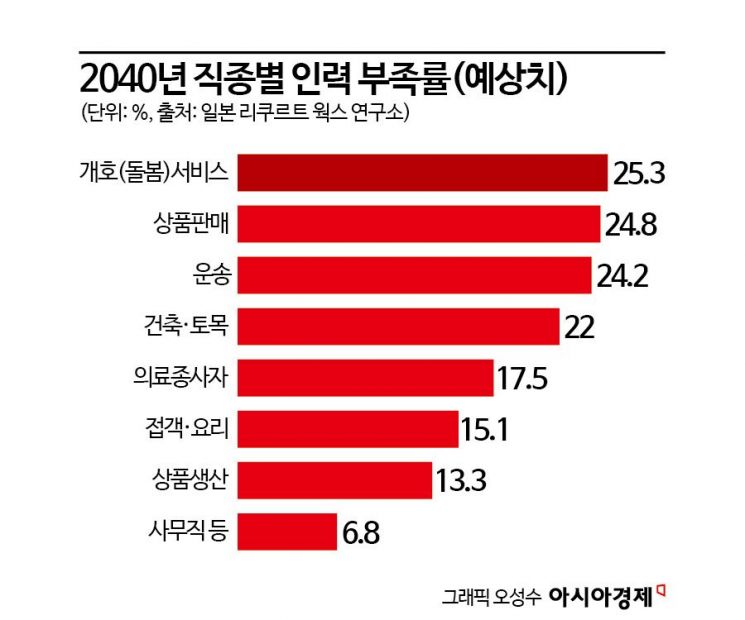
The survey forecasts that by 2040, labor shortages will reach 25.3% in caregiving services such as nursing care workers, 24.8% in retail sales, 24.2% in transportation, 22% in construction and civil engineering, and 17.5% in medical professions. NHK expressed concerns, stating, "A shortage of transportation workers could disrupt logistics and deliveries, and a lack of construction workers could delay recovery efforts in the event of disasters such as earthquakes," adding, "People might not be able to receive medical examinations because there are no doctors available." In other words, the nation could literally come to a complete standstill.
Nevertheless, Japan’s birth rate last year was 1.26, the lowest since statistics began. With less than 20 years until 2040, the Japanese government judged that focusing solely on low birth rate measures would be insufficient to respond to the impending national paralysis. They concluded that immigration policy must be opened immediately and cultural changes must be pursued simultaneously. Following these policies to expand foreign labor supply, the number of foreign workers in Japan has continued to increase, reaching 1.66 million as of October 2019 and about 1.72 million in October 2020, despite entry restrictions due to COVID-19.
Foreign Worker System Established Since the 1990s...Rapidly Changing Japanese Immigration Policy
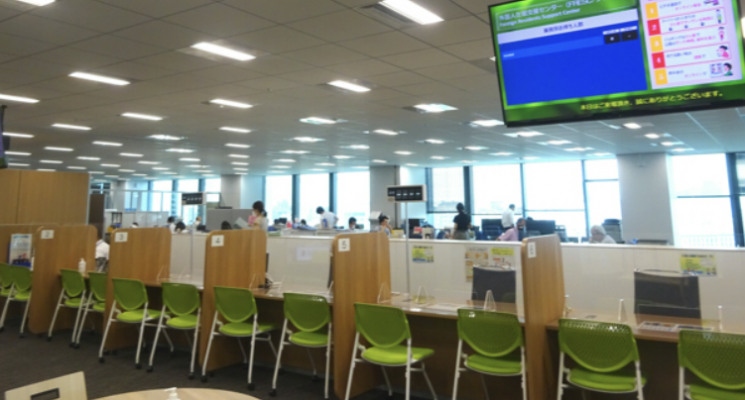 The Foreign Resident Support Center (FRESC). It provides anonymous free consultations to protect the privacy of foreign workers. (Photo by FRESC)
Japan began increasing foreign workers as early as 1993, when its working-age population started to decline, by establishing the "Technical Intern Training Program." This system allows workers from developing countries to receive a certain level of technical training and employment in Japan. As of the end of last year, there were 325,000 foreign technical interns in Japan, accounting for 20% of all foreign workers.
However, this program has faced ongoing human rights controversies due to poor working conditions, low wages, wage arrears, and the condition that interns cannot change jobs. In response, last month, a government expert panel proposed abolishing this system and introducing a new "Development Employment System."
Efforts to become a country chosen by foreigners continue. A dedicated immigration management agency has even been established. In 2019, Japan created the Immigration Services Agency under the Ministry of Justice. This was established following the passage of amendments to the Immigration Control and Refugee Recognition Act and the Ministry of Justice Establishment Act in the Japanese Diet in 2018. It is equivalent to an immigration agency, a concept currently under discussion in South Korea.
This agency handles not only the screening of foreign workers’ entry, exit, and residency status but also various support measures and responses to illegal residents, covering most tasks related to foreign workers. Notably, it has established various departments for support. Within the agency, the "Residency Support Division" was created to provide assistance to foreigners residing in Japan. In July 2020, the Foreign Residents Support Center (FRESC) was established in Tokyo as the command center overseeing these efforts. FRESC offers free consultations and legal support for foreign workers. Additionally, it provides consultations for companies and local governments wishing to employ foreigners, connecting businesses and workers.
This has drawn attention in conjunction with the "Specified Skilled Worker Program" newly established in 2019. The program is divided into Type 1 and Type 2: Type 1 allows work for up to five years, while Type 2 has no residency period limit for foreigners with skilled abilities. Type 2 also permits family accompaniment and offers the possibility to apply for permanent residency after more than 10 years of residence. In July, the scope of Type 2, previously limited to construction and shipbuilding, was significantly expanded to 11 fields. This is a groundbreaking policy linked with a supporting agency operating in tandem.
Japanese Business Community: "Still Insufficient...From Acceptance to Attraction"
However, Japan’s business community is urging the government to accelerate policy improvements and provide full support. On the day the government announced the expansion of fields under the Specified Skilled Worker Program Type 2, the Japan Chamber of Commerce and Industry and the Japan Business Federation (Keidanren) welcomed the move but also pointed out, "To sustain continuous growth, acquiring excellent foreign talent is inevitable," and emphasized, "It is important to quickly create a society where people can continue working."
Keidanren published a "2030 Vision Report" last year, stressing that Japan should transform its strategy from simply "accepting" foreigners who come to work to strategically "attracting" the talent the country needs. They argued that support should not focus solely on immigration and residency status but should be based on policies reflecting the general life cycle of living, learning, working, forming families, and retiring in Japan.
The report included somewhat radical proposals, such as the government providing subsidized educational devices to help children of foreign workers adapt smoothly to Japanese schools, reducing insurance premium burdens, and significantly lowering and reconsidering permanent residency requirements.
It also added, "Now is the time to advance toward securing highly skilled talent. The government should increase incentives and support to attract IT professionals, research talent, financial institutions, and venture capital."
© The Asia Business Daily(www.asiae.co.kr). All rights reserved.