The vicious cycle of fraudsters committing crimes again even after being punished continues, increasing the suffering of victims. They exploit the fact that sentences are light and the recovery of criminal proceeds is not properly enforced, committing fraud again after punishment and causing new victims.
 Jeon Cheong-jo, who has been decided to be sent to the prosecution on charges including fraud, appeared at the Songpa Police Station in Seoul on the morning of the 10th and is being escorted to the Eastern District Prosecutors' Office while answering questions from the press.
 [Image source=Yonhap News]
According to the National Police Agency on the 22nd, among the 169,528 fraud offenders booked by the police last year, 71,030 (41.9%) were repeat offenders. Notably, those with nine or more prior convictions numbered 27,077, exceeding the number of first-time offenders (26,698). Repeat offenders are divided into 'same-type offenders' (those with prior convictions for the same crime) and 'different-type offenders' (those with prior convictions for different crimes). Among fraud offenders, 33,063 were identified as same-type offenders with previous fraud convictions.
Fraudsters continue their fraudulent activities even after punishment. A representative case is Jeon Cheong-jo. Jeon Cheong-jo is known as a 10-time repeat offender who previously engaged in marriage fraud. He deceived former national fencing athlete Nam Hyun-hee by claiming to be from a wealthy family and was also sued by another man for marriage fraud. Additionally, in March last year, he defrauded acquaintances by claiming he was terminally ill and needed hospital fees, continuing his fraudulent acts. Jeon Cheong-jo was detained and sent to the Seoul Eastern District Prosecutors' Office on the 10th on charges of fraud under the Act on the Aggravated Punishment of Specific Economic Crimes. Earlier, in 2021, a man in his 60s, Mr. A, who ate at a restaurant in Dongdaemun-gu, Seoul, without paying, was prosecuted for habitual fraud and sentenced to 10 months in prison. Mr. A committed the crime immediately after serving six months for the same habitual fraud charge and was found to have 48 prior convictions for similar offenses.
Fraud crimes disrupt ordinary daily life. Ms. Yoo (70, female) learned about a self-proclaimed 'high-yield investment company' through an acquaintance early last year. The company promised a 10% profit in three months by investing in land or gold. After losing her husband and worrying about her retirement, Ms. Yoo invested 70 million won in the company. As the promised dividends came in well, she increased her investment to 500 million won. However, from September last year, dividends stopped, and she could not even recover the principal. In October last year, Ms. Yoo filed a complaint with the Gangnam Police Station in Seoul against the operators of the investment company, but the investigation is still ongoing. Ms. Yoo heard from an acquaintance who was also defrauded that these individuals committed the same crime during their probation period for fraud. She said, "It's my fault for trusting them, but I am angry at the social reality where fraud offenders repeat the same scams and are left unchecked."
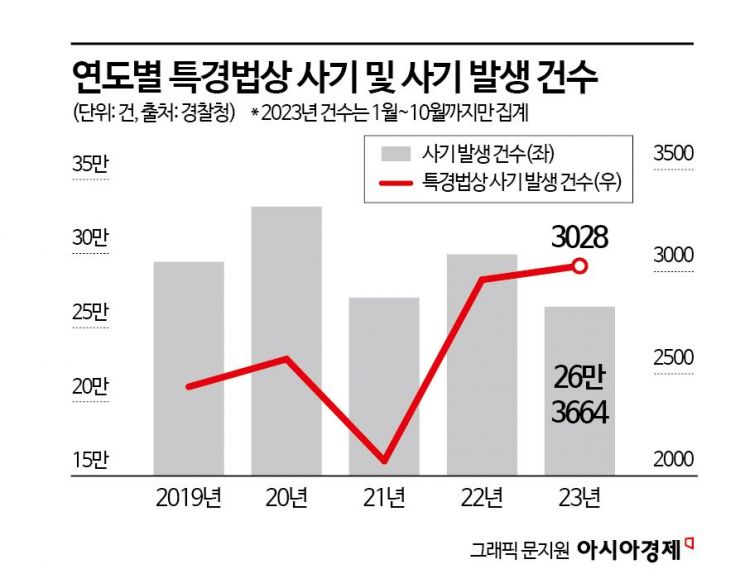
The biggest reason fraudsters continue their crimes is the leniency of punishments. According to the Judicial Yearbook by the Court Administration Office, among 40,796 first-instance sentences for fraud and extortion last year, 30% received suspended sentences (9,405) or fines (3,040). About 25,000 were sentenced to imprisonment, but the sentences are generally considered light. According to the Supreme Court sentencing guidelines, if the fraud damage is less than 100 million won, the sentence ranges from six months to one year and six months in prison. Even if the damage exceeds 30 billion won and aggravating factors such as intentional concealment of criminal proceeds or deceiving the court during trial are present, the maximum sentence under the guidelines is 13 years in prison.
The inadequate recovery of criminal proceeds also motivates fraudsters to commit fraud again. They do not compensate victims, citing reasons such as asset depletion. According to the National Police Agency, from 2017 to June 2021, the total amount of fraud damage was about 121 trillion won. However, the recovered amount was only 6.5 trillion won, about 5.3%. To restore fraud damage, a confirmed judgment in a criminal trial must be followed by a civil trial, which takes time. Meanwhile, fraudsters often squander or hide assets on entertainment expenses, making actual damage recovery difficult.
Experts emphasize the need for measures to deter criminal intent, such as strengthening punishments and imposing heavy compensation responsibilities on fraud offenders. Professor Lee Geon-su of Baekseok University's Department of Police Science said, "Because sentences are light, fraudsters are not afraid of going to trial. Economic hardships caused by fraud can threaten victims' lives, so measures such as increasing sentences must be prepared to eradicate fraud crimes." Professor Lee Woong-hyuk of Konkuk University's Department of Police Science said, "Unlike overseas countries that order astronomical compensation, fraud offenders in Korea have no burden and continue their fraudulent activities. Since fraud is a planned crime, sentences should be increased, and measures such as promptly ordering astronomical compensation should be devised to fundamentally block criminal intent."
© The Asia Business Daily(www.asiae.co.kr). All rights reserved.