66,000 Households, Over 166,000 Residents
Expansion and Early Supply of Public Housing Units
The construction of the Namyangju Wangsuk New Town has officially begun. This area will become the nation’s first ‘hydrogen city’ using hydrogen as an energy source and a ‘compact city’ with self-sufficient functions. Covering a total area of 11.77 million square meters, Namyangju Wangsuk New Town is the largest among the 3rd phase new towns, expected to house approximately 66,000 households and around 166,000 residents.
Currently, land and structure compensation is in the final stages, so site development is expected to proceed smoothly. Korea Land and Housing Corporation (LH) plans to actively implement the project by timely installing various infrastructure such as metropolitan transportation facilities by the second half of 2026, when pre-sale move-ins begin, ensuring residents experience no inconvenience.
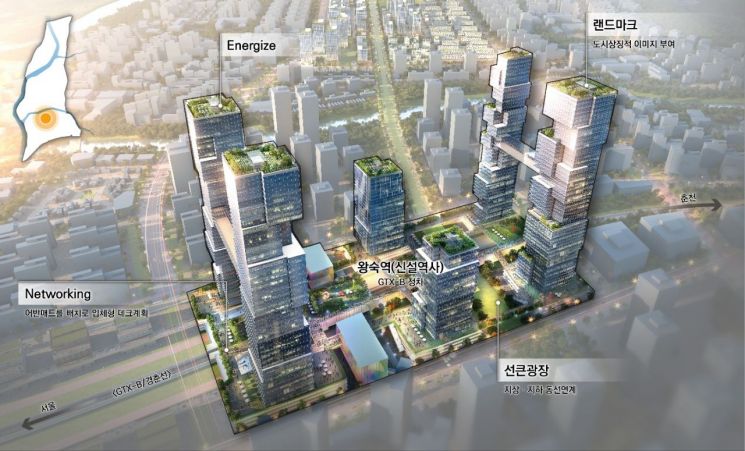
Wangsuk District Developed as a ‘Compact City’ Based on Ultra-Station Area
The Ministry of Land, Infrastructure and Transport and LH announced that the groundbreaking ceremony for Namyangju Wangsuk New Town was held on the 15th. The event was attended by key officials from the Ministry of Land, Gyeonggi Province, Namyangju City, the project implementers LH and Gyeonggi Housing and Urban Corporation (GH), as well as local residents.
The Namyangju Wangsuk Public Housing District will be developed as a compact city with self-sufficient functions. A compact city is a condensed urban area developed with high-density, mixed-use spaces centered around a railway station. From the site selection stage, a metropolitan transportation plan is established to strengthen connectivity with the surrounding urban areas, creating a residential environment linked to transportation networks within a 1 km radius from the railway station, forming a radial city layout. Unlike conventional urban development methods where transportation measures are devised after site selection, this approach proactively resolves transportation issues, minimizing inconvenience after move-in.
Additionally, Namyangju Wangsuk Compact City will implement various functions such as advanced residential, office, and cultural facilities on high-rise buildings centered around Wangsuk Station. It will be a self-sufficient city where residents can live, work, and enjoy cultural life all within one city.
The Wangsuk District is traversed by three railway lines: GTX-B Line, Gyeongchun Line, and Subway Line 9 (Seoul?Gangdong?Namyangju urban railway). It is also adjacent to Subway Line 4 (Jinjeop?Danggogae), the extended section of Line 8 (Amsa?Byeollae), and the Gyeongui-Jungang Line, providing optimal conditions for the creation of a compact city.
To successfully promote the compact city, LH plans to connect the GTX-B Line and Line 9 urban railway passing through Namyangju Wangsuk District and establish an urban high-tech industrial complex 2.6 times the size of Pangyo Techno Valley to create quality jobs close to residences.
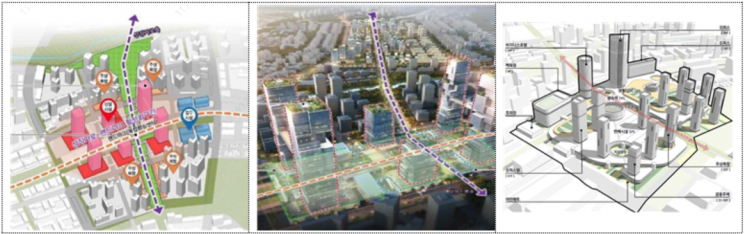
Namyangju Wangsuk 2: The First Hydrogen City Among 3rd Phase New Towns
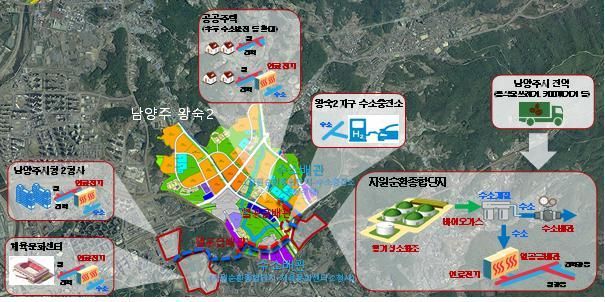
Wangsuk 2 District will be developed as the nation’s first carbon-neutral hydrogen city. A hydrogen city is an urban area equipped with infrastructure such as hydrogen production facilities, transportation facilities, and utilization facilities (fuel cells, hydrogen charging stations, etc.) to enable the use of hydrogen as an energy source for apartments, buildings, and transportation facilities. Wangsuk 2 District was selected last year as a hydrogen city support project and will build hydrogen energy infrastructure over four years from this year to 2026 with a budget of 40 billion KRW, including national funds.
At the Wangsuk 2 District Resource Circulation Complex, biogas generated from food waste treatment will be converted into hydrogen to produce green hydrogen. The hydrogen produced will be supplied through pipelines to 1,100 nearby public rental housing units, Namyangju Sports and Culture Center, public offices, and used together with heat and electricity generated by fuel cells. These hydrogen-based facilities will be safely managed through a hydrogen integrated management center.
By utilizing hydrogen energy, Namyangju Wangsuk 2 District is expected to reduce 16,814 tons of CO2 and 1,200 kg of fine dust annually. By using biogas, hydrogen will be supplied at about half the market price (8,000 KRW/kg), and electricity will be supported through building fuel cells, reducing residents’ electricity and heating costs.
Integration of Cultural and Lifestyle Infrastructure such as Green Network and Smart Edu Park
Namyangju Wangsuk District will also establish cultural and lifestyle infrastructure connecting various functions such as residential, office, shopping, culture, and leisure, including a green network and smart edu park.
A green network in a grid pattern of 200m by 200m will be arranged along the central green axis dividing the city north to south, allowing access to waterfront spaces, parks, and green areas within a 10-minute walk from anywhere in the district. Safe school routes connected to the green network will be planned to provide children with secure commuting paths. Residential, cultural, welfare, and community facilities will be organically arranged around the green network to offer residents high-quality cultural infrastructure.
Additionally, the Wangsuk Cultural Belt and Smart Edu Park will be established around the interchange station of the Gyeongui-Jungang Line and Subway Line 9. The Wangsuk Cultural Belt will connect the Cultural Plaza, Cultural Park, and Youth Culture and Arts Village, creating participatory cultural spaces for citizens to enjoy diverse cultural activities.
The Smart Edu Park will form an edu community equipped with shared childcare hubs for children and educational and cultural facilities for all generations, nurturing Wangsuk New Town as a city where joint childcare is possible. School facilities will be shared with residents to serve as a joint childcare community, where parents can gather to share childcare experiences and information, and children can use play spaces and libraries together with peers.
Groundbreaking Ceremonies for Other 3rd Phase New Towns to be Held Sequentially
Starting with the groundbreaking ceremony for Namyangju Wangsuk Public Housing District, the development of 3rd phase new towns is expected to gain momentum. Including Incheon Gyeyang, which began construction last year, all five new towns will have started construction by September. Other districts such as Goyang Changneung will also hold groundbreaking ceremonies sequentially to accelerate the signal of expanded housing supply in the real estate market.
LH President Lee Han-jun stated, “With the groundbreaking ceremony for Namyangju Wangsuk Public Housing District, the largest among the 3rd phase new towns, we will redouble efforts to supply public housing early, increase volume, and ensure safe project management. We hope this groundbreaking will serve as a catalyst to realize housing stability for the public through the Yoon Seok-yeol administration’s policy to supply 2.7 million homes.”
© The Asia Business Daily(www.asiae.co.kr). All rights reserved.