Blue Crab Varieties Importable Domestically
Import Possible but Profitability Is Low
As Italian authorities declare war on the explosively increasing population of blue crabs (scientific name: Callinectes Sapidus), attention is focused on whether Korea, a country of blue crab enthusiasts, can officially start importing 'blue crabs.'
Recently, domestic blue crab importers have been actively reaching out to Italian authorities to inquire about export possibilities or accepting advance reservations for blue crabs.
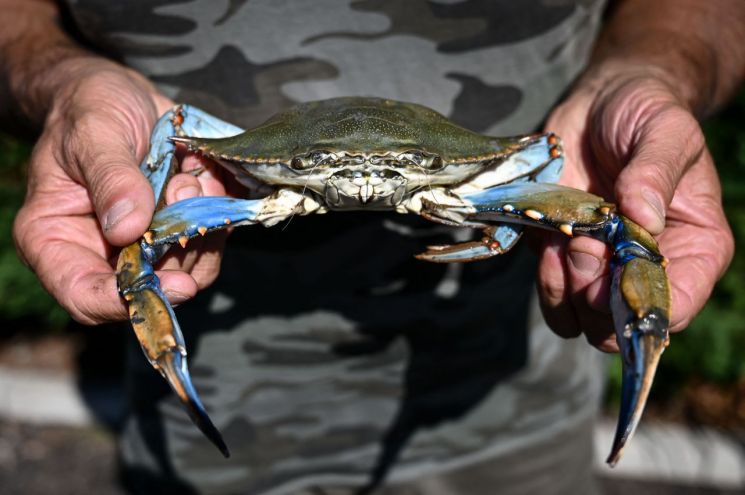 As Italian authorities have declared war on the blue crab (scientific name: Callinectes Sapidus), whose population has exploded, public interest is focusing on whether South Korea, a country of blue crab enthusiasts, will be able to officially import the 'blue crab.'
 [Photo by AFP·Yonhap News]
According to the Ministry of Food and Drug Safety on the 21st, the procedure for domestic companies to import blue crabs from abroad is not complicated. Imported food entering the country undergoes three types of inspections: detailed, on-site, and document inspections. If it receives a 'suitable' judgment, customs clearance is possible.
The blue crabs that companies are currently trying to bring in from Italy are also a species allowed for import under the Ministry of Food and Drug Safety standards, so if they pass these inspections, the crabs can be sold to consumers.
One company is already accepting advance purchase reservations, stating that they will be able to import and sell blue crabs starting at the end of next month.
Concerns Raised That Blue Crab Imports May Be One-Off
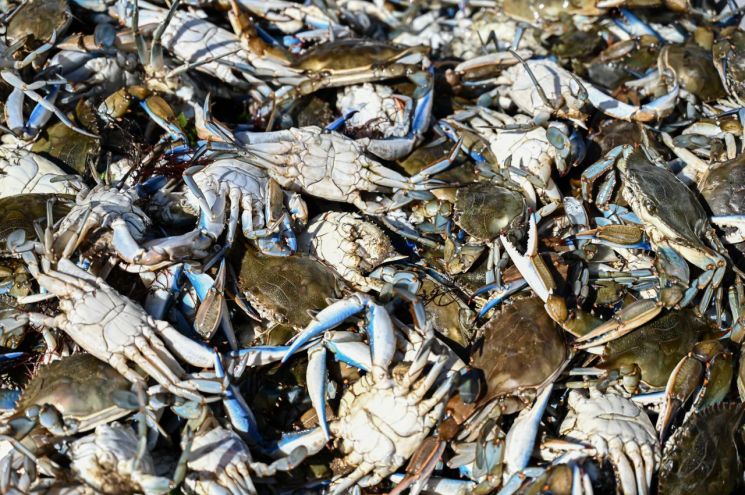 In recent years, blue crabs that have entered the Mediterranean from the Atlantic coast have been devouring clams and oysters favored by Italians, pushing local aquaculture farmers to the brink of closure.
 [Photo by AFP·Yonhap News]
Some voices suggest that blue crab imports may be a one-off event. Considering Italy’s high labor costs, the establishment of local freezing systems, and transportation costs, the profitability of importing blue crabs is not expected to be very high.
Na Myung-hoon, director of a blue crab importing company with five years of experience, said, "To import blue crabs that were originally discarded, sorting work must be done, and freezing and transportation costs are incurred separately. Unless the price is clearly cheaper, wholesalers are unlikely to switch their imported species to blue crabs."
He added, "There will be some demand from individual consumers buying for fun, but since retail prices are higher than wholesale prices, this is also unlikely to be a significant possibility."
Previously, in Tunisia, a similar species called 'blue swimming crab' has rapidly increased and is being exported to countries including Korea, China, and Japan, but the situation is different here.
Tunisia’s labor costs are 7 to 8 times cheaper than Korea’s, making local crab processing costs significantly lower and giving it a price competitiveness advantage, allowing imports to continue steadily.
Most Imported Blue Crabs Are from China
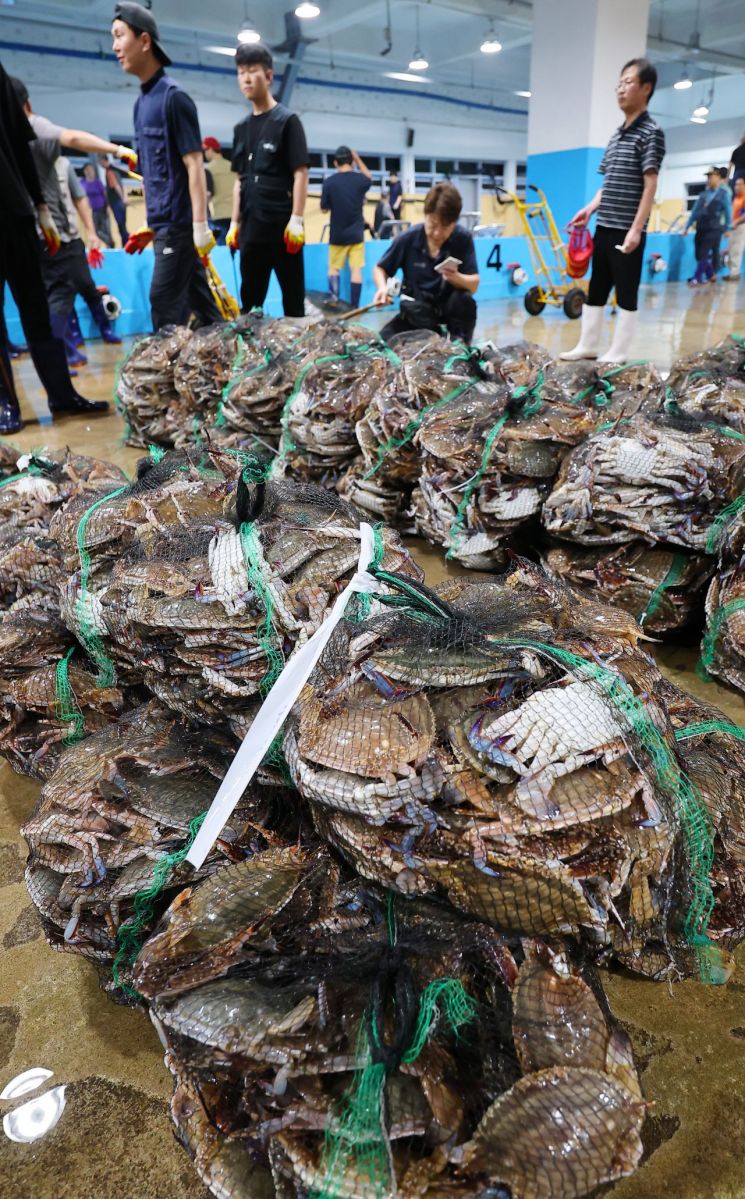 With the full-fledged autumn blue crab season underway, fishermen are preparing for the Yeonpyeongdo blue crab auction at the Ongjin Fisheries Cooperative auction market in Jung-gu, Incheon, on the morning of the 11th.
 [Photo by Yonhap News]
According to the Korea Trade Statistics Promotion Institute’s blue crab trade statistics, among the 12,860 tons of blue crabs imported by Korea last year, the majority?12,470 tons?were inexpensive Chinese products. Tunisia followed with 160 tons.
Park Kyung-soo, director of the blue crab importing company Gomes, said, "I am skeptical whether blue crabs can establish a foothold when even the price of the most delicious domestic blue crabs has dropped significantly. Unlike Tunisia, Italy’s labor costs are similar to Korea’s, so the cost competitiveness will be low if they have to properly collect and process the crabs."
He continued, "Chinese blue crabs are extremely cheap, so to be price competitive, blue crabs must be purchased locally in Italy at 700 to 800 won per kilogram and imported to Korea. If the price is higher than that, there is no reason to import Italian blue crabs."
The news about pushing for blue crab imports gained attention after Italian authorities allocated a large budget for discarding blue crabs that cause massive damage to shellfish farms.
In recent years, blue crabs that have entered the Mediterranean from the Atlantic coast have been devouring clams and oysters, which Italians enjoy eating, pushing local aquaculture farmers to the brink of closure.
The Veneto region in northeastern Italy allocated a budget of 2.9 million euros (about 4.2 billion won) to eradicate blue crabs. This budget is paid as rewards to those who capture and discard blue crabs.
When news spread that blue crabs were being discarded for money, domestic reactions included sentiments of "What a waste." On some online communities and social networking services (SNS), comments such as "Please dump them in Korea," "Let's make gejang (marinated crab) ourselves," and "Korea should import them" were posted one after another.
© The Asia Business Daily(www.asiae.co.kr). All rights reserved.