Organic solar cells that deliver high efficiency even over large areas have been developed, bringing the commercialization of next-generation solar cells one step closer.
A research team led by Professor Bongsu Kim from the Department of Chemistry at UNIST, in collaboration with Dr. Haejung Son's team at the KIST Next-Generation Solar Cell Research Center, developed high-efficiency large-area organic solar cell materials.
The researchers controlled the miscibility of n-type and p-type semiconductors to suppress the aggregation phenomenon of organic materials, which is the main cause of efficiency degradation in existing large-area organic solar cells.
Organic solar cells are attracting attention as next-generation cells because they are lighter, flexible, and can be made semi-transparent compared to currently commercialized silicon solar cells. However, it has been difficult to achieve high efficiency due to the aggregation of organic materials occurring during the device fabrication process.
The joint research team developed an "asymmetric n-type semiconductor" by introducing atoms located at the end of the electron-accepting electron receptor. They also developed a new "p-type copolymer semiconductor" by combining two types of monomers that make up the polymer compound of the semiconductor.
By controlling the miscibility of the newly developed semiconductors, they suppressed the aggregation of organic materials during the fabrication process of large-area organic solar cell devices and produced a uniform photoactive layer film with roughness controlled at the scale of a few nanometers.
The large-area organic solar cells using the semiconductors developed in this study recorded a high power conversion efficiency of 11.28% even over a large area of 58.5㎠. This performance is significantly higher compared to the average power conversion efficiency of 6.69% reported for organic solar cells of similar size.
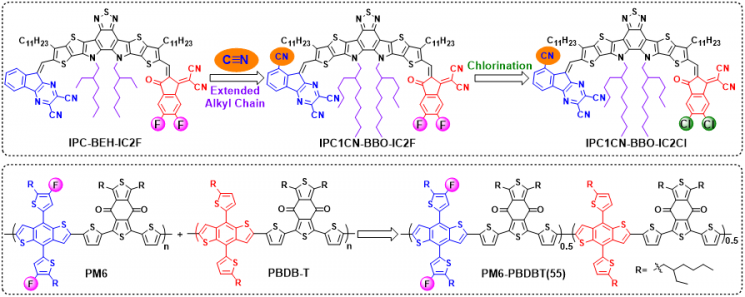 Chemical structure information of the developed asymmetric n-type semiconductor and p-type copolymer semiconductor.
Dr. Haejung Son explained, “We maintained the fill factor of the 1㎠ organic solar cell device even in the 58.5㎠ large-area organic solar cell,” adding, “We also maintained 80% of the power conversion efficiency compared to the 1㎠ device, achieving high efficiency stability.”
Professor Bongsu Kim from the Department of Chemistry said, “This study presents a new direction that controlling the miscibility between n-type and p-type semiconductors can improve the performance of large-area organic solar cells,” and added, “We hope this research will contribute to the development of high-efficiency large-area organic solar cells in the future.”
This research was conducted with support from the Ministry of Science and ICT and the National Research Foundation of Korea. Researchers Peddaboodi Gopikrishna and Doohyun Eom from the Department of Chemistry at Ulsan National Institute of Science and Technology, and Jinhyung Lee and Sungwon Yoon from KIST participated as first authors.
The research results were published online on July 14 in the world-renowned journal Advanced Functional Materials.
© The Asia Business Daily(www.asiae.co.kr). All rights reserved.







![15-Year Veteran Field Mechanic Becomes AI Talent... Korean Air's Experiment [AI Era, Jobs Are Changing]](https://cwcontent.asiae.co.kr/asiaresize/319/2025121111232252273_1765419802.jpg)