Residents of Yongin Namsa and Idong-eup Areas Express Mixed Expectations and Concerns
Rapidly Increased Land Transactions Plummet After Designation as Permit Zone
"Now I feel like real development is finally happening." (Resident A, Namsa-eup, Yongin)
"Suddenly, I found out my land was going to be seized, and it made me angry." (Resident B, Idong-eup, Yongin)
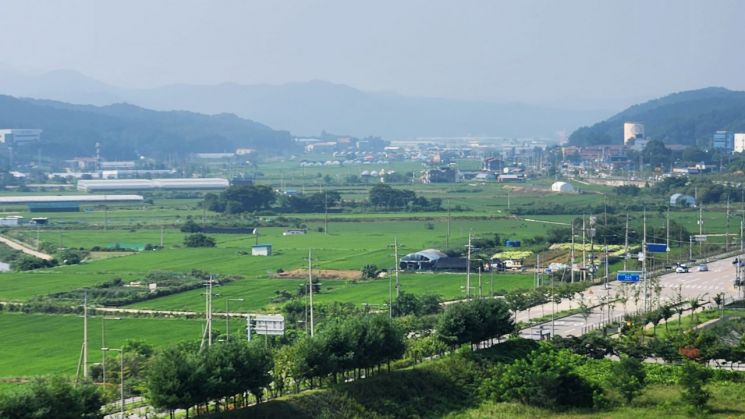 A panoramic view of Agok-ri, Namsa-eup, Cheoin-gu, Yongin-si, Gyeonggi Province. Samsung Electronics plans to invest 300 trillion won by 2042 in Namsa-eup and the nearby Idong-eup area to establish advanced memory and foundry lines.
 [Photo by Jeong Doohwan]
From Hwaseong Dongtan New Town, it takes about 5 minutes by car along Local Road 23, where the mountains that once blocked both sides disappear and suddenly wide-open rice fields spread out. This is Namsa-eup, Cheoin-gu, Yongin-si, Gyeonggi-do.
On the morning of the 21st, despite it being rush hour, the area around Namsa-eup that the reporter visited was quiet and sparsely populated. Although it is called an eup (town), it is small in scale and surrounded entirely by rice fields.
Namsa-eup and nearby Idong-eup were designated on the 20th as one of the national advanced strategic industry specialized complexes in the semiconductor sector by the government. This area is the planned site for Samsung Electronics' 'Yongin Namsa Advanced System Semiconductor Cluster.' Samsung Electronics plans to invest a total of 300 trillion KRW by 2042 to build advanced memory and foundry lines within the semiconductor cluster, which will cover a total area of 7.1 million square meters.
Development clock stopped for 16 years, revived by semiconductors
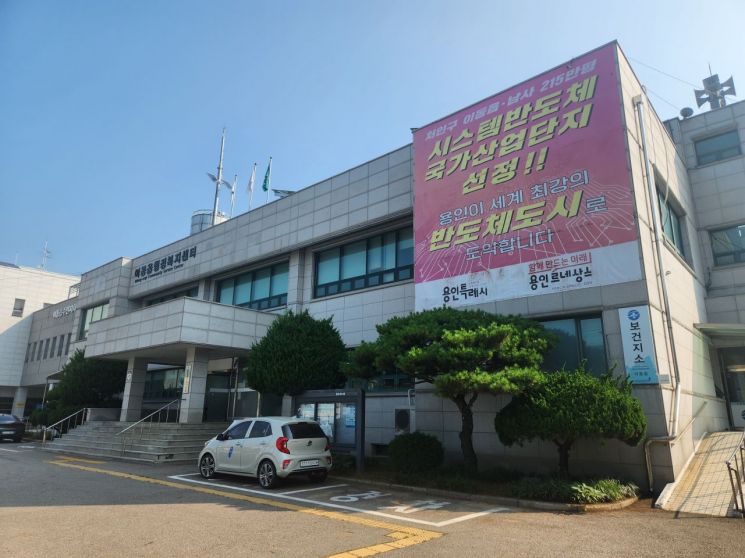 A large banner congratulating the designation of this area as an advanced semiconductor cluster is hung on the exterior wall of the Namsa-eup Administrative Welfare Center in Cheoin-gu, Yongin-si, Gyeonggi-do.
 [Photo by Jeong Duhwan]
The emergence of Namsa and Idong-eup as development candidates dates back 16 years to 2007. In the last year of the Roh Moo-hyun administration, the government announced plans for the second phase of new town development in the metropolitan area to curb soaring housing prices, and this area was identified as a strong candidate.
However, it was eventually excluded from the new town candidates due to its distance from Seoul. Since then, only small to medium-sized factories have been built along the roads, and the area has remained a small eup region left out of development. In fact, buildings taller than five stories are rarely seen in Namsa eupnae (town center). A representative from a local real estate agency, C Real Estate, said, "Nothing has changed from 16 years ago until now. Who would think this is a big city with a population over one million?" and laughed.
However, the atmosphere changed dramatically after the semiconductor cluster designation in March and the recent designation as an advanced strategic industry specialized complex. Especially, with the government's designation of Namsa and Idong-eup as land transaction permission zones simultaneously with the cluster designation, local residents are beginning to feel the development.
A representative from D Real Estate in Idong-eup said, "Reactions among residents vary depending on whether their land is subject to acquisition or not, but overall, the semiconductor cluster creation is welcomed."
Transactions stir just before cluster designation... frozen after permission zone designation
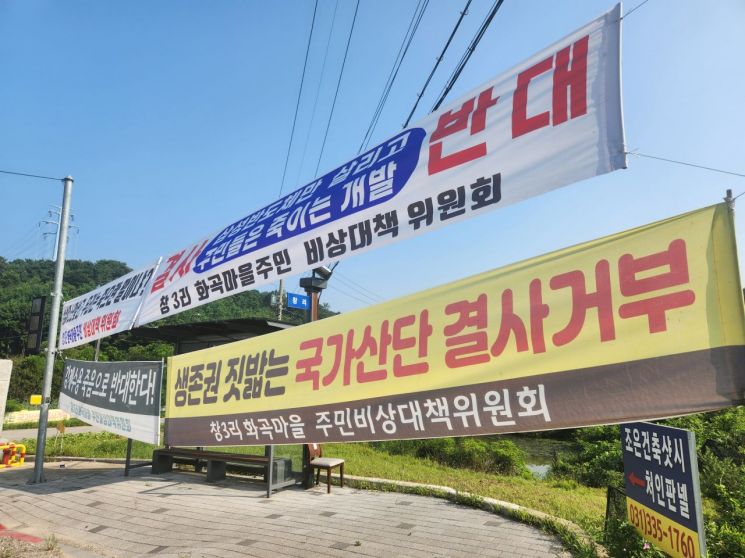 Banners opposing land expropriation due to the designation of a semiconductor cluster are displayed along the roadside connecting Namsa-eup and Idong-eup in Cheoin-gu, Yongin.
 [Photo by Jeong Doohwan]
Land transactions sharply declined after the cluster designation in March. This is because sales for investment purposes were prohibited after the area was designated as a transaction permission zone.
According to an analysis of the Ministry of Land, Infrastructure and Transport's actual transaction price disclosure system, the number of land transactions in Namsa-eup was 30 in January this year, surged to 75 in February and 122 in March. After that, the volume dropped sharply, with only 11 to 26 transactions per month from April to last month.
Among the transactions made in February and March, 20 contracts were canceled. Most cancellations were due to the designation of the permission zone.
Local real estate offices say land prices have not shown significant changes. A representative from S Real Estate in Namsa-eup explained, "For land along the roadside, the asking price is around 3 to 4 million KRW per 3.3 square meters," adding, "Prices have not changed much in the past 2 to 3 years."
Dramatic support including shortened permits and relaxed floor area ratio
The designation as a ‘National Advanced Strategic Industry Specialized Complex’ is based on the National Advanced Strategic Industry Special Act (Semiconductor Act) enacted in August last year.
The specialized complex designation does not physically create a new complex. It is intended to group planned or already operating industrial areas as clusters and provide various special support measures. The Namsa specialized complex was already designated as a semiconductor cluster by the government last March.
The designation has significant effects. The government prioritizes support for establishing core infrastructure such as power supply in the national advanced strategic industry specialized complexes and allocates government R&D budgets preferentially. This is the so-called ‘selection and concentration’ strategy.
The specialized complexes are also exempt from preliminary feasibility studies and apply the ‘permit timeout system.’ If 60 days pass after the Advanced Industry Committee’s rapid approval decision, the permit is considered granted. Companies holding advanced strategic technologies may receive up to 1.4 times relaxed floor area ratio benefits within the specialized complex.
Song Jong-yul, head of Yongin City’s Future Business Promotion Division, said, "With this specialized complex designation, various special regulations will be applied, accelerating the creation of the semiconductor belt. We will proceed with the project without delay so that semiconductors can establish themselves as the future growth engine not only for Yongin but for the Republic of Korea."
© The Asia Business Daily(www.asiae.co.kr). All rights reserved.