Jasaeng Korean Medicine Hospital Upholds Spirit of Independence Activist Shin Gwang-ryeol
Leading Support for Patriots and War Veterans... Steady Social Contribution
'Geunghuljisimsim (矜恤之心)'
This four-character idiom, which refers to the heart that feels pity for those in hardship and wishes to help them, is the management principle of Jaseng Medical Foundation and Jaseng Korean Medicine Hospital. It is also the lifelong philosophy of Cheongpa Shin Gwang-ryeol (1903?1980), an independence activist and Korean medicine doctor, who was the father of Dr. Shin Jun-sik, the founder of Jaseng Korean Medicine Hospital. Continuing Shin Gwang-ryeol’s legacy, Jaseng Medical Foundation and Jaseng Korean Medicine Hospital are leading social contribution activities for supporting independence patriots as well as socially vulnerable groups.
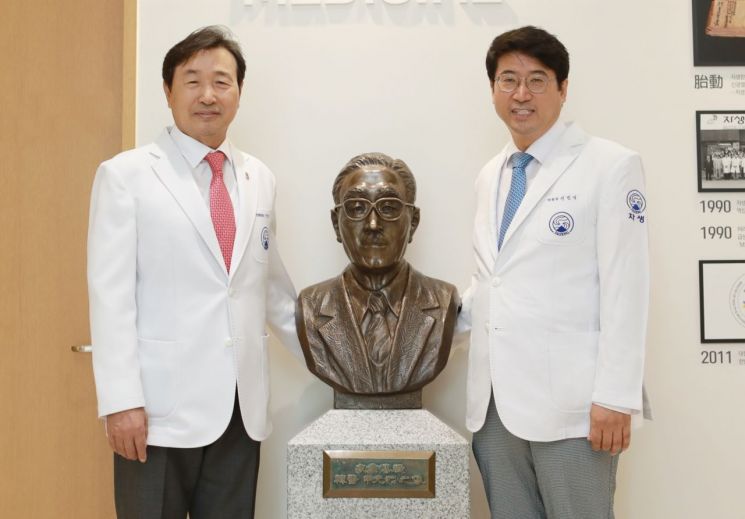 Dr. Shin Jun-sik (left), founder of Jaseng Hospital of Korean Medicine, and Shin Min-sik, chairman of the social contribution committee of the Jaseng Medical Foundation, brothers, are honoring their father in front of the bust of independence activist Cheongpa Shin Gwang-ryeol.
 [Photo by Jaseng Medical Foundation]
Carrying on the Will of an Independence Activist Family
Shin Gwang-ryeol was born on February 13, 1903, into a family of independence activists in Bukcheong-gun, Hamgyeongnam-do. After the country was taken by Japanese colonial rule, his family crossed the Yalu River and relocated to Jiandao, where they laid the groundwork for the independence movement. His uncle, Shin Hong-gyun, had a significant influence in this. Shin Hong-gyun was a Korean medicine doctor who served as the leader and military doctor of the independence army group 'Daejindan.' Notably, he participated as a military doctor in the Battle of Daejeonja-ryeong in March 1933, one of the three major independence army victories. He boosted the morale of the independence fighters, who were shivering from cold and hunger, by ingeniously collecting black mushrooms (wood ear mushrooms) as food supplies, contributing to a great victory. The Battle of Daejeonja-ryeong was recorded not only as a major victory but also as the battle that secured the largest amount of military supplies.
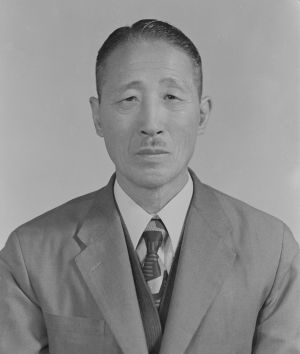
Influenced by this, Shin Gwang-ryeol naturally devoted himself to the independence movement. On the 11th anniversary of the March 1st Movement in 1930, he led anti-Japanese demonstrations in the Jiandao region. He was wounded with a more than 30 cm long cut on his side by a Japanese mounted police wielding a military sword and was eventually arrested by the police at the Japanese consulate in Jiandao and imprisoned in Seodaemun Prison. After his release in 1932, he passed the medical licensing exam, opened Gwangsaeng Clinic in Manchuria, and secretly treated injured independence activists for eight years. In 1942, he followed Shin Hong-gyun to Mudanjiang, Manchuria, where he played a role in supplying military goods and funds to the anti-Japanese allied forces. After liberation, during the Korean War, Shin fled and took it as his mission to revive Korean medicine. After passing the Korean medicine licensing exam, he opened Cheongpa Korean Medicine Clinic in Asan, Chungnam, in 1957, caring for patients in underdeveloped rural fishing villages. Leaving behind the legacy of Geunghuljisimsim, saying "One must practice humaneness, not just medical skills," Shin Gwang-ryeol passed away in 1980 and was posthumously awarded the Presidential Citation for Independence Patriots on Liberation Day in 2022.
Sincere Respect for National Meritorious Persons and Their Descendants
Inheriting the spirit from his great-uncle and father, Jaseng Medical Foundation and Jaseng Korean Medicine Hospital have been conducting various activities to foster a social atmosphere that honors national meritorious persons and their descendants. A representative example is the 'Traditional Korean Medicine Primary Care Project for Living Patriots,' launched in 2021, which provides medical services such as acupuncture and herbal prescriptions to patriots who resisted Japanese colonial rule. Last year, they signed a medical support agreement with the Ministry of Patriots and Veterans Affairs (now the Ministry of Patriots and Veterans) to provide treatment for spinal and joint diseases to 100 Korean War veterans, promising support worth 300 million KRW.
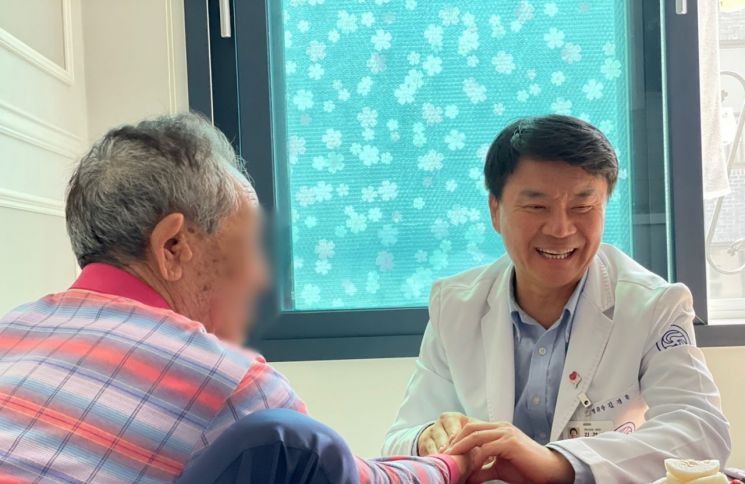 Director Kim Kyung-hoon of Bundang Jaseng Korean Medicine Hospital is examining a repatriated Korean War POW veteran.
 [Photo by Jaseng Medical Foundation]
This year, they continue various social contribution activities. In January, they donated 10 million KRW to honor the dedication of the late Police Lieutenant Yu Jae-guk, who died in the line of duty while searching for a jumper in the Han River, and to support his family. They also delivered 3,000 kg of rice to households at risk of solitary death in Seoul and provided traditional Korean medicine medical services to former prisoners of war and their families. They consistently visit remote islands and mountainous areas with weak medical infrastructure to conduct medical volunteer activities for the elderly.
They are also actively engaged in projects to reexamine independence activists. In August last year, they held an academic seminar titled 'The Lives of Korean Medicine Doctors Dedicated to the Independence Movement,' reviewing the independence achievements of Shin Gwang-ryeol and Shin Hong-gyun and introducing the influence of Korean medicine on independence army activities. From November last year to January this year, they held an 'Independence Activist Content Contest,' providing an opportunity to revisit the hidden footsteps of independence activists. The contest received 460 submissions, with 36 works selected as winners. Jaseng Medical Foundation stated, "We will take the lead in discovering and reexamining forgotten independence activists," adding, "Following the spirit of our predecessors' independence movement, we will establish a social atmosphere where independence activists and patriots are respected."
© The Asia Business Daily(www.asiae.co.kr). All rights reserved.


![15-Year Veteran Field Mechanic Becomes AI Talent... Korean Air's Experiment [AI Era, Jobs Are Changing]](https://cwcontent.asiae.co.kr/asiaresize/319/2025121111232252273_1765419802.jpg)