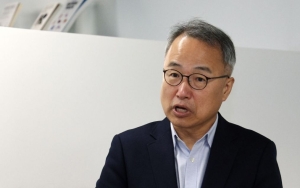
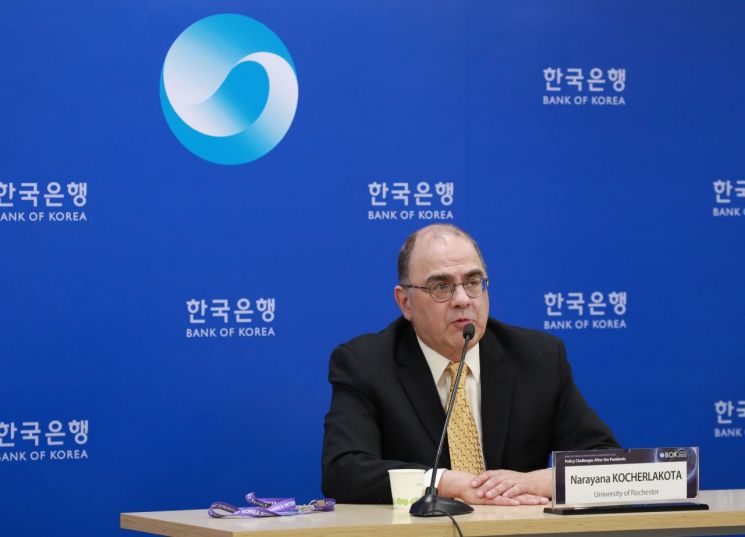
 Professor Narayana Kocherlakota of the University of Rochester is holding a press conference on the 2nd at the Bank of Korea in Jung-gu, Seoul. (Photo by Bank of Korea) [Image source=Yonhap News]
Narayana Kocherlakota, former president of the Minneapolis Federal Reserve Bank and a professor at the University of Rochester, argued that the U.S. Federal Reserve (Fed) needs to raise its policy interest rate to around 6-7% annually to combat inflation. He also stated that emerging countries like South Korea must naturally consider the U.S. interest rate hikes when deciding their own monetary policies.
At a press briefing held on the 2nd at the Bank of Korea press room in Jung-gu, Seoul, Professor Kocherlakota said, "The Fed must continue to aggressively tighten monetary policy." When asked whether the Fed needs to raise rates several more times this year, he replied, "Considering the current inflation rate, my ideal target is 6-7%."
During a policy discussion at the 'BOK International Conference' held the previous day, Professor Kocherlakota also made a hawkish remark, saying, "The right question at this point is not whether to raise rates or not, but whether to raise by 0.25 percentage points or 0.50 percentage points." He emphasized, "What matters now is not simply whether to raise rates, but sending a signal about the Fed's intentions. If the Fed does not raise rates, it will signal concerns about financial market instability."
Considering that the current U.S. interest rate stands at 5-5.25%, this implies that the Fed needs to raise rates more aggressively. Professor Kocherlakota said that the U.S. Congress has given the Fed two mandates: price stability and employment creation, adding, "Some people argue that the Fed should reflect the interests of the stock market or regional banks in its monetary policy, but in my view, these are not more important than inflation or unemployment rates."
He also mentioned that emerging countries like South Korea cannot help but consider the interest rate differential with the U.S. when deciding their own rates. Professor Kocherlakota said, "If you ask any policymaker, they will say that when thinking about their own country's rate hikes, they naturally take into account the U.S. rate hikes. U.S. rate hikes affect the entire world." He added, "I think the Bank of Korea is doing a good job in this regard."
Furthermore, he explained that while the long-term status of the U.S. dollar as the global reserve currency may be challenged, it is not expected to happen in the near term. Professor Kocherlakota said, "In the long term, I think the dollar's status could be shaken, and looking ahead 10 to 20 years, this is an important issue," but added, "I do not think the dollar's position will be shaken within the next 1 to 2 years."
© The Asia Business Daily(www.asiae.co.kr). All rights reserved.