Chief Justice Kim Myung-su to Soon Propose Successors for Justices Jo Jae-yeon and Park Jung-hwa
Judged That 'Balance of Judgments' Was Lost Over the Past Five Years
Chief Justice Kim Myung-soo of the Supreme Court is drawing keen attention from the Presidential Office regarding the pool of candidates to be recommended for appointment as successors to Supreme Court Justices Cho Jae-yeon and Park Jung-hwa. Since progressive-leaning justices currently constitute the majority, there is speculation within political circles that if candidates who have direct or indirect ties with Chief Justice Kim or share similar ideological leanings are selected as Supreme Court nominees, President Yoon might exercise his veto power. Although the official stance is that it is not possible to determine whether a veto will be exercised before any candidates have been recommended, the Presidential Office internally perceives that the 'balance of judgments' has been lost over the past five years.
On the 2nd, a senior official from the Presidential Office told Asia Economy in a phone interview, "No recommendation or appointment procedures have been initiated yet," adding, "Procedures will proceed according to the principles set forth in the Constitution and laws, and no policy has been decided yet." The official emphasized that since the three branches of government?the executive, legislative, and judiciary?are separate, it is inappropriate for the executive branch to take preemptive action while the judiciary’s selection process is still ongoing. Another senior official also responded, "There have been no discussions or decisions made yet."
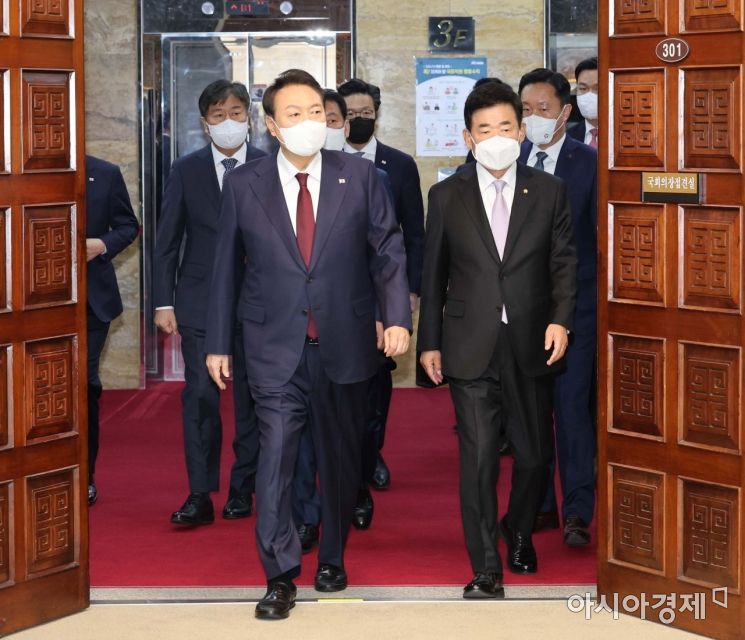 President Yoon Suk-yeol is entering the reception room to have a conversation with Speaker of the National Assembly Kim Jin-pyo, Chief Justice of the Supreme Court Kim Myung-soo, Prime Minister Han Duck-soo, and leaders of both ruling and opposition parties, as well as other attendees, ahead of his policy speech on next year's budget at the National Assembly on the 25th. Photo by Yoon Dong-ju doso7@
Currently, the Supreme Court Justice Candidate Recommendation Committee (Chairperson Choi Young-ae) has finalized a pool of eight candidates: Yoon Joon, Chief Judge of the Seoul High Court; Seo Kyung-hwan, Presiding Judge of the Seoul High Court; Son Bong-gi, Presiding Judge of the Daegu District Court; Eom Sang-pil, Presiding Judge of the Seoul High Court; Kwon Young-jun, Professor at Seoul National University School of Law; Park Soon-young, Judge of the Seoul High Court; Shin Sook-hee, Standing Member of the Sentencing Commission; and Jung Gye-seon, Presiding Judge of the Seoul Southern District Court. Chief Justice Kim will select two from among them, after which the nominees will undergo a confirmation hearing in the National Assembly, and the President will make the final appointment.
The Presidential Office and the ruling party are refraining from specific comments but express concern over the deepening imbalance in the current composition of Supreme Court justices. This is based on the assessment that Chief Justice Kim has recommended, and former President Moon Jae-in approved, justices from groups such as the Uri-beop Research Association, the International Human Rights Law Research Association, and the Lawyers for a Democratic Society (Minbyun), resulting in a majority of progressive-leaning justices among the 13 Supreme Court justices. Justices Park Jung-hwa, Noh Jung-hee, and Lee Heung-gu are from the Uri-beop Research Association, a progressive judges’ group within the judiciary, while Justices Kim Sang-hwan and Oh Kyung-mi are from the International Human Rights Law Research Association, a successor to Uri-beop. Justice Kim Sun-soo previously served as president of Minbyun.
For this reason, within the ruling party, there is speculation that if Chief Justice Kim selects individuals with whom he has direct or indirect ties or who share similar ideological leanings, President Yoon may reject the nominees recommended by Chief Justice Kim in the future. One ruling party official pointed out, "Trials should be conducted from a balanced perspective, but the public’s view is that the Supreme Court has been issuing rulings skewed to one side."
However, since President Yoon has recently exercised veto power over opposition-led bills such as the Grain Management Act and the Nursing Act, increasing his political burden, there is also a possibility that if Chief Justice Kim recommends progressive-leaning candidates, negotiations may take place. In the past, during the Lee Myung-bak administration in 2009, the Blue House and then-Chief Justice Lee Yong-hoon had differences regarding Supreme Court nominees and engaged in consultations, with Chief Justice Lee recommending Min Young-il, then Chief Judge of the Cheongju District Court, as a Supreme Court nominee.
© The Asia Business Daily(www.asiae.co.kr). All rights reserved.