Reconnaissance Satellite Displayed by North Korea "Crashed Due to Engine Malfunction"
Military Recovers Part of Launch Vehicle in Interim China-Korea Maritime Zone
"More Like a Space Launch Vehicle Than a Missile... Launch Procedures Have Accelerated"
North Korea launched a space launch vehicle it claimed to be a 'military reconnaissance satellite' on the 31st, but it flew abnormally and then crashed. Our military authorities recovered floating debris presumed to be part of the launch vehicle. It is estimated to be the cylindrical connection section between the first and second stage rockets, and it is expected that a detailed analysis will confirm the engine's performance, the use of foreign components, and the technological level. The military plans to continue search operations for the remaining debris.
A Joint Chiefs of Staff official told reporters on the day, "Around 8:05 a.m. today, we recovered debris presumed to be the cylindrical connection section between the first and second stage rockets at the drop point of the North Korean space launch vehicle." He added, "The drop point is in the Korea-China provisional waters, roughly the mid-sea area between Korea and China," and explained, "We plan to collect the remaining launch vehicle debris and verify the overall performance and technological level."
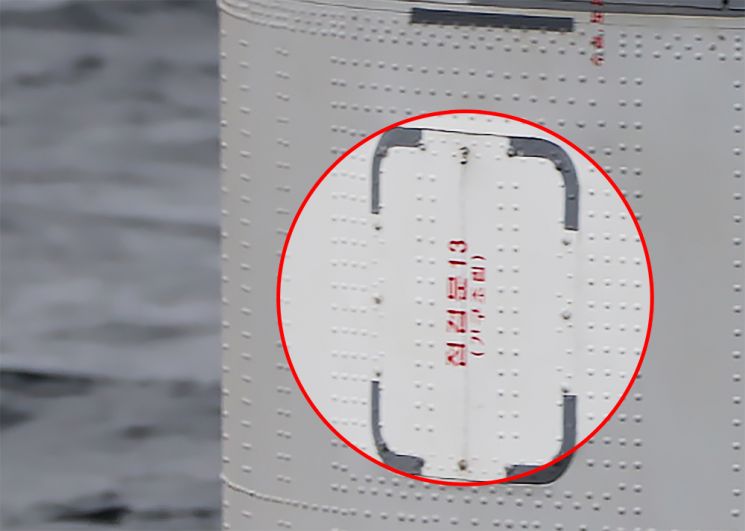 Object presumed to be part of the North Korean space launch vehicle. [Photo by Joint Chiefs of Staff]
 The Joint Chiefs of Staff announced on the 31st that they are recovering some parts of the so-called 'space launch vehicle' launched by North Korea from the sea. The photo shows an object presumed to be part of the 'North Korean claimed space launch vehicle.'
 [Photo by Joint Chiefs of Staff]
If the military conducts a detailed analysis of the debris from the North Korean space launch vehicle, it is expected to confirm the propulsion engine's performance, the use of foreign parts, and the technological level. Previously, after recovering North Korea's 'Kwangmyongsong-4' launch vehicle in 2016, the military confirmed that the fairing (satellite protective cover) had no measures against shock, vibration, or soot to protect the satellite, concluding that the launch was not intended for satellite deployment.
On the day, North Korea launched one projectile southward from the Dongchang-ri area in Pyonganbuk-do around 6:29 a.m., but it fell into the sea about 200 km west of Eocheongdo. Eocheongdo is an island located about 60 km west of Gunsan, Jeonbuk. Initially, North Korea announced that the first stage propulsion unit would be dropped in international waters 230?300 km west of Daecheon Port, Chungnam, and the fairing would be dropped in the southwestern sea international waters 270?330 km west of the Jeju naval base, then the second stage propulsion unit would fall into the sea 700?1000 km east of Luzon Island, Philippines.
North Korea also acknowledged the failure of the space launch vehicle it claimed to be a 'reconnaissance satellite.' The National Aerospace Development Administration of North Korea stated through the Korean Central News Agency on the day, "At 6:27 a.m. on the 31st, the military reconnaissance satellite 'Manlilyeong-1' was launched from the West Sea Satellite Launching Station in Cholsan County, Pyonganbuk-do, mounted on the new satellite carrier rocket 'Chollima-1'." It added, "The Chollima-1 flew normally but lost propulsion after the first stage separation due to abnormal ignition of the second stage engine, causing it to crash into the West Sea." The problematic second stage engine is a high-altitude engine that operates in the vacuum outside the atmosphere.
Surprise Launch Despite June Announcement?...Military: "Launch Procedures Accelerated"
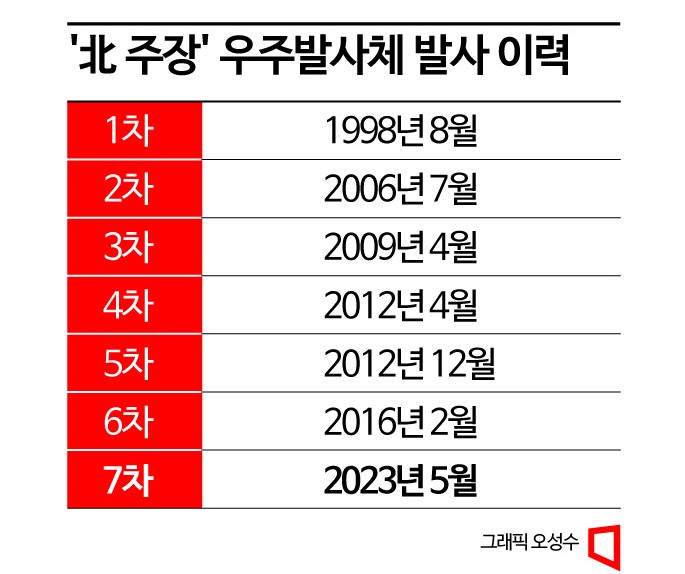
There is also a view that this launch was a 'surprise launch.' Ri Pyong-chol, the vice chairman of the Central Military Commission of the Workers' Party, considered a powerful figure within the North Korean military, announced the day before that "our first military reconnaissance satellite will be launched soon in June," but the launch vehicle was fired before June arrived. However, the military authorities do not attach much significance to this, as North Korea had notified Japan, the regional navigation area adjustment authority of the International Maritime Organization (IMO), that it would launch a satellite between 0:00 on the 31st and 0:00 on the 11th of the following month.
The difference from the past lies in the 'pre-launch procedures.' Before launching a vehicle claimed to be a satellite, North Korea loads the long-range rocket body for satellite launch onto a train and transports it to the West Sea Satellite Launching Station. Then, the rocket is assembled by standing it on the launch pad in stages before proceeding with the launch. This time, the full launch proceeded before such movements were detected. When asked if the launch procedures were faster, making prior movements undetectable, a Joint Chiefs of Staff official said, "It is true that the process was faster than before," but added, "(The military) was continuously tracking those procedures."
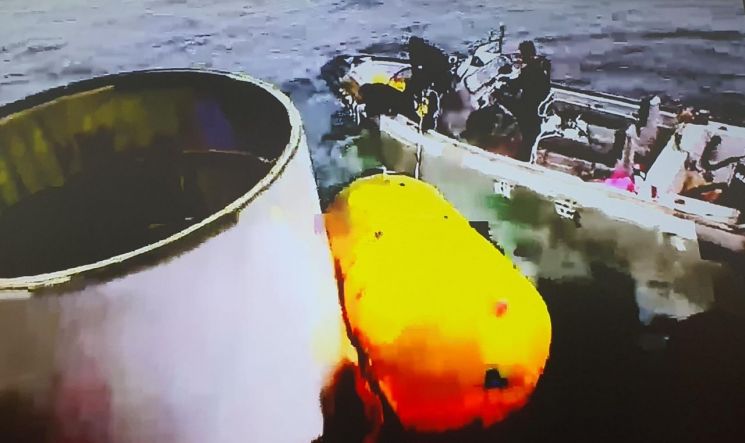 The Joint Chiefs of Staff announced on the 31st that they are recovering parts of the so-called 'space launch vehicle' launched by North Korea from the sea. The photo shows an object presumed to be part of the 'North Korean claimed space launch vehicle.' [Photo by Joint Chiefs of Staff]
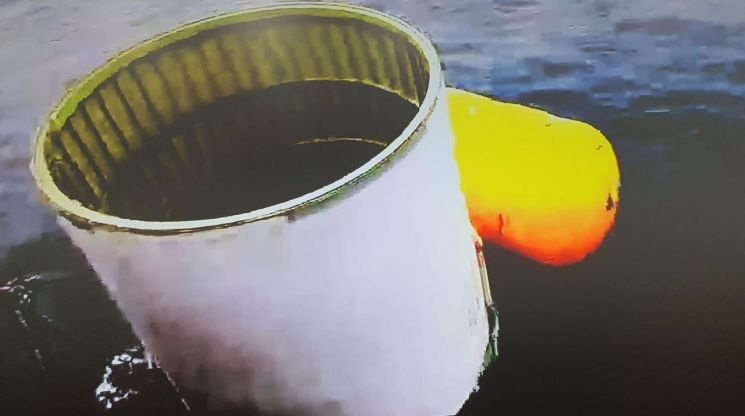 The Joint Chiefs of Staff announced on the 31st that they are recovering some parts of the so-called 'space launch vehicle' launched by North Korea from the sea. The photo shows an object presumed to be part of the 'North Korean claimed space launch vehicle.'
 [Photo by Joint Chiefs of Staff]
The official explained the military's use of the term 'space launch vehicle' by directly quoting North Korea's claim, saying, "It is a missile only if it carries a warhead," and "Since it was launched from the West Sea Satellite Launching Station, the possibility of it being a space launch vehicle is given weight." Regarding the names given by North Korea to the vehicle claimed as a reconnaissance satellite, 'Manlilyeong-1,' and the carrier rocket, 'Chollima-1,' the official interpreted, "Since they claim it is a new model, it seems they named it Manlilyeong, meaning 'looking far as a reconnaissance satellite,' and Chollima, meaning 'going far,' respectively."
Meanwhile, North Korea has announced plans for a re-launch. A spokesperson for the National Aerospace Development Administration said, "We will urgently investigate and clarify the serious defects, devise scientific and technological measures to overcome them, conduct various partial tests, and carry out a second launch as soon as possible." However, the military authorities expect that the procedures such as 'investigation, measures, and partial tests' will take some time.
© The Asia Business Daily(www.asiae.co.kr). All rights reserved.