Work Plays a Central Role in US Pressure on China and Supply Chain Development
Utilized as an Opportunity to Secure Production Facilities and Strengthen Lagging Technologies
On the 18th, Japanese Prime Minister Fumio Kishida gathered the heads of seven global semiconductor companies from the United States, South Korea, Taiwan, Europe, and other regions in one place. With the world’s attention focused on Japan a day before the Group of Seven (G7) summit, Prime Minister Kishida made a promise at the Tokyo Prime Minister’s Office that the government would provide support. In response, the U.S. company Micron immediately pledged an investment of 500 billion yen (approximately 5 trillion won). Japan’s image as a global semiconductor powerhouse was highlighted, and it was reported that Micron secured subsidies worth 200 billion yen. It was truly a ‘win-win’ situation.
![[Japan Semiconductor Revival] ① The Semiconductor Kingdom Toppled by the US, Now Reviving as the US Vanguard](https://cphoto.asiae.co.kr/listimglink/1/2023052608592944168_1685059170.jpg)
According to a report by the Yomiuri Shimbun on the 25th, this scene was orchestrated under the meticulous calculation of the Japanese government. Since March, the Ministry of Economy, Trade and Industry, which planned the meetings between global semiconductor CEOs and Prime Minister Kishida, carefully selected the venue and schedule to maximize the staged effect. This is interpreted as Japan’s effort to turn the opportunity into tangible results.
![[Japan Semiconductor Revival] ① The Semiconductor Kingdom Toppled by the US, Now Reviving as the US Vanguard](https://cphoto.asiae.co.kr/listimglink/1/2023052516193743535_1684999177.jpg) Japanese Prime Minister Fumio Kishida (fourth from the left) is taking a photo with CEOs of global semiconductor companies.
Japanese Prime Minister Fumio Kishida (fourth from the left) is taking a photo with CEOs of global semiconductor companies. [Image source=AP Yonhap News]
Japan, which dominated the global semiconductor market in the 1980s and 1990s, is busily moving to make a comeback to its heyday once again. As the United States reorganizes the global semiconductor supply chain from the perspectives of national security and economy, Japan is taking on a pivotal role and leveraging this as an opportunity to revive its domestic semiconductor industry. Japan is not only attracting large-scale investments to build semiconductor factories but also catching up in semiconductor technology, where it had fallen behind.
◆ Different from 30 Years Ago... Seeking Revival by Leveraging U.S.-China Conflict
The trigger for Japan’s semiconductor revival was the U.S.-China conflict. As the semiconductor hegemony competition intensifies, the United States is exerting pressure on China, which had been striving to rise in the semiconductor industry, to seize the advantage. To isolate China in the semiconductor market, cooperation from allied countries is essential, and Japan has been a key U.S. ally in Asia to check China.
Especially for the United States, which felt the need to diversify the semiconductor supply chain concentrated in South Korea and Taiwan within Asia, Japan’s presence was even more important. All cutting-edge semiconductors under 10 nanometers (nm; 1 nm is one-billionth of a meter) are produced in Taiwan and South Korea. Taiwan is always under the threat of Chinese attacks, and South Korea has many manufacturing facilities of major semiconductor companies located in China. The ‘ally’ Japan is in a structure that can enjoy geopolitical advantages.
![[Japan Semiconductor Revival] ① The Semiconductor Kingdom Toppled by the US, Now Reviving as the US Vanguard](https://cphoto.asiae.co.kr/listimglink/1/2023050809225922863_1683505380.jpg)
The situation is completely reversed from about 30 years ago when the United States attacked Japan’s semiconductor industry. In 1988, Japan was the world’s semiconductor powerhouse, accounting for 51% of global semiconductor sales. In the early 1980s, from the perspective of the United States, which had led the semiconductor market, Japan was not an ally but a competitor and a threat itself. Japan could not withstand U.S. pressure and had to sign a semiconductor agreement in 1986 to partially open its domestic semiconductor market, eventually entering a path of decline.
Now, the United States and Japan have joined hands for the common goal of isolating China, their greatest adversary, and building supply chains. In May last year, during his first visit to Japan, U.S. President Joe Biden met Prime Minister Kishida and signed an agreement to strengthen semiconductor procurement and advanced semiconductor research and development cooperation. In the changed international situation and industrial environment, Japan has seized the opportunity for semiconductor industry revival on the stage set by the United States.
◆ Welcoming Investment in Production Facilities... Generous Subsidies Even for Non-Domestic Companies
![[Japan Semiconductor Revival] ① The Semiconductor Kingdom Toppled by the US, Now Reviving as the US Vanguard](https://cphoto.asiae.co.kr/listimglink/1/2023052609201344229_1685060413.jpg)
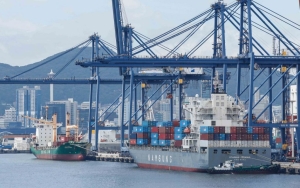
Like other major countries, Japan is eager to attract semiconductor investments. Taiwan’s TSMC, the world’s number one semiconductor foundry (contract manufacturing) company, is building semiconductor production and development bases in Kumamoto Prefecture and Ibaraki Prefecture. Intel has indicated the possibility of investing in a semiconductor packaging factory, Samsung Electronics announced plans for a semiconductor production line dedicated to research and development (R&D), and Belgium’s imec said it would establish a research center.
The Nihon Keizai Shimbun recently reported, “Since the Japanese government focused on fostering the semiconductor industry in 2021, the total announced investment amount by related companies in Japan has exceeded 2 trillion yen,” and based on this, semiconductor-related sales in Japan are expected to triple to 15 trillion yen by 2030.
The bait Japan offers to attract investment is subsidies. As long as semiconductors are produced domestically for more than 10 years, subsidies are provided regardless of whether the company is domestic or global. The scale is up to one-third of the capital investment for both advanced and general-purpose semiconductors, and up to 50% support for semiconductor equipment and materials. Since Japan still holds the lead in the materials, parts, and equipment industries, and many major semiconductor customers such as automobile manufacturers like Toyota and global electronics companies including Sony are gathered, subsidies can reduce costs and help global semiconductor companies decide to invest.
![[Japan Semiconductor Revival] ① The Semiconductor Kingdom Toppled by the US, Now Reviving as the US Vanguard](https://cphoto.asiae.co.kr/listimglink/1/2023010209282970683_1672619309.jpg)
For example, Samsung Electronics is reportedly considering investing more than 30 billion yen to build an advanced semiconductor prototype line near Yokohama, close to Tokyo, Japan. If this base is newly established, joint research with material and manufacturing equipment companies, where Japan has strengths, is expected. If Samsung confirms the investment, it is anticipated that more than 10 billion yen of the investment amount will be provided as subsidies by the Japanese government.
In the case of TSMC, semiconductors produced at the Kumamoto plant are likely to be supplied first to Sony, which is a joint investor, and Japanese automobile companies such as Denso and Toyota. The Japanese government provided subsidies of 476 billion yen for the construction of the TSMC Kumamoto plant.
◆ Learning Ultra-Fine Processes in the U.S... Japan Utilizes Opportunity to Strengthen Technology
Japan is also focusing on strengthening its technological capabilities through cooperation with the United States. Having fallen behind in manufacturing technology over the past 30 years, Japan is actively utilizing cooperation with the U.S. to secure ultra-fine process technology, a core competitiveness of the semiconductor industry.
![[Japan Semiconductor Revival] ① The Semiconductor Kingdom Toppled by the US, Now Reviving as the US Vanguard](https://cphoto.asiae.co.kr/listimglink/1/2023052607433643962_1685054616.jpg)
The so-called ‘Semiconductor Dream Team’ Rapidus, created by Japanese companies with massive government support, is receiving know-how on gate-all-around (GAA) process technology, which is crucial for advanced semiconductor production, from IBM in the U.S. Extreme ultraviolet (EUV) lithography equipment, essential for ultra-fine processes, will be supported by Belgium’s imec. Based on this, Rapidus has set a goal to mass-produce 2-nanometer process semiconductors by 2027.
Micron’s investment is also expected to help strengthen Japan’s technological capabilities. When announcing its investment in a DRAM production plant, Micron stated that it would introduce EUV equipment for the first time in Japan and incorporate it into the production facility. This means that advanced semiconductor production will begin in Japan. U.S. Ambassador to Japan Rahm Emanuel evaluated, “The cooperation between Micron and Japan shows that allied countries can achieve both economic opportunities and security when they collaborate in advanced technology fields.”
© The Asia Business Daily(www.asiae.co.kr). All rights reserved.