The trust company filed a lawsuit seeking nullification and cancellation against the disposition of distributing the auction proceeds of real estate entrusted by the family of the late former President Jeon Du-hwan to the prosecution, but lost. If this ruling is finalized, it is expected that about 5.5 billion KRW of unpaid fines can be additionally recovered.
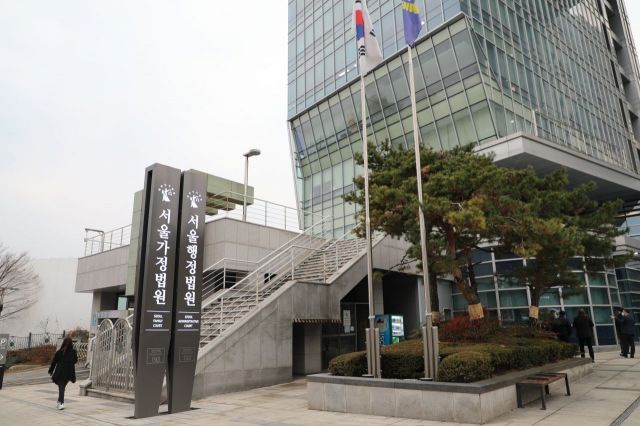
The Administrative Court of Seoul, Administrative Division 6 (Chief Judge Lee Ju-young) ruled on the 7th that Kyobo Asset Trust lost the lawsuit against the Korea Asset Management Corporation seeking cancellation of the disposition of distribution of auction proceeds. Kyobo Asset Trust sought confirmation of invalidity of the distribution disposition as the main claim and cancellation of the distribution disposition as an alternative claim, but both were dismissed.
The court judged, "The disposition to seize real estate in Osan, Gyeonggi Province and to distribute a total of 5.5 billion KRW from the proceeds of the real estate sale to the Seoul Central District Prosecutors' Office in three installments is lawful."
This lawsuit arose over the seizure of fines related to three of five plots of forest land in Osan City entrusted to Kyobo Asset Trust by the family of former President Jeon.
Former President Jeon was sentenced to life imprisonment and a confirmed fine of 220.5 billion KRW by the Supreme Court in 1997 on charges including rebellion and bribery.
The Seoul Central District Prosecutors' Office, to enforce the seizure of fines against former President Jeon, regarded the five plots of forest land in Osan City as "illegal property" under the Public Officials Crime Forfeiture Act, and considered that the trust company Kyobo Asset Trust acquired them knowing such circumstances. Accordingly, on August 14, 2013, pursuant to Article 447, Paragraph 4 of the Criminal Procedure Act and in accordance with the National Tax Collection Act's provisions on tax delinquency disposition, each property was seized. The forest land was auctioned in 2017, and 7.56 billion KRW was distributed as part of the fines.
In response, Kyobo Asset Trust filed a lawsuit in July of the same year seeking cancellation of the seizure, and in 2019 filed an administrative lawsuit seeking cancellation of the distribution of auction proceeds for three plots.
The Supreme Court ruled in July last year that the seizure by the prosecution was legitimate, so the land value of two plots amounting to about 2.052 billion KRW was forfeited to the national treasury, but the recovery for the three plots subject to the distribution cancellation lawsuit has not yet been made.
Kyobo Asset Trust argued in this lawsuit that the seizure disposition was inherently void, and that this defect was inherited by each distribution disposition, so the distribution disposition should be null or canceled due to illegality. They raised three main defects.
First, Kyobo Asset Trust claimed that the real estate in question could not be considered as illegal property under Article 2, Clause 4 of the Public Officials Crime Forfeiture Act, as it was not included in the bribes received by former President Jeon from businessmen nor property obtained in exchange for such bribes. They also argued that even if it was illegal property, they were not subject to seizure because they did not acquire it knowing such circumstances.
However, the court referred to the previous ruling in the seizure invalidity lawsuit and judged, "The real estate in question corresponds to illegal property owned by former President Jeon under the names of his wife or son, and the plaintiff entered into a collateral trust contract after the judgment against former President Jeon was finalized. At that time, the parties to the collateral trust contract knew the relationship with former President Jeon and the existence of unpaid fines against him, so they were aware that the real estate was illegal property."
Second, Kyobo Asset Trust argued that the Public Officials Crime Forfeiture Act's provision allowing seizure enforcement against "persons other than the offender who acquired illegal property" does not include third parties who acquired the property by paying a substantial price. They also claimed that "acquisition" in the relevant provision should be interpreted narrowly as ultimate ownership, so transfer of trust property should not be included.
However, the court rejected this, stating, "Considering the legislative purpose of the Public Officials Crime Forfeiture Act and the intent of Article 9-2 of the Act, to ensure the realization of state criminal authority and thoroughly recover illegal property, if a third party acquires ownership of illegal property knowing the circumstances, seizure enforcement is necessary even if the third party paid a substantial price or the property was not ultimately attributed to them."
Lastly, Kyobo Asset Trust argued that the seizure dispositions under Article 9-2 of the Public Officials Crime Forfeiture Act violate Article 22 of the Trust Act, which prohibits compulsory execution, preservation disposition, or delinquency disposition on trust property except for rights arising before the trust.
Regarding this, the court pointed out, "If an offender who committed a specific public official crime transfers illegal property to a trustee who knows the circumstances through a trust contract, and seizure enforcement is not allowed under the Public Officials Crime Forfeiture Act Article 9-2 on the grounds that compulsory execution is prohibited on trust property, it would nullify the legislative purpose of the Act and the intent of the provision. It would also give offenders a strong motive to evade seizure enforcement through trusts, and such abuse would undermine trust in the trust system and ultimately hinder its development."
The court continued, "Therefore, if an offender who committed a specific public official crime enters into a trust contract with a trustee who knows the circumstances and transfers ownership of illegal property, it constitutes abuse of the trust system, and the independence of trust property need not be protected, so the application of Article 22, Paragraph 1 of the Trust Act is excluded."
Meanwhile, Kyobo Asset Trust also argued that since the offender died, according to general principles of execution of property penalties including forfeiture and seizure, execution of property penalties against the offender is impossible, and seizure enforcement against persons other than the offender is also impossible, so the prosecutor should decide that enforcement is impossible.
Since former President Jeon died on November 23, 2021, they claimed that subsequent seizure enforcement by the prosecutor is impossible and that the distribution dispositions themselves should be null or canceled.
Regarding this claim, the court first cited a Supreme Court ruling that "the legality of administrative dispositions in administrative lawsuits should be judged based on the laws and facts at the time the disposition was made, and changes in laws or facts after the disposition do not affect it."
It then judged, "The distribution dispositions lawfully made on February 14, September 6, and December 6, 2018, before former President Jeon's death, cannot be considered retrospectively illegal due to factual changes after the disposition such as his death."
The court indicated that while the death of former President Jeon may be a reason to discontinue enforcement procedures related to the real estate, it is difficult to see that the distribution dispositions themselves are illegal.
The state has recovered 128.22 billion KRW in fines from former President Jeon so far. If this ruling is finalized, the prosecution will be able to recover an additional 5.5 billion KRW.
© The Asia Business Daily(www.asiae.co.kr). All rights reserved.