![[Insight & Opinion] What the Constitutional Court's Ruling on the 'Complete Prosecution Reform Act' Has Raised](https://cphoto.asiae.co.kr/listimglink/1/2023033115004174451_1680242441.jpg)
Controversy continues over the Constitutional Court's ruling on the 'Complete Prosecution Reform Act' (Geomsu Wanbak Law). This is a decision regarding the amendment of the Prosecutors' Office Act and the Criminal Procedure Act. The Constitutional Court's decision and the ensuing debate starkly reveal the judicialization of politics, the politicization of the judiciary, and the severity of factional politics.
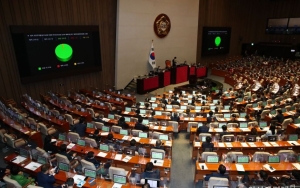
Recently, conflicts and power struggles within the legislature have increasingly become judicial issues. This is the judicialization of politics. It is evidence that the National Assembly lacks the capacity to resolve issues on its own. Of course, the National Assembly can seek the judiciary's judgment on legality or constitutionality. However, the National Assembly is the highest representative body that integrates the will of the people. The Constitution places the National Assembly at the forefront of state institutions. Yet, it relies on the judiciary to resolve its own problems. Even so, conflicts are not resolved by judicial decisions. The judicialization of politics leads back to the politicization of the judiciary in a vicious cycle.
The core issue in the dispute over the 'Complete Prosecution Reform Act' was whether Assemblyman Min Hyung-bae, who was a member of the ruling Democratic Party at the time but left the party and participated in the agenda adjustment committee as an independent opposition member, did so in accordance with Article 57-2 of the National Assembly Act. The Constitutional Court ruled 5 to 4 that the deliberation and voting rights of the Legislation and Judiciary Committee were infringed. The other four justices believed it was lawful because the principle of equal representation between ruling and opposition parties, including independents from non-negotiating groups, was maintained.
The operation of the agenda adjustment committee is legislatively intended to "guarantee opportunities for minority opinions to be expressed" and "to reconcile differences." The defection of a ruling party member to create a practical ruling party majority goes against this legislative intent. Whether it was a disguised defection or a conscientious one, the effect is the same. The justices who found no problem argued that the formal requirement of equal numbers between ruling and opposition parties was not violated. If the meaning of ruling and opposition parties is applied in such a way, the purpose of the agenda adjustment committee?to allow minority opinions and reconcile differences?becomes meaningless.
In any case, the majority of five justices decided that there was a problem with the Legislation and Judiciary Committee's resolution process. However, one justice opposed invalidating the 'Complete Prosecution Reform Act,' stating that although deliberation and voting rights were infringed, it did not render the National Assembly's function hollow, resulting in a 4 to 5 dismissal. Some criticized this as opportunistic or likened it to saying "I drank alcohol but was not driving under the influence." Nevertheless, while there were issues with deliberation and resolution, invalidating the legislature's enactment is a matter of a different dimension, which is not without merit. I focus on the decision that, although it cannot be enforced, recognizes problems in the legislative process. Now, the National Assembly must reflect. It is the responsibility of the legislature, the highest representative body, to take a hard look at itself. Yet, there are only self-serving interpretations of the Constitutional Court's decision.
Whether 5 to 4 or 4 to 5, if not unanimous, neither side can claim to be entirely right. Compromise and concession are necessary. In this case, the Democratic Party, which was in a defensive position, especially needs to reflect. The main actors in resolving the issue have become polarized, leading to the repeated cycle of judicialization of politics and politicization of the judiciary that characterizes contemporary Korean politics.
The 5 to 4 and 4 to 5 split in the Constitutional Court's decision mirrored the positions of the factions that recommended the justices themselves. This was not an ideological issue. It was a conflict arising from a power struggle laid bare by factional politics. The fact that even the Constitutional Court, which confirms the constitutional foundation of the Republic of Korea community, is entangled in factional politics is truly serious. The constitutional justices themselves need to reflect. Above all, the ruling and opposition parties and the National Assembly, which are at the center of factional politics, bear fundamental responsibility. The remaining tasks posed by this Constitutional Court decision also belong to the ruling and opposition parties and the National Assembly.
Kim Man-heum, Chair Professor at Hansung University, Former Director of the National Assembly Research Service
© The Asia Business Daily(www.asiae.co.kr). All rights reserved.